
Reel Rundown: Memorable movie moments in journalism
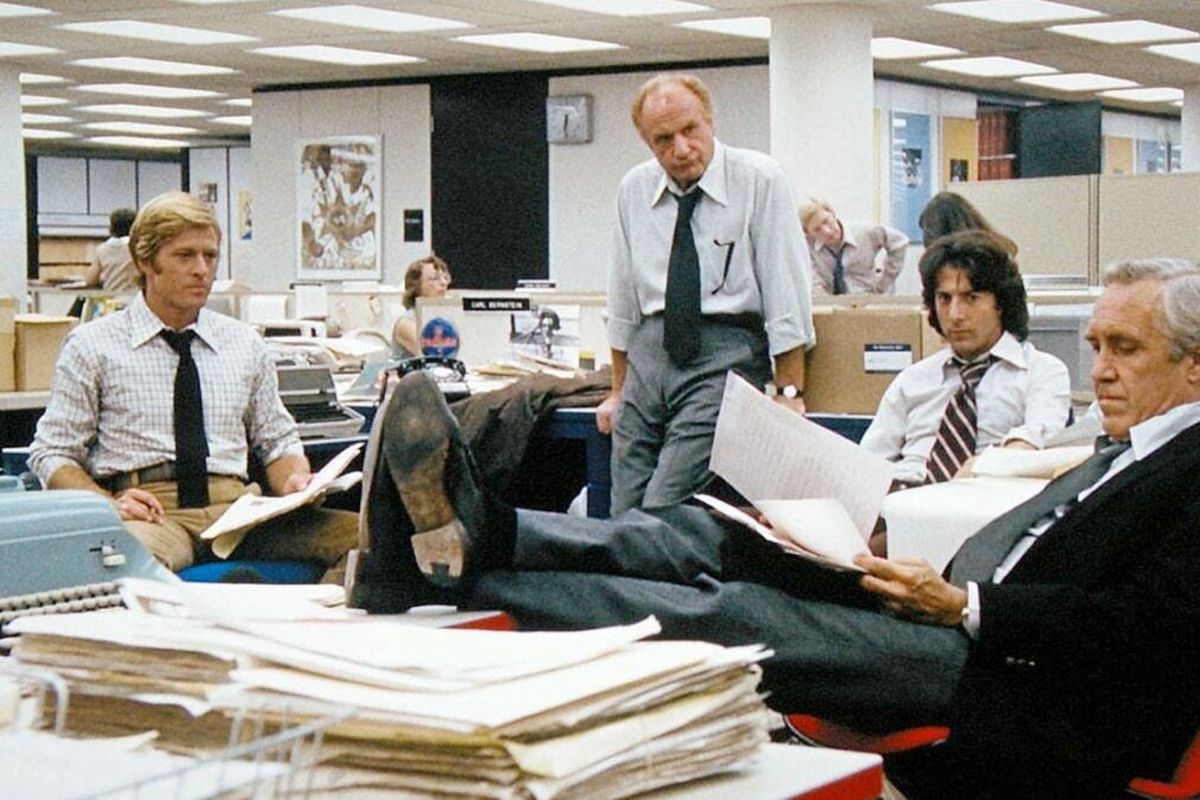
It’s no secret that many members of the American public have trouble trusting today’s journalism. Pretty much any national poll will tell you that.
So, credit the people who make movies for doing what they can to portray journalism in all its shades of black and white – which, of course, is suitable for a trade that for so long has worked in white paper and black ink.
On Wednesday, Northwest Passages will run a slate of movies focusing on journalistic work, not just print but broadcast and pretty much everything else pre-internet. Most depict journalism in the best light possible.
Hollywood overall, though, has historically taken a more balanced view, telling stories of those who are concerned with telling the truth as they see it (and are willing to pay any price to do so) as well as those who see ethics as merely an impediment to what they want to achieve.
Let us, then, look at some of journalism’s more memorable movie moments.
The missionaries
Delete the religious aspect from the word missionary and you have the perfect description of so many real-life journalists portrayed in the movies. Think of the Woodward and Bernstein characters played by Robert Redford and Dustin Hoffman in Alan J. Pakula’s 1976 film “All the President’s Men.”
Other notable efforts:
“Spotlight” (2015): Director/co-screenwriter Tom McCarthy cast the likes of Michael Keaton, Rachel McAdams and Mark Ruffalo to portray the Boston Globe reporters who in 2002 broke the child-abuse scandal involving Catholic priests. Winner of 2016 Best Picture Oscar.
“Good Night, and Good Luck” (2005): George Clooney directed and co-wrote the story of how pioneer broadcast journalist Edward R. Murrow (played by David Strathairn) stood up to the red-baiting Sen. Joseph McCarthy. (Clooney played former CBS President Fred Friendly).
“Zodiac” (2007): David Fincher directed this look at the efforts of a couple of San Francisco Chronicle staff members, cartoonist Robert Graysmith (Jake Gyllenhaal) and reporter Paul Avery (Robert Downey Jr.), along with police detective Dave Toschi (Mark Ruffalo), to identify the serial killer known only as Zodiac.
“Kill the Messenger” (2014): Jeremy Renner stars in this Michael Cuesta-directed film as Gary Webb, a one-time San Jose Mercury reporter. Webb wrote a controversial series for the paper that claimed an association between the Central Intelligence Agency and Nicaraguan Contras had been the origin of the U.S. crack-cocaine epidemic.
The scoundrels
As in every occupation, you’ll find unethical individuals. Perhaps the most unscrupulous journalist in movies is the reporter played by Kirk Douglas in Billy Wilder’s 1951 film “Ace in the Hole” who creates a media circus around a man trapped in an underground cave.
Other notable efforts:
“Nightcrawler” (2014): Dan Gilroy wrote and directed this story of a guy (played by Jake Gyllenhaal) who hunts down lurid stories in night-time Los Angeles. Over time, his efforts to document crime and sell his stories to a local television station blur the line between being a reporter and participating in the stories himself.
“Shattered Glass” (2003): Hayden Christensen stars as Stephen Glass, a writer for the New Republic magazine from 1995 to 1998. Like other disgraced journalists – Janet Cooke of the Washington Post and Jayson Blair of the New York Times come to mind – Glass was exposed as having fictionalized many of the stories he had written.
“Absence of Malice” (1981): Sydney Pollack directed Sally Field and Paul Newman in this tale about what can happen when getting a story out is deemed more important than getting the facts correct. Field plays a reporter whose story, based on bogus information, profoundly affects the reputation of Newman’s character.
“Truth” (2015): Calling Dan Rather a “scoundrel” is overkill. But this James Vanderbilt-directed/co-written film details the problems involving Rather’s controversial 2004 episode of “60 Minutes” about President George W. Bush’s military service. CBS producer Mary Mapes, who was fired over the incident, co-wrote the screenplay (Rather chose to retire).
The fallen
In the course of their work, many journalists and the people they use as sources suffer a range of serious consequences, a number of which prove fatal. The real-life character of Dr. Jeffrey Wigand (played by Russell Crowe) in director/co-screenwriter Michael Mann’s 1999 film “The Insider” is a prime example.
Other notable efforts:
“The Killing Fields” (1984): Sam Waterston starred as New York Times reporter Sydney Schanberg in director Roland Joffe’s adaptation of Schanberg’s nonfiction book detailing the Cambodia crisis following the victory of the Khmer Rouge. But the central focus of the film is on Dith Pran (played by Dr. Haing S. Ngor), Schanberg’s Cambodian colleague who faced years of torture under Khmer Rouge captivity.
“Navalny” (2022): Including mention of the late Russian politician/social activist in a list of journalists, real or fictional, may seem like a stretch. But as Daniel Roher’s Oscar-winning documentary shows, Alexei Navalny also had a strong social media presence. And his online reports on repression in Putin’s Russia led to his imprisonment and ultimate death in 2024.
“A Private War” (2018): At last count by the United Nations, some 200 or more journalists have been killed while covering the Gaza war. Years earlier, in 2012, the American war correspondent Marie Colvin – covering the Syrian civil war for the UK newspaper the Sunday Times – was reportedly killed by Syrian artillery fire while documenting street fighting. In Matthew Heunemen’s film, Colvin is played by Rosamund Pike.
“Lee” (2023): Ellen Kuras directed the Oscar-winning actress Kate Winslet in this portrayal of the American fashion model-turned-photographer Lee Miller. A pioneer, Miller fought the sexist attitudes of U.S. authorities who attempted to prevent her from joining her male colleagues in covering front-line action during World War II. As with many who witness war, Miller suffered from the resulting trauma, which was exacerbated after British authorities censored her photos of German concentration camps.