
Spokane parks to remove 200 trees killed by native bark beetles, including 50 at Manito
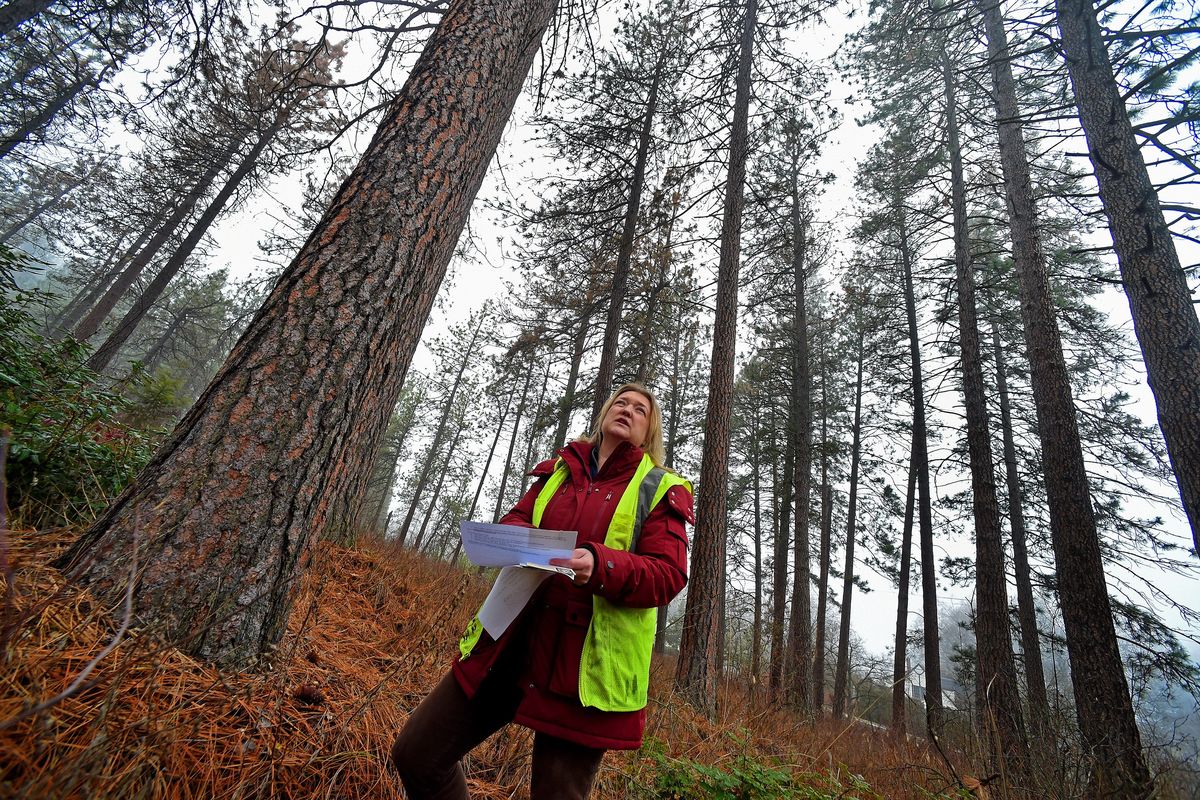
On the northwest corner of Manito Park, dozens of ponderosa pines appear to stand strong. Joggers and dog walkers weave through the towering trunks on their morning routes, and gray squirrels run halfway up the familiar trees, flicking their tails as they observe the human visitors before retreating into the canopies.
By a trained eye, though, the majority of the thick ponderosa grove is already dead.
An unusual orange needle canopy is one sign, city parks and recreation urban forester Katie Kosanke said. Getting closer to one of the ponderosas, she pointed out a series of popcorn-sized yellowish nodules running up and down the bark. Higher up, the tree bore woodpecker scars.
Over 200 ponderosa pine trees like these will be removed from Spokane’s city parks by March as naturalists attempt to limit increasing amounts of damage done by bark beetles to forested areas.
“I would say that from a management standpoint, we have definitely been seeing an uptick in beetle populations now,” she said. “The beetles typically aren’t huge tree killers. They’ll finish them off, but we’re just seeing massive damage.”
In Washington, bark beetles consist of a number of species, most of which are native to the area and have evolved alongside conifers for thousands of years, Department of Natural Resources entomologist Dana Brennan said. Brennan is based in Colville and has helped advise the City of Spokane in its bark beetle response.
Ips beetles, western pine beetles and red turpentine beetles are the biggest players in the Spokane area, Kosanke said.
When an adult bark beetle is searching for a tree to lay its eggs on, it is attracted by chemical cues given off by stressed trees, Brennan said.
“I like to call it the ‘happy hour taco bar,’ ” she said. “It’s easy getting for these bark beetles.”
When the eggs hatch, the beetle larvae feast on the tree’s cambium layer, directly under the bark. With fast-growing populations, their tunnels sever the vertical food transportation system in the host tree – the phloem – preventing nutrients from making their way from the sugar-producing needles to the roots. Once the larvae sever phloem pathways around the circumference of the tree, the tree starves to death.
“ Like putting a bunch of clamps in your stomach,” she said.
Healthy conifer trees can typically defend themselves against bark beetle infestations. Some types of trees can alter their wood to be more toxic or difficult for the beetles, but the most common defense is flushing intruders out with pitch. A single nodule on a tree can be an example of a successful defense against a beetle, Kosanke said.
“These kind of movers and shakers in our forests are all native issues,” Brennan said of the beetle-tree conflict. “Really, what we’re seeing is kind of this interplay of how these trees are responding to their environment and how these, specifically, bark beetles are responding to those trees’ response.”
The increasing mortality of Inland Northwest trees via bark beetle infestation can be traced back to the region’s increasingly hot summers, historical fire suppression and persistent drought.
Frequent, small wildfires have long been the norm for Eastern Washington, knocking back young plant populations and reducing resource competition among the survivors. As humans have increasingly populated forested areas, Brennan said that their fire suppression efforts have resulted in overcrowded plant populations. Coupled with a shortage of water and steadily increasing global temperatures, all of the trees become dryer, leading to bigger fires and stressed, beetle–susceptible populations.
Warmer winters also spells out lower beetle mortality rates than years past, and occasionally, an extra generation per year, Kosanke said.
“This is going to vary site by site, but overall, thinning can be our way of mimicking what fire used to look like on these landscapes,” Brennan said. “That’s what the city is doing right now with these tree removals in their parks. If we can preemptively get in there and remove those attack trees and process and destroy that material, we are going to put a little dent in the population of bark beetles in the area. And the hope is that we reduce it enough that we reduce our losses further.”
In the cold weather, the Spokane bark beetles are currently overwintering, Kosanke said. Trees need to be removed before the beetles emerge in spring.
The City of Spokane plans to remove 50 trees in Manito Park, 50 at Downriver Golf Course and 70 at Indian Canyon. Each removed tree with a trunk 25 inches in diameter represents around $1,500 in lost ecosystem services spread over a 20-year period, according to the i-Tree National Tree Benefit Calculator, an initiative of Davey Tree Expert Company, the Arbor Day Foundation and many other organizations. Ecosystem services from pine trees include shading, carbon sequestration and air pollution removal.
Trees are removed using in-house employees and tools, meaning the financial burden is comparatively low, Kosanke said. There is an additional disposal fee of roughly $50 per large tree, though Parks and Recreation is searching for collaborators to avoid this. Dead trees cannot be left in the area due to beetle presence, but excess dry wood also acts as a fire hazard.
Though the details are not yet confirmed, Kosanke said that the city plans to do a native restoration project at the Manito site, getting seedlings back on site to grow into the environment.
“But once this is opened up, there’s going to be less competition, and there is seed stock all in here, so we’ll get the natural regen happening anyways,” she said. “But as people, we want to see it faster. That’s when we intervene and plant and then intermix some other (native tree) species in.”
Neighbors near Manito Park have mixed feelings about the city’s plans to alter their view of the pines.
Neighbor Tyler Lyson said in an email statement to The Spokesman-Review that he opposes the tree removal, despite the damage by bark beetles.
“Imagine going from having a beautiful view of trees and then the city comes in and chops them all down and puts in tiny trees that take on average 10 years to reach a substantial height,” he wrote. “We then would have a view of a parking lot once that’s completed.”
A few doors down, Cleve Penberthy was more concerned that he hadn’t heard about the removal project than he was for the loss of the trees. He stopped by to speak with Kosanke as she was showing a Spokesman-Review reporter damage to a tree on Wednesday.
“I don’t like to have to tear trees down, but (Kosanke)’s right in assuming there isn’t an alternative,” he said later. “It’s just concerning that there was no effort.”
Kosanke said the parks department shares plans on its blog and intends to contact neighbors later. On March 28, the department will hold a free community workshop at the Finch Arboretum for interested neighbors, professionals and property owners.
Spokane is far from alone in its beetle problem, though.
David Cass, manager of Washington State Parks’ tree risk and forest health programs, said beetle populations and infestations have been up across the state this year.
While the beetles killing large numbers of old growth trees “is usually not good,” bark beetles are not inherently bad for the environment, he said. Management in cities like Spokane stems largely from human preference.
“A lot of what we think of as being ‘good’ or ‘bad’ for a forest is based on our own management objectives and our own perceptions of what a forest should look like at any one point in time,” he said. “If you are managing a forest for timber, then bark beetles in your stand of timber are typically viewed as either a nuisance or a catastrophe. You could be losing a lot of money to them.
“And if you’re managing a forest for ecological function, bark beetles can create snags that are valuable habitat for lots of species, and they can help with the natural successional processes – the stages of development that a forest goes through.”
The nuance to the relationship between humans, bark beetles and trees means Washington State Parks handles bark beetle infestations on a case-by-case basis, even if its presence across the state is above average .
Though he was unable to provide specific tree removal data on Thursday, Cass said state parks has removed “thousands and thousands of trees” across Washington this year. The parks agency generally treats 1,000 acres of forest for varying issues each biennium, which includes beetle risk mitigation.
“A lot of it depends on where the beetles are attacking trees, the size and importance of the trees they’re attacking, and the amount of beetle activity we have in an area,” Cass said.
More than the beetles, Cass points to the drought and tree overpopulation issues in forests that allow them to proliferate.
“It is largely our management and our needs from our forests and our own activities that cause changes in bark beetle populations that make it an issue for us,” he said.
“I think people say ‘good’ and ‘bad’ about trees or beetles or forests, and it’s applying this moralistic construct onto nature that I don’t think exists.”