
This day in history: Bunker Hill Mine announced construction of 715-foot smokestack. Spokane bank president improving after assassination attempt

From 1976: The Bunker Hill Co. in Kellogg announced it would build a second smokestack, 715 feet high.
It would stand next to the 613-foot chimney already under construction.
The company president said the two tall stacks would allow the company to meet the federal ambient air standards for sulfur dioxide, as well as existing Idaho regulations.
The president said the company was “proceeding on the basis of the belief that we can meet any reasonable present or future regulations.”
The company earlier said it had to either build the second stack or begin an “orderly shutdown of the Bunker Hill lead smelter,” which employed 500 people.
From 1926: R. Lewis Rutter, prominent Spokane bank president, was slowly recovering from gunshots fired by disgruntled pawnbroker Phineas Saffron.
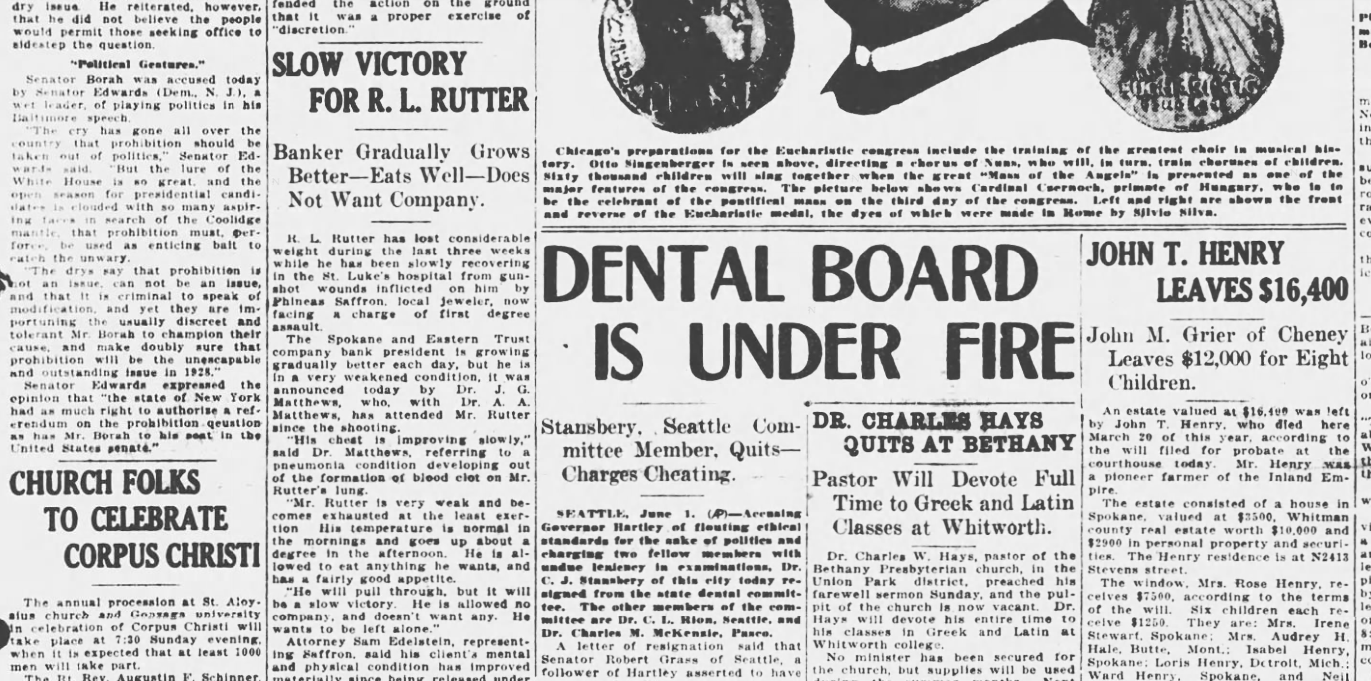
Rutter had lost considerable weight over the last three weeks, but was “growing gradually better every day.”
“He will pull through, but it will be a slow victory,” said his physician. “He is allowed no company and doesn’t want any. He wants to be left alone.”
His assailant, meanwhile, was having troubles of his own. Saffron was free on $10,000 bond, but was “considerably worried about not having any employment between now and the time he comes up for trial.”
Also on this day
(From onthisday.com)
1774: Following the passage of the Boston Port Act, the British government orders the Port of Boston closed to punish the colonists for the Boston Tea Party.