
Symphony Review: Guest conductor Samuels-Shragg transforms movements at symphony’s ‘Masterworks 6’
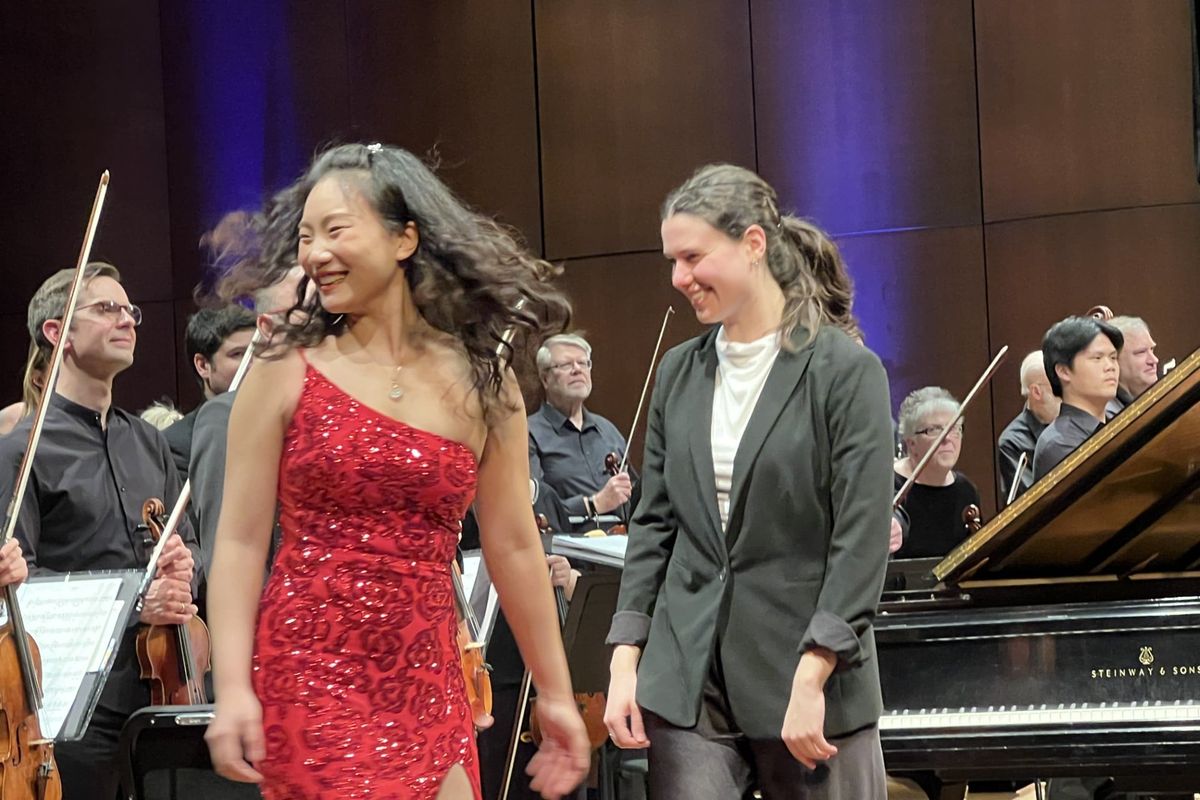
The Spokane Symphony performed its “Masterworks 6” program this weekend led by guest conductor Shira Samuels-Shragg, who served as assistant conductor in Spokane during the 2023-24 season and is now serving in that capacity with Dallas Symphony. As she explained in her interview with Jim Tevenan on KPBX, she was called upon by Music Director James Lowe to conduct these concerts when Johannes Schlaefli, who had been scheduled to lead a these concerts, was unable to appear. As it turned out, he could not have chosen better, as Saturday’s audience could attest. Once again, Samuels-Shragg showed herself to be a fully finished conductor, possessed not only of superb technique, but also of an ability to penetrate to the heart of a complex musical artwork and convey what lies there to her audience.
The program consisted of Robert Schumann’s “Manfred Overture” (1848), the Piano Concerto in A minor Op. 7 (1835) written at the age of fourteen by Clara Wieck, who became Schumann’s wife in 1840, and the “Symphony No. 1 in C minor Op. 68” (1868) by Johannes Brahms, who was loved sincerely but platonically by the Schumanns, while he struggled for many years to contain his own passionate love of Clara. Joining Samuels-Shragg and the orchestra in performing Clara’s piano concerto was the brilliant and sensitive pianist, Wynona Wang.
After listening to only a few measures of the overture, one was caught up irresistibly by the forward motion of Samuels-Shragg’s reading, combined with her careful linking together of broad dynamic patterns and finely judged transitions between phrases and themes. The aesthetic impact on the listener was a mixture of dramatic intensity and striking textural clarity.
In fact, not only were the orchestral textures of the overture to Manfred clear, they were vividly clear, with individual timbres drawn out of each line in keeping with the expressive effect the conductor wished to convey. The total effect was gripping, and made one eager to hear more of this peculiar work.
No such effort was required to clarify Clara Wieck’s orchestral writing, which , while very attractive, is also entirely conventional. Young Clara was not, after all, intending to establish herself as a composer. She and her father knew better than to attempt to swim against the prevailing male-dominated tide of the music publication establishment. To succeed as a virtuoso performer, however, which was very much her intention, it was necessary to equip herself with repertoire that exhibited her technical skills. That was the reason for the composition of this piece, and, in that, it served its composer well , until it was supplanted in her repertoire by her husband’s Concerto in A minor, which has gone on to be regarded as one of the indispensable pillars of the concerto repertoire, along with those of Chopin, Liszt, Grieg, Tchaikovsky and Rachmaninov.
This is not to say that Clara’s concerto is devoid of musical interest. It not only provides an impressive display of the soloist’s technical equipment, but contains several unique and effective technical features, chief among which are the facts that its three movements flow together without a break (actually, an innovation of Beethoven’s in his “Emperor” concerto), and that its second movement is made up of a long passage for solo piano, followed by an intimate, lyrical duet for piano and cello only. In this, Wang was partnered with the orchestra’s principal cellist, John Marshall, who performed Wieck’s lovely lyrical line with his customary immaculate taste, while Wang provided the decorative filigree.
The concerto’s outer movements provide ample opportunity for the soloist to display the thundering octaves and purling scales that were demanded by the audiences of the period. It was just at this time that crowds would gather to see Franz Liszt and Sigismond Thalberg take the stage together to compete in producing the most dazzling effects from the piano. In fact, after Clara adopted Robert’s concerto as her signature piece, she would return from a tour to insist that he make the writing more pianistically impressive.
No such criticism could have been leveled at Wynona Wang’s playing, which was as dazzling in virtuoso passages as it was beguiling and sensitive in passages of quiet lyricism. She provided a tantalizing sample of her interpretive abilities in music of greater subtlety and complexity by playing as an encore the second movement, entitled “Aria,” from Robert Schumann’s Piano Sonata No. 1 in F-sharp minor Op. 11.
The program concluded with a performance of Brahms’ First Symphony. Samuels-Shragg explained that this is her first opportunity to perform the piece in concert. When asked to make a few remarks about the piece, she demurred, explaining that her heart was so full of the beauty and majesty of the work that she found suitable words hard to come by. One had no difficulty in understanding this explanation after watching her guide the orchestra through every tiny nuance of the great work with unflagging precision, clarity and focus. The dramatic intensity, patient control of dynamic levels over long spans and differentiation of orchestral timbre that we heard in the “Overture to ‘Manfred’,” when applied to such a titanic masterpiece as Brahms’ C minor symphony, produced an effect that was nothing short of revelatory.
The complaints lodged against Schumann’s orchestral writing have also been directed to Brahms, though less intensely. He has been accused of providing a sound analogous to the overstuffing of furniture during the Victorian era. Many very fine conductors have responded by smoothing out Brahms’ dense orchestral writing into a smooth tapestry of sound from which individual voices emerge, like lilies on the surface of a pond. Samuels-Shragg employed quite a different technique. The four choirs that make up the orchestra – strings, winds, brass and percussion – were encouraged to maintain their own distinctive identities, and to contribute them to Brahms’ complex dialogue in the way that one expects from a chamber ensemble. The result was to produce the type of nimble expressivity that one appreciates in chamber music, but rarely finds in symphonic playing.
This allowed us to trace the argument of Brahms’s symphony more surely and more easily than is usually possible. To these ears, the argument that emerged was very close to that one encounters in the “German Requiem” which Brahms was working on at the same time as he was completing his work on the C minor Symphony, a demonstration of the power of compassion and acceptance to blunt the suffering of life’s tragic nature, and finally transform it into joy.
In Samuels-Shragg’s reading, the transformative center of the symphony is not delayed to the last movement, but located plainly in the second movement, which was rendered with inexpressible beauty and tenderness. The gorgeous duet between the horn of Clinton Webb and the violin of Mateusz Wolski was a moment of transcendence, in which the storm and stress of the first movement is transmuted by heavenly love – by caritas – first into tranquil acceptance, and then, in the final movement, into triumph over earthly limitations.