
As national debt nears $39 trillion and Trump promises to balance budget, Americans spend more on interest payments than on defense
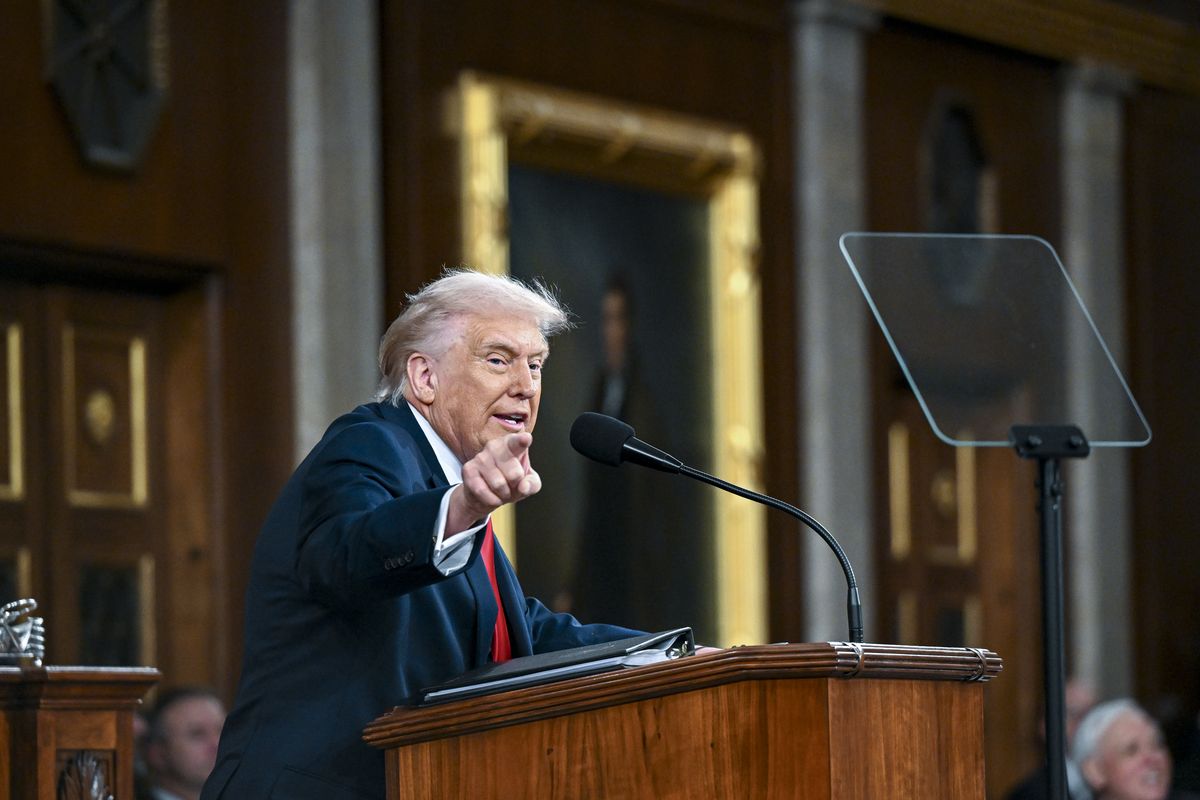
WASHINGTON – In his address to a joint session of Congress in March 2025, President Donald Trump set a bold goal for the U.S. government.
“In the near future, I want to do what has not been done in 24 years: balance the Federal budget,” the president said, before describing his plan to solve a problem Congress had only made worse over the past quarter-century: the “gold card,” a new visa program to let wealthy immigrants pay $1 million to move to the United States.
“It’s like the green card, but better and more sophisticated,” the president said, drawing laughs from Republicans in the House chamber.
On Dec. 19, Trump announced his administration had raised more than $1.3 billion through gold card sales. That’s about 0.07% of the federal government’s $1.78 trillion budget deficit in the fiscal year that ended in September.
Since Congress last enacted a balanced federal budget in 2000, when Bill Clinton was still president, it has become clear that closing the widening gap between what the government spends and the revenue it collects will take more than one odd trick.
As of Friday, the national debt had surpassed $38.7 trillion, according to the Treasury Department – or more than $113,000 per American. It has grown at a pace of nearly $77,000 per second over the past year, according to a tracker maintained by Republicans on Congress’s Joint Economic Committee.
“We’re $39 trillion in debt,” Rep. Michael Baumgartner said in an interview Feb. 18. “We’re running annual 20% budget deficits.”
The Spokane Republican made that point in the context of the United States’ defense spending and the need for its European allies to shoulder more of the burden of their collective security. But in an era when Democrats and Republicans seem at odds on nearly everything, the parties have agreed on spending more on the armed forces. In December, Congress authorized a record $901 billion in military spending for the year – about $8 billion more than the Trump administration had requested.
Of the $10.3 trillion the government spent in fiscal year 2025, according to federal spending data, $1.4 trillion went to national defense – just a little more than the $1.3 trillion taxpayers collectively spent on interest on the national debt. So far in the fiscal year that began Oct. 1, interest payments have surpassed defense spending to become the third-largest category of federal spending, after only Social Security and Medicare.
Most government spending is mandatory, which means it will keep going out the door without Congress doing anything. Only about a quarter of the federal budget goes toward discretionary spending, which lawmakers squabble over each year in an appropriations process that requires bipartisan support to become law.
Democrats such as Sen. Patty Murray of Washington, the top member of her party on the Senate Appropriations Committee, has slammed Republicans for increasing the deficit through tax cuts while pushing for more spending on programs she supports. Republicans like Sen. Mike Crapo of Idaho, the chairman of the Senate Finance Committee, which handles tax policy, has warned of the perils of a ballooning debt while dismissing concerns that cutting taxes will make that problem worse.
“For there to be real, sustainable deficit reduction, it’s really going to have to take an act of Congress,” said Kyle Pomerleau, a senior fellow at the American Enterprise Institute, a conservative think tank. “Because the growth in debts and deficits going forward is the imbalance between spending and revenue, and most spending is being driven by mandatory spending programs – Medicare, Medicaid and Social Security – and the gap between the spending programs and revenue is growing year over year.”
Those costly benefit programs, which mostly benefit American retirees who vote at a higher rate than any other segment of the population, are a political third rail that few politicians in either party want to touch.
The last time Congress made a serious effort to reduce deficits came when Barack Obama was president. In 2011, Crapo was part of the bipartisan “Gang of Six” that came up with a plan to cut deficits by $3.7 trillion over a decade, while Murray was co-chair of the “supercommittee” charged with finding a way to agree on more modest cuts.
Those talks ultimately failed, triggering automatic “sequestration” cuts that – combined with expiring Bush-era tax cuts, an economic recovery from the 2008 housing crisis and other factors – reduced the deficit from about $1.3 trillion in fiscal year 2011 to about $442 billion in fiscal year 2015. The latter number represented 2.4% of the country’s gross domestic product – a ratio economists use to track deficits as inflation changes the value of the dollar.
That progress was reversed under Trump’s first term and President Joe Biden’s single term in office, only partly because of massive federal spending in response to the COVID-19 pandemic. According to the Committee for a Responsible Federal Budget, a nonpartisan group that advocates for deficit reduction, Trump approved $8.4 trillion in new debt during his first term and Biden approved $4.7 trillion more.
Since the day Trump took office in 2017, the national debt has nearly doubled from just under $20 trillion to more than $38.7 trillion.
On Feb. 11, the nonpartisan Congressional Budget Office released its annual economic outlook report, projecting a federal deficit of $1.9 trillion for the current fiscal year, or 5.8% of GDP. In January, a bipartisan group of House lawmakers that includes Rep. Marie Gluesenkamp Perez, a Democrat from southwest Washington, introduced a nonbinding resolution calling for Congress to reduce the deficit to 3% of GDP. As of Friday, only 16 of the 435 members of the House had signed onto that measure.
In his State of the Union address on Tuesday, Trump repeated his pledge to balance the budget, this time with a different quick fix. He announced Vice President JD Vance would lead “the war on fraud,” saying that theft of government funds “shreds the fabric of a nation, and we are working on it like you wouldn’t believe.”
“He’ll get it done,” the president said of Vance. “And we’re able to find enough of that fraud – we will actually have a balanced budget overnight. It’ll go very quickly. That’s the kind of money you’re talking about.”
The Government Accountability Office, a nonpartisan watchdog agency, estimates the federal government loses between $233 billion and $521 billion each year to fraud and improper payments. Pomerleau said that even coupled with the roughly $300 billion in revenue Trump’s tariffs were projected to generate before the Supreme Court ruled the import taxes unlawful on Feb. 20, tackling fraud isn’t enough to balance the budget.
“We’re talking pennies compared to the scale of the existing deficit,” he said. “The only way to really solve this is to go after the fundamental imbalance between spending and revenue.”
In the State of the Union, Trump said his tariffs – which he reimposed using different authorities immediately after the court struck down his original import taxes – would raise enough revenue that the government could eliminate the federal income tax. Pomerleau said that would be impossible, since the tariff would have to be raised from the current 15% to 425% to replace the income tax. At such an astronomical tax rate, virtually no one would buy imported goods, so the tariffs would raise next to nothing in revenue.
In his response to Trump’s address on Tuesday, Rep. Dan Newhouse, R-Sunnyside, hailed the progress Republicans made in reducing federal spending through the One Big Beautiful Bill Act, a massive tax-and-spending package Congress passed along party lines in July. That legislation paired $4.8 trillion in new costs with $1.4 trillion in spending cuts, adding $3.4 trillion to the national debt over 10 years, according to the Congressional Budget Office.
Pomerleau said that bill could have an effect on federal spending in the sense that it would make Medicaid costs rise more slowly than they would otherwise, but Republicans wrote the legislation so those cuts won’t go into effect until 2029, delaying the political pain of denying health care coverage until Trump has left office. If Congress reverses those cuts, he said, the national debt will rise even more quickly than is currently projected.
The debt held by the American public is currently almost equal to the nation’s GDP. In its Feb. 11 report, the Congressional Budget Office projected that debt will rise to 120% of GDP in a decade. In an analysis published before the Supreme Court’s tariff ruling, the Committee for a Responsible Federal Budget estimated that figure would rise to 131% of GDP in the same period if the court overturned Trump’s tariffs, Congress makes the temporary tax cuts in the One Big Beautiful Bill Act permanent and lawmakers revive the health insurance subsidies that Republicans allowed to lapse at the end of 2025.
“If the job was to fact-check the president on this, clearly he said a bunch of things that are not true,” Pomerleau said of the State of the Union. “When Republicans talk about the spending cuts, it is true – they’ve actually done something there. But the broader picture remains unchanged. The federal government is still in a poor place financially, and will be for the foreseeable future, and Congress is going to have to step in and do something.”