
A new tool to fast-track Spokane’s shooting investigations could pay dividends for police
Two years ago, outraged Spokane Police Chief Kevin Hall told reporters the city should be outraged over children dying at the hands of gun violence.
He was passionately reacting to the January 2025 death of 13-year-old Gavin Looper, who was shot and killed while playing video games inside his home. Police determined the shooting was a drive-by and Gavin was not the target.
But his death was part of what compelled Hall to try to change things.
Hall told reporters two years ago he often hears about other concerns – homelessness, theft and drugs. But rarely does he hear about gun violence.
“We have to address it,” Hall said. “We need to address it.”
Police have long examined the telltale markings on bullet casings left behind at a crime scene to try to track down the gun from which it was fired and, ultimately, the person who fired it.
The logic is relatively simple: The firing pins of guns leave a sort of fingerprint on bullet casings, which can help identify not only the kind of gun that was used, but also in the best-case scenario the specific gun with a decent degree of confidence. It’s a widely used technique; since 2019, the Spokane Police Department has entered more than 5,000 bullet casings into a national database.
Like fingerprints, the forensic technique is not infallible, but is generally considered a fairly reliable piece of evidence, though it can be a slow process.
“Locally, that was only done by four people, so that would take anywhere from two to four weeks for that correlation to happen,” said Kevin Berry, an evidence supervisor for the Spokane Police Department.
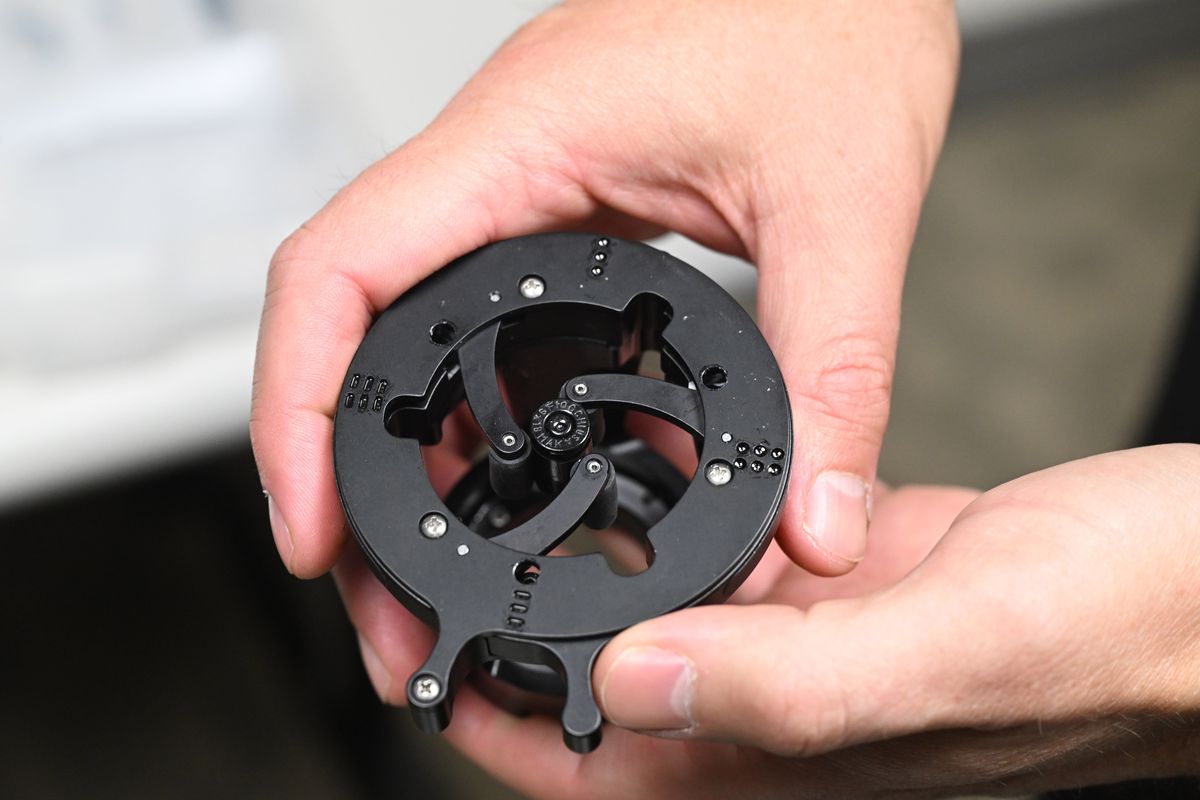
Now, with an expensive piece of National Integrated Ballistic Information Network machinery and database, the Spokane Police Department can make an in-house initial assessment of casings in hours, rather than days or weeks. The Integrated Ballistic Identification System machines contain high-resolution cameras to photograph bullet casings, which are entered into a national database for comparison against other, similar casings found at crime scenes across the country. It has been up and running since the beginning of the year.
It is meant to do one thing: give police credible, evidence-based leads.
The forensic machine and database largely cuts out the “middle man” of detectives driving outside the city to use another agency’s ballistic machine while also attempting to match guns and bullets themselves. It is also so sensitive and valuable that detectives who use it are not allowed to move and adjust any of the equipment. They must call the technology team to come out and do it for them.
Because NIBIN leads have just hours of turnaround time, it is likely that police will start to solve cases within the next year. One NIBIN lead can sometimes disrupt an entire criminal network, Hall suggested in an interview with The Spokesman-Review, because firearms are frequently passed around within them.
The system has put the technology directly into the hands of detectives for the first time.
“We’re already making matches,” Hall said. “Now we’re developing the protocol and the capacity to build a squad that is going to run down these leads and connect different shootings locally, regionally, and nationally.”
In 2025, the city of Spokane saw 155 shootings. Thirty-three of them caused an injury, according to data from the Spokane Police Department. The year prior saw 147 shootings and 46 of them caused an injury, data shows.
Hall has spearheaded a gun violence reduction plan in response. The plan has four components: to align gun violence reduction priorities departmentwide; to collaborate with community members and other organizations to better approach people most affected; to disrupt group dynamics that may lead to violent activity; and to emphasize hot-spot policing.
Hot -spot policing is a data-driven policing strategy that aims to place more police resources at higher crime locations. Studies show that it has reduced criminal activity in those areas, according to the National Institute of Justice.
But perhaps the most interesting component to Hall’s plan was the NIBIN system.
As of October 2024, there are 378 active NIBIN sites across the United States, according to the U.S. Bureau of Alcohol, Tobacco, Firearms and Explosives.
“When I first came in, I was shocked to find that a city of this size (didn’t) have their own NIBIN machine and their own gun crime unit that follows up with NIBIN leads,” Hall said.
Spokane Police Det. Shane Phillips has been on the map – as a special victims unit and major crimes detective. He is more than familiar with putting puzzle pieces of a crime together.
Phillips just completed a week of training to learn how to use NIBIN, he told The Spokesman-Review. Instead of spending time working major crimes, his time is now focusing on reducing Spokane’s gun violence.
Investigating gun crimes is starting to become far less tedious: If Spokane has a shooting, police will put the bullets into a cylinder-like container and into ClearCase, a machine that will suggest what gun fired the bullets or if they came from multiple guns.
The bullets then go into BrassTrax, a machine that will take high-resolution photos of each bullet. The photos are so high-resolution, police are able to see the shapes of markings on the bullet left by a gun. Phillips said he was surprised at the level of detail.
“It leaves some very distinct, too-hard-to-see-with-your-eyes drag marks,” he said. “They’re fairly unique to not only the gun, but sometimes even the type of gun. It’s not really so much about the guns, but what the guns lead to.”
Police are then able to match the evidence to other ballistic evidence that is already in the NIBIN database, likely from other crimes. Phillips said if Spokane were to have three drive-by shootings in a week, linking the machine’s results to the NIBIN database would hopefully give police enough leads to connect all of them and begin making arrests.
Before NIBIN and BrassTrax it might be a couple weeks, or a month, before all the evidence was matched up.
“The goal is to have all evidence cartridges, evidence casings and test fire entered in the system within 48 to 72 hours of collection,” Berry said. The leads are preliminary, meaning the leads still have to go to a trained forensic scientist to match the evidence under a microscope.
But it’s a start.
If Phillips were to describe the work in simple terms, he would say this: “We want to reduce gun violence in Spokane. So, we spent some time and money to get some machines that will lower our timelines for our investigations and focus those investigations on the right things.”