
Architectural wonders and music history abound in Chicago
New year, new Amtrak trip.
When my sister Ashley and I rode the train to the East Coast last year, we were celebrating my grad school graduation. This year, there was nothing to celebrate, only a two-for-the-price-of-one sale on roomettes we couldn’t pass up.
In short, we’re Amtrak enthusiasts. We don’t mind the longer travel time, because the gorgeous scenery and friends we make onboard more than make up for it.
This year, we decided to venture to Chicago, then to Denver, then to San Francisco. We wanted to spend more time in Chicago after a brief layover last year, and from my experience riding the train around the country in 2021, I knew Denver to Northern California was the most beautiful train route of them all, so I was more than happy to repeat that leg of the trip.
So off we went at 1 a.m., from the Spokane Amtrak station, heading east to Chicago. This trip marked my third time traveling from Spokane to Chicago, my third time sleeping through most of Glacier National Park, my third time feeling like I was never going to get out of North Dakota (no offense to North Dakota).
My second trip was a 30-minute layover on the way to Boston last year, but on my first, during my monthlong train trip in 2021, I had about 15 hours to see as much as I could. Unbeknownst to me when I booked my trip, my overnight layover would coincide with the Chicago Marathon. While stressful to navigate at the time, it makes for a fun memory now.
Nonetheless, I was excited to have two and a half days to explore the city this time around.
Just like with our decision to visit Boston in the winter last year, Ashley and I questioned our decision to visit Chicago in January shortly after arrival once the chill of the city hit us, but we soldiered on.
Our first stop after dropping off our luggage at HI Chicago Hostel (24 E. Ida B. Wells Drive) was Lou Malnati’s (multiple locations) for deep dish pizza. While everyone you ask will likely have a different restaurant pegged as the best deep dish in the city, a Chicago-area born-and-raised friend told me that Lou’s was the best before my 2021 train trip. I tried it then and remember only good things, so Lou’s it was.
As shared on the restaurant’s website, Luciano Malnati began working with pizza in the 1940s at the first deep dish pizzeria in the city. Decades later, he decided to open his first restaurant in 1971, and the Malnati family has been bringing deep dish pizza to Chicago ever since.
Pizzas are made to order at Lou Malnati’s, but they’re worth the wait. We both ordered personal size deep dish margherita pesto pizzas ($15.25 each). The crust was buttery and flaky, we could taste the freshness of the tomatoes and mozzarella, and the pesto was a nice addition to a classic.
After dinner, we went to another Chicago institution, the Second City, for an improv show. Second City, founded in 1959 by Bernie Sahlins, Howard Alk and Paul Sills, counts comedy greats like Dan Akroyd, Jim and John Belushi, Rachel Dratch, Eugene Levy, Tim Meadows, Catherine O’Hara, Martin Short and Gilda Radner among its thousands of alumni.
We chose to see “Shamilton,” a show that found members of the comedy group Baby Wants Candy improvising an hourlong musical.
With one suggestion from the audience, the cast of six comedians created an improvised musical that found Buddy, from “Elf,” traveling to New York where he meets Little Orphan Annie and her dog Sandy, with the pair bonding over their shared desire for a father.
While calling in other orphans, like Oliver Twist and Batman, the story featured a similar plot to “Elf,” with Buddy finding that his father was a publishing bigwig in New York City. But in a surprise twist, Annie shot Buddy, because she was jealous he found his family. (You’ll be happy to know he was revived by Christmas spirit.)
This wasn’t my first time seeing improv, or even my first show at Second City, but I was still impressed with the cast’s ability to create a story that was both funny and truly had a beginning, middle and end.
The next day, our first stop was the Chicago History Museum (1601 N. Clark St.). We started with what seemed to be the museum’s permanent exhibition on the history of Chicago, a fascinating look at the highs and lows the city has experienced.
The lows: the Great Fire of 1871, which wasn’t actually started by Mrs. O’Leary’s cow, the capsizing of the “Eastland” in 1915, which claimed 844 lives, the 1919 Race Riot that left 38 dead and more than 500 injured, and the St. Valentine’s Day Massacre in 1929.
The highs: revolutions in railways and the meatpacking industry, thanks in part to Upton Sinclair’s “The Jungle,” as well as the city’s history with jazz and blues, sports teams like the Chicago Bulls and the 1893 World’s Fair.
There were also special exhibits like “Designing for Change: Chicago Protest Art of the 1960s-70s,” which showcased protest signs from groups like the Chicago Women’s Liberation Union and the Chicago Freedom Movement and a heart-wrenching exhibit about the murder of Emmett Till.
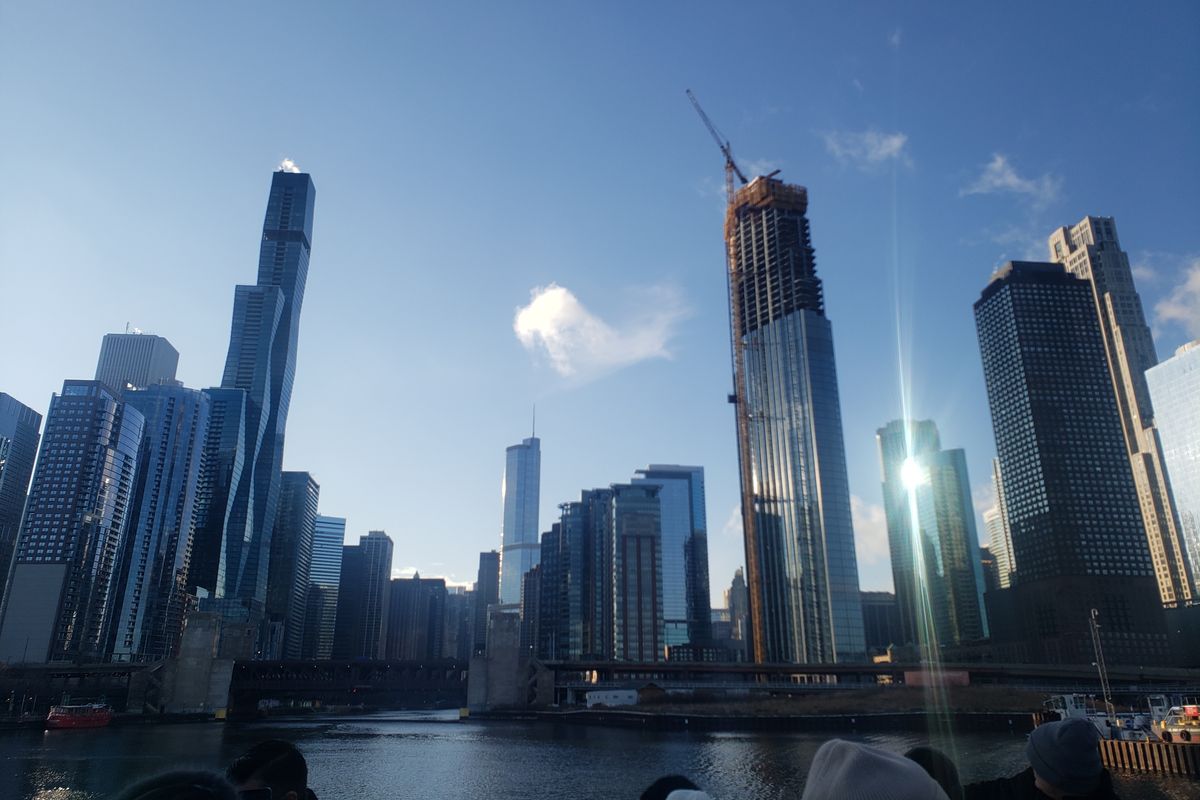
To learn even more about the city, we then took an architecture boat cruise on the Chicago River with Wendella (400 N. Michigan Ave.) and our tour guide Tess, who promised to tell us “all about this beautiful city, from the river’s perspective at least.”
For 90 chilly minutes, we traveled along all three branches of the river, learning about everything from the DuSable Bridge, which was named after the city’s first non-Native settler, and the Tribune Tower, the neo-Gothic architecture of which was inspired by the Rouen Cathedral in France, to the Jeanne Gang-designed Aqua skyscraper, which looks like it’s undulating like water, and the former home of Montgomery Ward, which was so large employees used roller skates to get from place to place quickly.
Tess was so knowledgeable, yet the cruise didn’t feel like a lecture. There were plenty of opportunities to ask questions and take pictures, and there was even a little cafe below deck for those looking to warm up during the tour.
It may be a touristy way to spend the afternoon, but we learned a lot and definitely looked at the city differently once we were back on land.
After stopping by BienMeSabe (29 E. Adams St.) for a delicious veggie bowl ($14.95) and tropical vegan arepa ($12.95), we headed to one of our main reasons for picking Chicago: Mavis Staples at the Chicago Theatre (175 N. State St.)
Ashley had seen the legendary Chicago-born-and-raised singer before, but this was my first time. We were in awe at the ornate theater, which, like the Martin Woldson Theater at the Fox, had a decorative feature worthy of admiration nearly everywhere you looked.
After a great opening set from Nathaniel Rateliff, perhaps most known for his work with his band the Night Sweats, WXRT DJ Terri Hemmert took the stage. She was clearly much beloved by the audience and was met with a loud round of applause.
“We’ve seen a lot here,” she said, referring to the theater. “Tonight’s probably going to be the best … It will be more than a concert. It will be therapy.”
And she was right, as Staples sang in a way that felt like a balm had been spread across the audience that allowed us to forget about the world outside and just enjoy the work of a legend.
“We’ve come this evening to bring you some joy, some happiness, some inspiration and some positive vibrations,” Staples said early in the show. “We want you to feel good. We want you to leave feeling better than when you first came in here.”
And, in short, we did. So much so, that Ashley and I are plannin g to see Staples again later this month.
The next morning, we were back at the Chicago Theatre, but not for a show. This was the meeting place for our walking tour of the city led by Dave with Intrepid Urban Adventures. What was meant to be a small group outing turned into a private one when the other pair signed up for the tour didn’t show up.
Chicago, it turns out, was once seen as an outpost of the Midwest, a bit of a backwater place, with seemingly nothing but sheep, cows and pigs. Fast-forward a bit to 1890, and Chicago was the second largest city in the country.
As we walked, we heard more about some of the founders we heard about on the boat cruise, only this time we got a closer look at their contributions to the city, including the Marina City Towers and the Carbon and Carbide Building, which resembles a bottle of champagne.
Though each building seemed to be more ornate than the next, my favorite stop by far was the Chicago Cultural Center (78 E. Washington St.). In the building, fairly unassuming from the outside, are housed two breathtaking glass domes.
One, in the Grand Army of the Republic Hall and Rotunda, is 40 feet in diameter and contains 62,000 pieces. It was designed by the firm Healy and Millet. The other, in the Preston Bradley Hall, is a Tiffany-designed dome that is 30 feet in diameter and contains 30,000 pieces of glass.
We could have ended the tour there, and I would have been just fine, but on we went, learning about some of the innovations that have come out of the city, like the conversion to time zones worldwide after the 1883 General Time Convention, which was hosted in the city, and that perfume counters are near a department store’s entrance because Chicago department store founder Marshall Field didn’t want the store to smell like the horses pulling carriages out front.
We also saw “Goth Target,” which features an ornate, black metal facade and tried Chicago popcorn from Garrett Popcorn Shops, a Chicago tradition since 1949.
The tour ended at “Cloud Gate,” aka the Bean, where we unabashedly took photos of ourselves reflected in what felt like a funhouse mirror.
After saying goodbye to Dave, we grabbed a snack at the Nutella Cafe (189 N. Michigan Ave.), the only one of its kind around the world, plus a personalized jar of Nutella for my brother.
Then onward to the Art Institute of Chicago (111 S. Michigan Ave.). Home to instantly recognizable works like Edward Hopper’s “Nighthawks,” Grant Wood’s “American Gothic,” Georges Seurat’s “A Sunday on La Grande Jatte” and Katsushika Hokusai’s “The Great Wave,” I was excited to have a few hours to explore the museum after having only about an hour to see the highlights when I visited in 2021.
I joke that it’s not a vacation until I cry in an art museum, and this stop was no different, with Vincent van Gogh’s “Grapes, Lemons, Pears and Apples” bringing me to tears. Is is silly that a still life of fruit made me cry? Absolutely, but I had never seen the painting before, and the way van Gogh painted the background made it look as if the image was moving as you walked closer to it.
Luckily for me, my sister is used to this behavior and carried on as if nothing happened.
Even with a map, the museum felt like a bit of a maze at times, but as there was something beautiful to see around every corner, Ashley and I didn’t mind when we made a wrong turn.
After a quick stop at the sign marking the start of Route 66, it was time for another legend of Chicago jazz and blues: Buddy Guy, playing at his own venue Buddy Guy’s Legends (700 S. Wabash Ave.) as part of his annual residency.
The show opened with a blazing set from 16-year-old blues guitar prodigy Marcel Meyer (remember that name). Then it was time for the man himself, who was introduced as ”the national treasure.”
Once onstage, Guy told the audience he was going to play “something so funky you can smell it.” And for the next couple hours, he did, showing as much prowess on the guitar as you’d expect from a musician of his caliber.
He also regaled the crowd with stories from his life and career. Guy started playing guitar as a kid living, at the time, with no electricity and no running water in Louisiana. He said he didn’t play guitar with a pick until he met B.B. King. Before that, he’d simply play with his fingers.
He also talked of his first time seeing King and Muddy Waters and how, before the Rolling Stones took one of his song titles as their band name, white America didn’t know about Waters.
But, it was mostly about the music, with Guy telling the audience at one point “If you don’t like the blues, you know you’re in the wrong” house.
As Guy walked a couple laps around the audience, all while playing his guitar, it felt like a once-in-a-lifetime chance to be so near someone who has done so much for the genre.
The next morning, we crossed our last jazz and blues-related stops off the list. The first was Chess Records (2120 S. Michigan Ave.). Though the building was closed to tours when we visited, even being outside the same place legends like Guy, Waters, Bo Diddley, Etta James and Chuck Berry had recorded was a treat.
The second was a historical marker that told of the Blues Trail, which brought African Americans from Mississippi to Chicago as part of the Great Migration. They brought with them the Delta blues that would become the foundation of the Chicago blues we heard Guy play the night before.
For our final stop in Chicago, we rode the “L” to the Pilsen Historic District to visit Pilsen Community Books (1531 W. 18th St.), a great little stop with tons of both new and used books. Founded in 2016, the store became Chicago’s only employee-owned and operated independent bookstore in 2020.
Grabbing lunch before we had to head back to the train station, we stopped by Penelope’s Vegan Taqueria (1165 W. 18th St.). Had we not been walking most of the day, I don’t know if I could have finished my chorizo burrito ($12.50) in one sitting, but with well-seasoned soy chorizo and hearty potatoes and beans, I had no problem eating every bite.
Though it hardly got above freezing while we were there, Ashley and I really enjoyed Chicago. It’s a very walkable city, though public transportation was also easy to navigate, and you could feel, like Spokane after its Great Fire, how resilient and innovative the city is.
There is so much history and culture in Chicago, and it makes me think something our guide Dave shared, quoting Chicago historian Shermann “Dilla” Thomas, was true: “Everything dope about America comes from Chicago.”