
It’s a wrap for the 2026 Washington legislative session. Here’s a look at some of what passed and what didn’t

OLYMPIA – Washington’s 2026 legislative session had an alarming finish on Thursday as an earsplitting fire alarm rang through the Capitol dome – forcing all but the House of Representatives to evacuate the building.
Representatives, staff and reporters in the chamber were told to stay put while what campus security said was a false alarm rang for 20 minutes. After Olympia firefighters arrived and checked the scene, building occupants went back inside for the remainder of the lawmaking season that wrapped at 8:23 p.m.
Aside from the drama of the alarm, the session was defined by the passage of a “historic” bill to impose an income tax on earnings above $1 million. The session also brought to Washingtonians a slew of new bills addressing many government functions.
Lawmakers and staff celebrate the close of a session in their glitteriest garb meant to represent “shiney die,” a play on words for the procedural name “sine die” for the last day of lawmaking.
Tiaras, rhinestones stuck to faces and shimmering blazers were popular among legislators on the festive occasion. As President of the Senate Denny Heck and Speaker of the House Laurie Jinkins banged their gavels at the same second, cheers from each chamber echoed throughout the rotunda.
In a statement Thursday evening, Gov. Bob Ferguson cited increased investment in infrastructure, housing and the adoption of the income tax on millionaires and the connected tax relief as some of the priorities lawmakers were able to address over the last 60 days.
“Together, we confronted historic challenges from the Trump administration head-on by protecting Washingtonians’ health and safety, and positioned our state for an even stronger future,” Ferguson said.
Here’s a look at what passed and what didn’t this session.
Income taxPerhaps the most consequential bill passed by the legislature this year is a new income tax on millionaires. While the bill passed both chambers in the final day of the session and is awaiting a signature by Ferguson, that’s far from the end of the fight. The bill, which challenges nearly 100 years of tax policy and state Supreme Court precedent, is sure to spark challenges at the ballot box and in the courtroom. Should it survive, the 9.9% tax will raise around $3.5 billion a year when it takes effect in 2029.
EducationEducation took the biggest hit as lawmakers balanced the budget, with a program that subsidized child care for those earning below 60% of the state’s median income, incurring cuts to the tune of $781 million over two years.
A program that helps qualifying families access preschool was also scaled back, reducing the some 7,000 Transition to Kindergarten slots by a third and saving the state $102 million over 4 years.
Smaller K-12 cuts include reducing how much districts are reimbursed for buying school buses and money for running start programs. These areas are cut by $77 million and $14 million over four years, respectively.
Washington’s public charter schools didn’t get a renewal on $7.4 million in “enrichment funding” meant to pay for extracurriculars, staffing and training.
A late-session change to the income tax would use the revenue to give all public school kids school breakfast and lunches at no cost to the student. The “universal free lunch” initiative has been a push from Democrats for years; one of its loudest proponents was Spokane’s Sen. Marcus Riccelli.
As for bills, a Democratic-sponsored initiative to end so-called “isolation and restraint” of students receiving special education made it the distance and is heading to the governor’s desk. The bill would ban “mechanical and chemical” restraint and forced isolation of a student as a measure in their educational plans. A staff member physically holding a student is still permitted under the bill, providing it’s not life-threatening to the student. It also would prevent schools from building new rooms to use for isolation in special education.
Two proposals are guaranteed a resurrection in November as legislators declined to consider a pair of citizen initiatives before them this session. On November ballots will be two citizen-sponsored initiatives backed by the Conservative group Let’s Go Washington. One would bar transgender girls from girls sports in schools, another seeks to restore a “Parent’s Bill of Rights” that lawmakers adopted two years ago and scaled back last year.
Law enforcement and immigrationWashington lawmakers also approved legislation aimed at pushing back against the federal immigration efforts.
Members of the public will be blocked from making, providing or possessing badges or other law enforcement insignia when “a reasonable person would believe the person is a peace officer.”
Legislators also banned law enforcement officers from wearing masks to conceal their identities while engaged in public duties.
While the legislation would be applicable to all law enforcement agencies in the state, supporters say it’s targeted at the increasing number of masked federal immigration officers across the country. The ban would be applicable to state, local and federal officers, though it’s not clear if federal officials would abide by the new law.
Addressing lawsuitsOne bill that failed to pass this year is legislation aimed at reigning in the state’s ballooning payments to settle litigation, which surpassed $500 million last year.
Most of the increase against the state has originated from litigation filed against the Department of Children, Youth and Families, which oversees child welfare, juvenile rehabilitation, early care and education, and family support services, with many of the lawsuits resulting from conduct that occurred decades ago.
Faced with a growing financial liability, lawmakers attempted this year to require that certain older cases against the state or local jurisdictions go through an arbitration process before proceeding to trial. The bill also would have required legislative hearings on judgments or settlements of claims against the state once they exceed $5 million.
The bill ultimately stalled in the house, with lawmakers saying they will look to find “balance” on allowing victims to seek justice while curbing increasing tort payouts.
Lawmakers also approved legislation that requires the Department of Energy to provide no-cost carbon credits to the facility between 2027 and 2030 as it gradually reduces its carbon emissions. Without it, local officials warned ratepayers would face increased solid waste bills, as the city spent millions each year as a result of the facility’s carbon emissions.
By December 2030, the owner or operator of the facility must submit a plan to show how it will comply with statewide greenhouse gas emission reduction standards by 2040 and 2050.
The legislation awaits signature by the governor.
Will Spokane’s most powerful legislator retire?State Rep. Timm Ormsby, D-Spokane, the longtime of chair of the House Appropriations Committee, was noncommittal about his future plans shortly after the legislative session ended Thursday. Ormsby, who is among the lead Democratic budget writers in the Capitol, said he’s “had a lot of personal conversations with family, friends and loved ones to talk it out.”
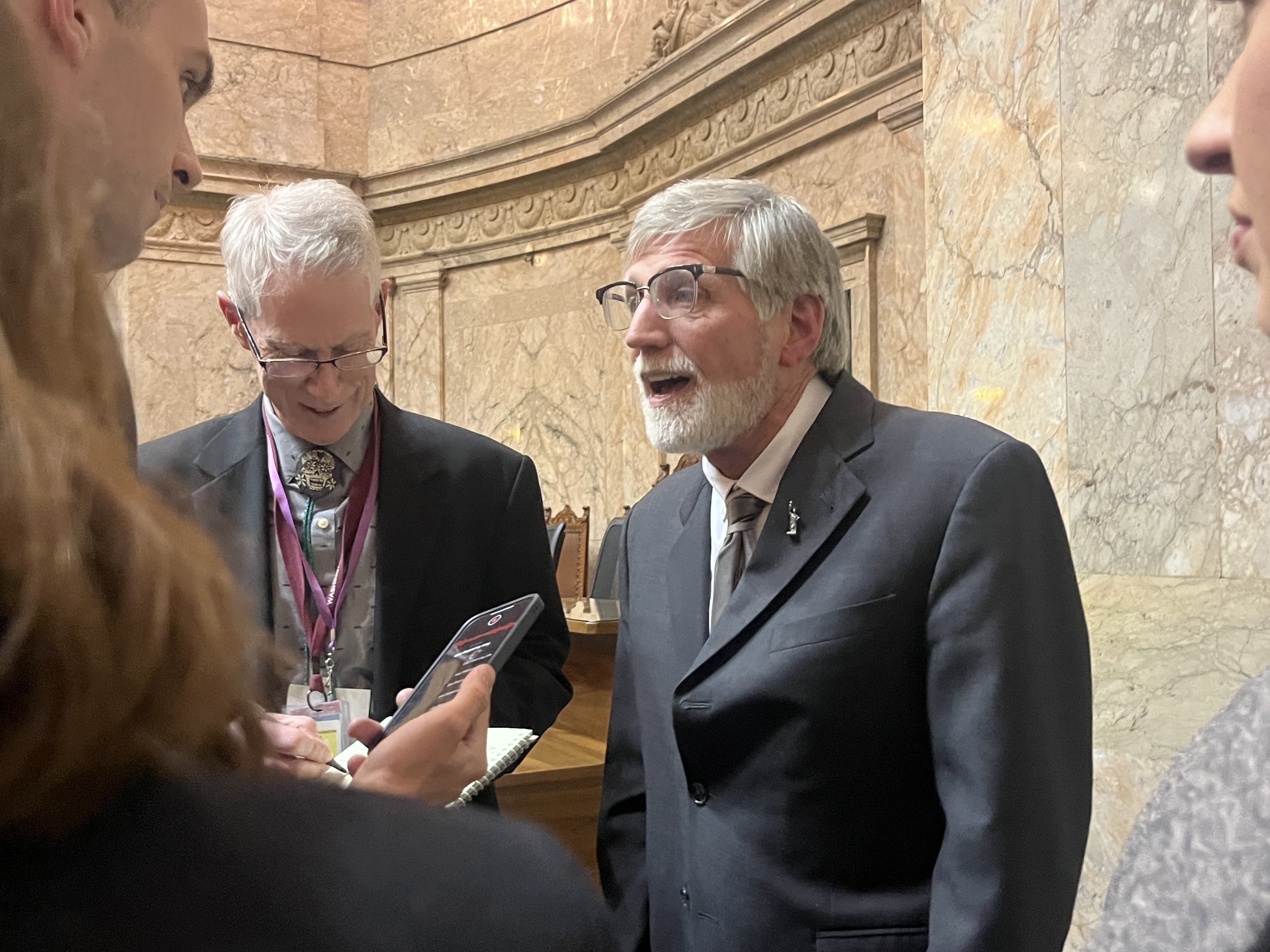
“If a person doesn’t self reflect before they try and return, they’re not doing their job,” Ormsby said. “So you should be a little bit of your own worst critic, and that’s difficult for most of us to do. So I’ve forced myself to do it, this time after a short session, but it takes a couple of weeks.”
Ormsby added that “when I have my thoughts and my soul put together, I’ll talk about it.”
While in Olympia, Ormsby has drawn broad respect from across the political spectrum. State Rep. Travis Couture, R-Allyn, who serves as ranking member on Appropriations alongside Ormsby, who joked on the House floor Thursday that Ormsby has two of the most difficult jobs in Olympia.
“His second most difficult job is the budget. His first most difficult job is listening to me every day,” Couture said. “And I would just say that despite some of our worldview differences, we get along great. I’ve had just an excellent pleasure working with him and members of his caucus on the appropriations committee.”
Couture added that regardless of the bill, Ormsby “listens to every single voice.”
“And I just want to thank him for his hard work and service to Washington,” Couture said.