
King County drug court marks major milestone at graduation ceremony
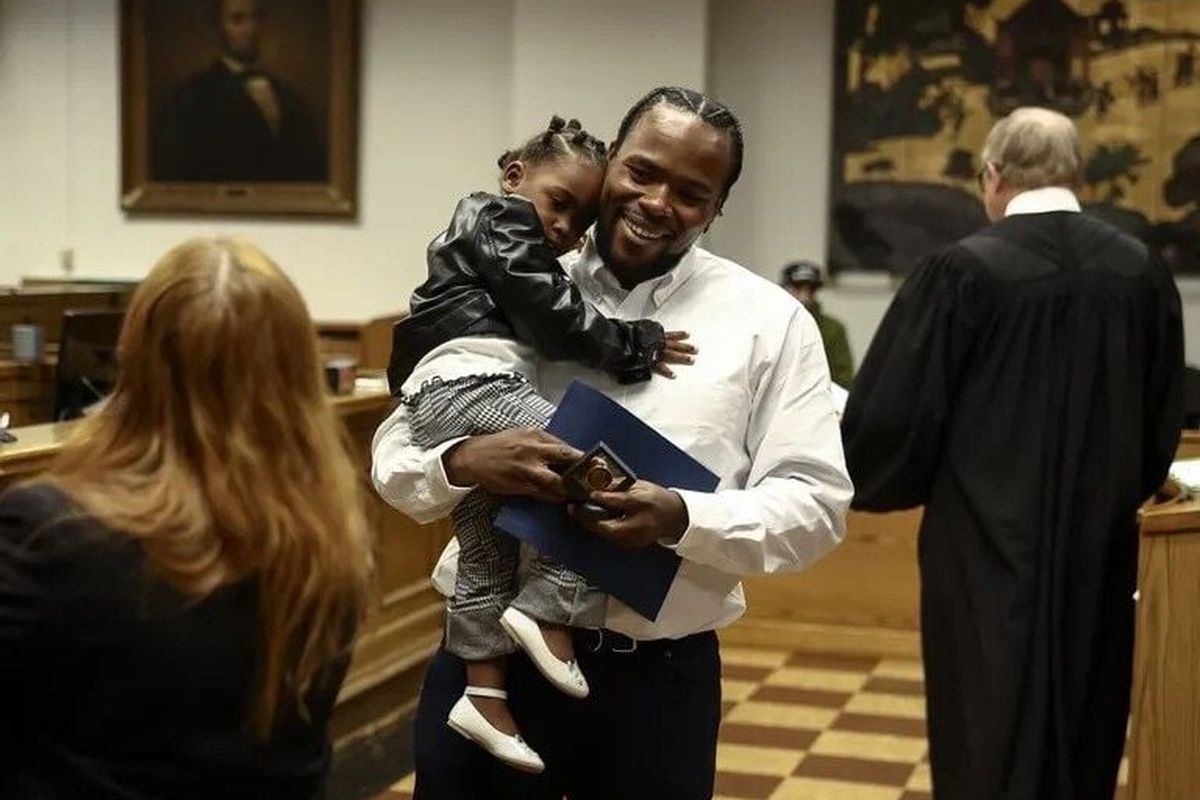
Four men accepted graduation certificates, commemorative coins and orders dismissing their criminal cases at a Wednesday celebration marking their completion of the rigorous, five-phase King County Drug Diversion Court program.
Their success represents a significant milestone for the therapeutic court that has now graduated over 3,000 participants since its inception in 1994.
“Welcome to one of the most joyful days we have here in King County Superior Court,” said Judge Michael Scott, who began his two-year rotation presiding over the court in January.
Started under the leadership of late King County Prosecutor Norm Maleng and then Superior Court Judge Ricardo Martinez, the court was the 12th drug diversion court in the country and the first in Washington, Scott said.
“There are now hundreds of drug courts around the country because data and experience demonstrate that therapeutic courts work extremely well,” he said.
Participants are provided with individual case management and services like substance use treatment, housing, transportation and employment assistance, cellphones, peer support and funds to help pay restitution to the victims of crimes that led to their participation in the program.
The program stresses honesty and accountability, and if people relapse, they’re subject to either therapeutic interventions or sanctions, depending on whether they fess up to using drugs before results from random urinalysis tests are received by the court.
Those who successfully complete the program have their criminal cases dismissed.
Scott noted in his remarks that an analysis by the Washington State Department of Social and Health Services found that 90% of King County’s drug court participants don’t have any new felony convictions in the three years after starting the program, and 73% have no new convictions at all during that time frame.
The court has a consistent graduation rate of 70% to 80%. The program takes a minimum of 10 months to complete, with most people averaging 16 months, though some remain in the program for two or three years as they work to transition from one phase to the next.
Showing up and opting in
The King County prosecuting attorney’s office screens all police case referrals to determine if someone is eligible for diversion into drug court. Most of the people accepted into the program have six or more prior felony convictions, mostly for drug and drug-related property crimes, though there are some exceptions.
No one convicted or accused of a serious violent crime, a drug-related homicide or a crime involving a firearm – whether real or fake – can participate. In certain circumstances, police can file objections to someone’s participation.
A postdisposition track was added in fall 2024 to allow people who would not otherwise be eligible for the program to participate, provided prosecutors agree to transfer a case to drug court. Defendants must plead guilty to the crimes they’ve been charged with – typically, second-degree robbery or eluding police – and comply with a negotiated agreement. If they fail to graduate, prosecutors can recommend any sentence allowable by law.
The first phase of the program is the pre-opt-in phase, when people can still be actively using drugs while they consult with their defense attorneys to decide whether to participate in drug court. They’re required to attend an orientation, court hearings, weekly check-ins, treatment sessions and sober support meetings.
They must also submit to at least two random, observed urinalysis screenings each week, a requirement that continues through each phase of the program.
In subsequent phases, participants stop using drugs, learn to manage their recovery, complete prescribed hours of community service and pay down any restitution they owe. The number of consecutive days they must be sanction-free and abstinent increases as they move through the phases.
The final phase, which takes a minimum of 90 days, also requires proof of 20 hours a week engaged in a productive activity, such as employment, vocational training, school, parenting activities or volunteering.
A second chance
The word “congratulations” was spelled out in black and gold letters on bunting flags strung along the lower bench in the presiding judge’s courtroom Wednesday as the four graduates waited in the jury box during Scott’s welcome address.
“It’s my privilege as the drug court judge to hear about our participants’ lives and see the remarkable changes that occur over the time of their involvement in drug court,” he said. “We see people get and stay sober and healthy. We witness participants moving into housing, some after many years of living on the streets.
“We see them finding work and educational opportunities, reconnecting with their children and families, finding housing, living full and happy lives,” Scott said. “Their stories are truly inspiring.”
Each of the graduates was then introduced by a member of the drug court team involved in their recovery.
Case manager Shawna Mokler told the gallery about JoJo Fatty, the first person admitted into drug court from the postdisposition track, as he stood nearby, his toddler cuddled in one arm.
“JoJo faced real challenges during his time in drug court. He let his guard down with someone he considered a friend, and that vulnerability led him to relapse,” Mokler said. “JoJo showed integrity by reporting into treatment and to me immediately; he showed introspection by taking the time to understand how he got there and what choices led him to that moment.
“That kind of honesty and self-reflection is the foundation for a long, lasting recovery,” she said.
In brief remarks from the podium, Fatty said, “I’m truly blessed I got a second chance. It’s not the end – it’s the beginning.”
Another graduate, Beau Harris, spoke of how “the challenges, adversity and inconveniences” of drug court spurred his personal growth and said the program helped him rebuild relationships with his parents, brothers and girlfriend.
Recovery coach Greg Biskey introduced himself as an alcoholic and said he still gets goose bumps entering a courthouse from the sidewalk instead of being led in chains through an underground hallway. A graduate of Pierce County’s drug court, Biskey said Corey Koon completed the King County program in 10 months.
“He didn’t just check off the boxes in this program,” Biskey said. “Corey knew he needed help … and was one of the people that respected the fact other people might actually know more about what he needed than he did in the moment, and that’s why he’s here so quickly.”
Michelle Mansmith, a peer services specialist, said when she met Thomas Pannek, he was facing a six- to eight-year prison term and was shy, reserved and lost in addiction. She said he’s transformed into a tenacious, responsible, insightful person who has “rebuilt his life from the ground up.”
“I’m not one for speeches or anything, but I appreciate everyone who has helped me get here,” Pannek said, thanking the judge, his caseworker and friends and family. “I appreciate this program.”