
Ferry navigates Norway’s coastline, sailing through Arctic Circle, Northern Lights and more
We stood on the bow of the ferry, facing the Norwegian sunset. The wind was briny and cold, bracing and refreshing, as the lights of Bergen receded behind us. We were on our way over 1,200 miles north to Norway’s border with Russia. For the next 12 days, we sailed Norway’s coastal ferry, stopping at 34 ports headed north and 33 on our way back.
Perhaps like me, you have friends who sing the joys of cruises. I am glad for them, but not as glad as I am to avoid joining them. I’m not attracted to the typical cruise experience. And honestly, with the bountiful food and drink offerings, I’d likely be boat-sized myself pretty quickly.
Luckily, there are alternatives, including Norway’s ferries. Two companies, Hurtigruten and Havila, operate the long coastal route, ferrying people, cargo and vehicles among dozens of coastal communities. Hurtigruten has been around 130 years. Havila began operations in 2021, with a smaller fleet. Both offer premium passenger service, and we joined Havila for its longest sailing.
Lasse Vangstein, Havila’s chief communications and sustainability officer, said the small size of these ships allows them to keep closer to the coast and stop in even small ports.
“You will see different towns and communities that you normally would not visit … and experience the best of Norway, because of the proximity to nature and the coastline,” Vangstein said.
Passengers come from the world over. Germans make up the largest group, though passengers from the U.S. and Canada increased to 18% in 2025, Vangstein said.
While the “main season is summer,” Havila has seen more interest in the “northern lights season” (October-March), and Vangstein notes “every season has its uniqueness.”
Havila’s ships are powered by liquified natural gas rather than diesel and use batteries when in fjords and ports. The Havila Pollux, which we were on, has 190 rooms, ranging from compact interior rooms to a few full suites.
These ferries lack what cruise ships typically promise: casinos, entertainment, big buffets and rides/slides/pools. What they offer is excellent regional food, modest workout facilities, saunas and lots of room outside and inside to watch wildlife, weather and scenery or just visit, read and relax. It’s a quiet mode of travel. The most raucous events were celebrating crossing the Arctic Circle and passing a ferry headed the opposite direction.
Havila, to reduce food waste, serves small plates by order (breakfast does include a cold buffet). The menu changes three times with the Norwegian countryside: featuring farm specialties in the south, seafood in the middle, and wild fare (including reindeer) in the north. There were always vegetarian, meat and seafood options and a few consistent dishes along the way, including soups, salads and side dishes. The small plates were great for trying different dishes and lingering over the meal, visiting with table mates. There’s also a grill for those who don’t want a daily meal plan. Havila put on several special tastings, along with educational briefings along the way.
Havila and Hurtigruten both offer excursions at the longer stops. We explored on our own, walking and sometimes hopping on public transport. The Coastal Ferry Handbook, dropped off at our predeparture hotel in Bergen, by author and guide Emma Verstrheim provided great walking notes and history about every stop (see hiddennorth.com). New onboard friends spoke highly of the excursions. These fellow travelers were from all over: Australia, the U.K., other parts of Scandinavia, Germany and other EU countries, Singapore, Thailand and more. And there were a few other Americans as well as Canadians. The staff, mainly from Scandinavian and Baltic countries, were friendly and fun to visit with when there was a chance.
Most folks sailed to just intermediate stops or one-way, with flights or overland travel from the north; others joined on foot or with bikes, as well as the occasional motorcycle, using the ferry as a part of a longer multimodal trip. There was plenty of room for everyone, with loads of indoor and outdoor seating and multiple decks where walking was easy and the views changed constantly.
In early September, we spied whales and dolphins; as well as sea eagles and other birds; and we caught some views of the northern lights as fall progressed. From October to April, Havila offers a “northern lights guarantee” – if you don’t see the aurora borealis, you get a free trip for another chance.
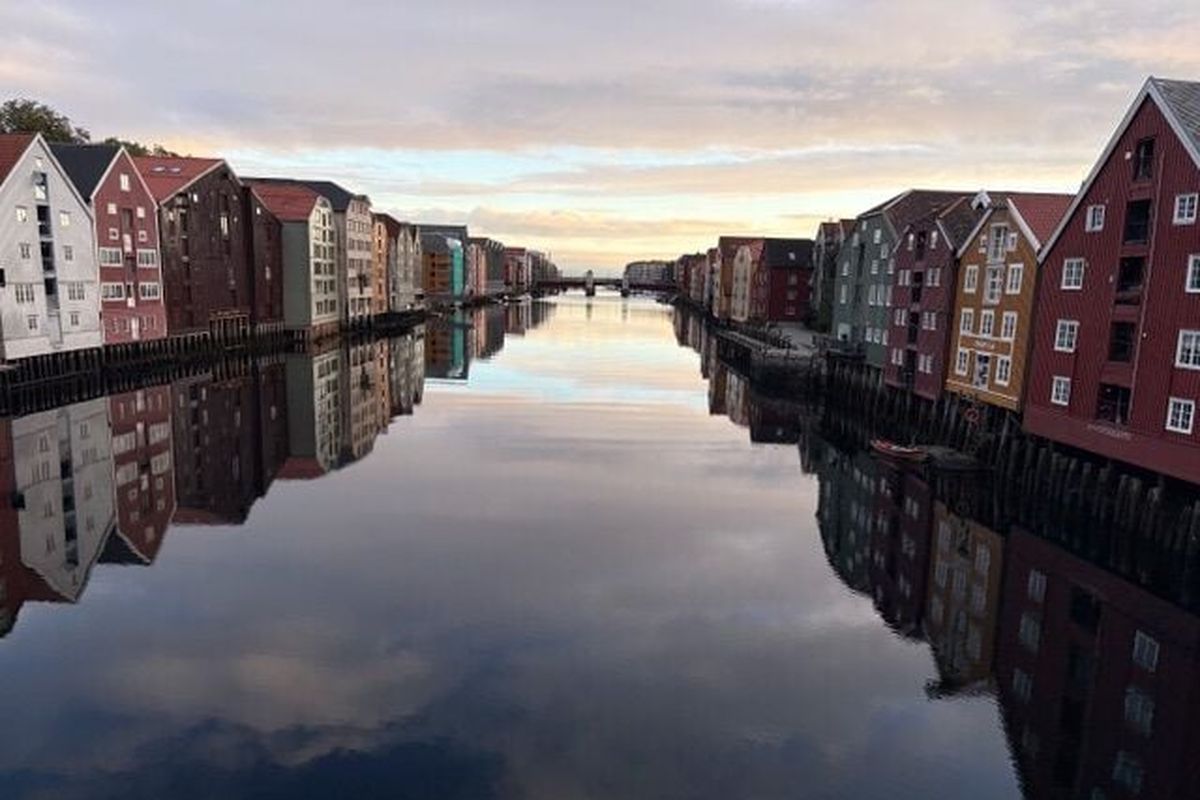
Sailing up the Hjørundfjorden, a tender dropped us at the tiny village of Urke, where we hiked into the hills. In Bodo, we explored the harbor and neighborhoods in town, picking up a few travel treasures at a secondhand store. Honningsvåg, Norway’s northern-most mainland town, offers a great museum, good walking and a brewpub, where Bruce Springsteen played in the background while we chatted with the bartender. We climbed Mount Aksla in Ålesund, visited the Arctic Cathedral as well as the northern-most botanical garden in the world in Tromsø, and a strangely marvelous World War II museum in Svolvær. In Trondheim, Norway’s third-largest city, we joined the flow of morning commuters on foot, bikes and scooters, soaking up the happy vibe, beautiful architecture, parks and cafes. Every stop provided unique opportunities.
Norway’s oil economy and environmental ethic create an interesting duality: Norway is both a top 10 oil exporter and leader in clean energy (over 95% of vehicle sales are EVs, and 98% of electricity is renewable ). Norway has applied oil proceeds to create a sovereign fund of over $2 trillion, build infrastructure throughout the country (evident everywhere we traveled) and support a social network for its 5.5 million residents. The fishing economy is still important, both the wild catch and particularly fish farming. We saw dozens of small fish farms dispersed along the coast’s pristine waters. Norway still has its challenges, including a high cost of living.
In addition to the companies’ own websites, YouTube and other sites offer tips on ferry trips. The biggest complaints seem to be from people who expected a “cruise.” The ferries promote a low-key travel style; with incredible scenery, peace and quiet, and time to reflect and relax. While there is Wi-Fi (so-so) and televisions in rooms (mainly Norwegian), being a bit disconnected is a feature.
Norway isn’t alone in offering travel by ferry. Similar ships connect the Scandinavian countries with other parts of northern Europe, from Poland to the U.K. Irish ferries deliver you to England, and Scottish ferries connect the Hebridean Islands to Norway. You can take a ferry from England to Spain along the coast of Brittany . Japan has several overnight ferries, as do other parts of Asia.
But you don’t need to go that far. The Alaska Marine Highway System operates from Bellingham to many Alaska stops, with options for deck camping, lounge chairs, and cozy if simple rooms. Or just head north to ride the Kootenay Lake Ferry, the “longest free (vehicle-carrying) ferry in the world,” a trip we made many times on family camping trips when our kids were little. Those trips led us to dream of – and take – the Alaskan and Norwegian ferries, with others to come, if we’re lucky.