
‘One Battle After Another’ takes best picture prize at the Oscars
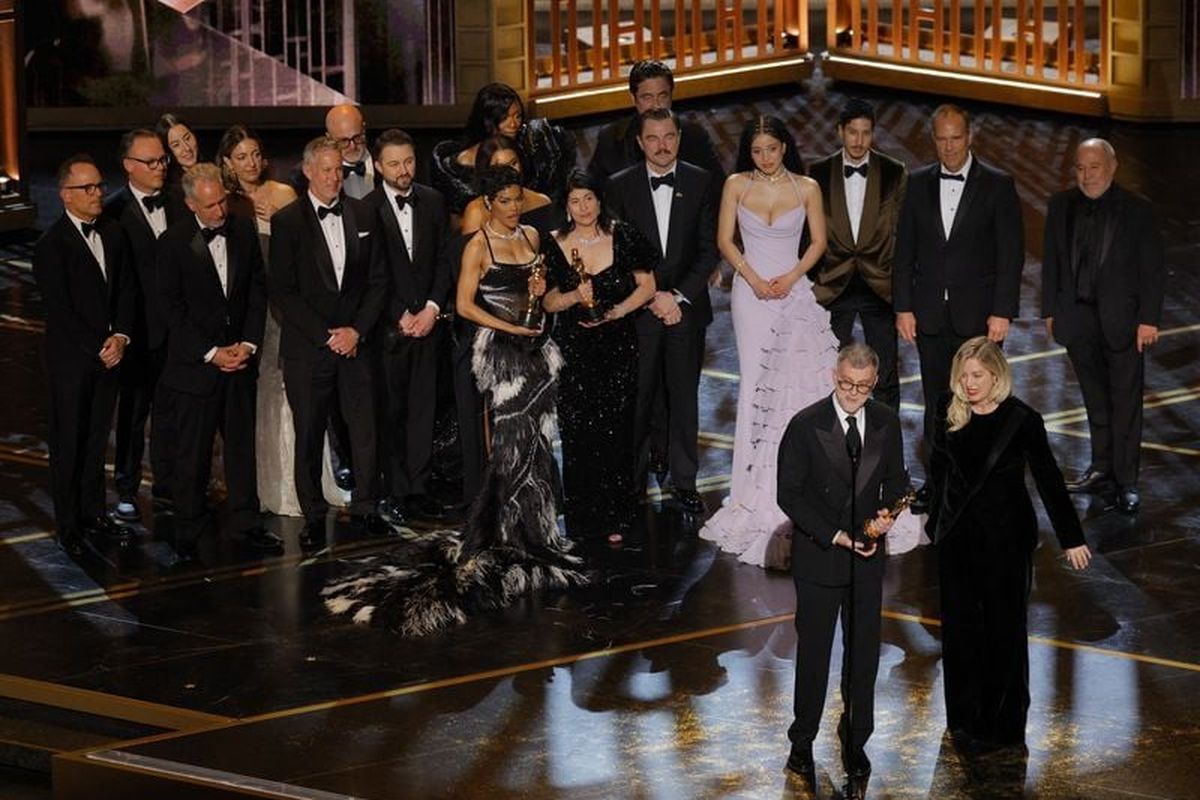
LOS ANGELES – The darkly comic thriller “One Battle After Another” claimed the coveted best picture prize at the Oscars on Sunday, winning a close contest with the vampire story “Sinners” at the highest honors in the film business.
Michael B. Jordan earned the best actor trophy for his dual roles as twin brothers in “Sinners.” Jessie Buckley won best actress for playing the wife of William Shakespeare, Agnes Hathaway, in “Hamnet.”
Sean Penn was named best supporting actor for his role as an obsessed military officer in the darkly comic thriller “One Battle After Another.” It was the third Oscar for Penn, who frequently skips movie industry awards shows and was not in the Dolby Theatre audience.
“Sean Penn couldn’t be here, or didn’t want to, so I’ll accept the award on his behalf,” said presenter Kieran Culkin, last year’s supporting actor winner.
The 75-year-old Amy Madigan was named best supporting actress for her role as the wacky Aunt Gladys in horror film “Weapons.” She earned her first Oscar 40 years after her first Oscar nomination.
In her remarks, Madigan thanked “Weapons” director Zach Cregger.
“He just wrote a dream part and he just let me grab it by the throat,” Madigan said.
“KPop Demon Hunters,” a Netflix movie that became a global phenomenon, was named best animated feature.
Amid the celebration, the show took on a serious tone to honor two major losses in the film world – the directors Robert Redford and Rob Reiner.
Billy Crystal, star of “When Harry Met Sally,” said Reiner’s films including “A Few Good Men” and “This Is Spinal Tap” would “last for lifetimes.” He was joined on stage by Demi Moore, Meg Ryan and other cast members from Reiner classics.
Barbra Streisand, who played opposite Redford in “The Way We Were,” called Redford a “brilliant, subtle actor” and an “intellectual cowboy.” She finished her remarks by singing a few lines from the movie’s well-known title song.
Eastern Washington-filmed “Train Dreams” was nominated in four categories: Best Adapted Screenplay, Best Cinematography, Best Original Song and Best Picture. The film did not take home any wins that night.
Host Conan O’Brien opened the festivities by joking that he was honored to be “the last human host” of the awards at a time when Hollywood is worried about artificial intelligence taking over jobs.
The glitzy celebration, Hollywood’s most over-the-top gala of the year, took place as the U.S. wages war on Iran.
Security was tight in and around the ceremony. Organizers said they were working closely with the FBI and Los Angeles police after a federal warning of a possible Iranian threat against California, though authorities have cited no specific or credible danger to the Academy Awards. Attendees had to cross through several traffic checkpoints and go through metal detectors to make their way into the event.
The festivities masked the unease in the film business over where movies are being made as studios chase tax incentives and lower costs elsewhere in the U.S. and overseas, weakening Hollywood’s grip on production.
Warner Bros., the studio behind “One Battle” and “Sinners,” is in the process of being sold to Paramount Skydance in a deal that will narrow the ranks of major film distributors. A media watchdog group, Free Press, circulated a roving billboard around Hollywood over the weekend airing its opposition to the merger.
Winners of the gold Oscar statuettes are chosen by the roughly 10,000 actors, producers, directors and film craftspeople who make up the Academy of Motion Picture Arts and Sciences.
The Academy took steps this year to try to ensure voters have actually watched the movies they are voting on. The online balloting system for the first time tracks whether a voter has streamed each movie. Voters, however, can check a box to say they watched the movie elsewhere outside the Academy website.
(Reporting by Lisa Richwine; Editing by Howard Goller)