
Ferguson signs bill barring masks on law enforcement as demonstrators urge him to go further
As protesters outside urged the state to take further action to protect Washingtonians from federal immigration enforcement, Gov. Bob Ferguson signed legislation on Thursday that prohibits law enforcement from wearing facial coverings during official duties and bans falsely identifying oneself as a police officer.
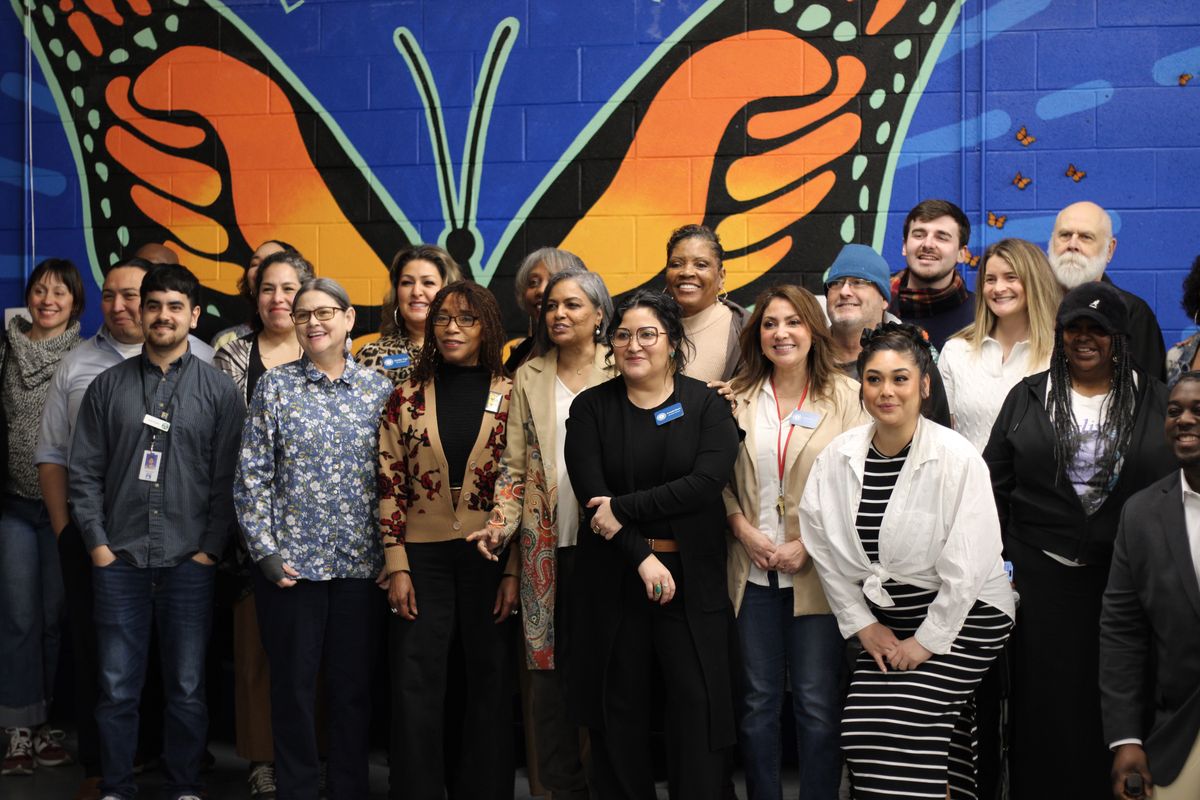
The pair of bills passed during the recent legislative session comes amid heightened concerns across the country as the Trump administration increases immigration action. During the bill signing, which took place at a cultural and resource center in Seattle and was attended by a collection of city officials and legislators, Ferguson was temporarily disrupted by a protester who urged the governor to further protect Washingtonians.
The protester yelled that the state Department of Licensing “needs to stop sharing data with anyone who will share it with” the U.S. Department of Homeland Security, as they were removed from the event.
In January, the University of Washington Center for Human Rights published a report that found the federal officials had used data from the state Department of Licensing in at least 15 incidents to locate people and initiate immigration arrests in violation of state law and policy. At least nine of the arrests were civil, not criminal. The report added that it was “impossible to calculate how many Washingtonians may have been affected by this widespread practice.”
The event on Thursday started approximately half an hour late, and bullhorns from protesters outside could be heard throughout the 30-minute affair.
Ferguson said during the event that he understood the “passion” of the demonstrators and appreciated their right to protest.
“No state takes this more seriously than Washington state,” Ferguson said. “No state is doing more to protect data than Washington state. We work closely with states all across the country, and we know how much we’re doing to limit that information.”
The governor added that “it’s a challenging time when you’re dealing with an administration that literally follows no rules.”
“We understand that we’re always going to have more work to do, to continually refine the information we provide and don’t provide to make sure we’re keeping our communities safe,” Ferguson said. “But I think that’s what today is all about, reflection of another step forward.”
The legislation Ferguson signed bars members of the public from making, providing or possessing badges or other law enforcement insignia when “a reasonable person would believe the person is a peace officer.”
“Right now, it’s actually perfectly legal for an individual to be in a car, to mark that car with ICE insignia, and drive around a school all day long, or to drive around a church, or drive around a courthouse. That’s perfectly legal to give that impression; you can do that,” Ferguson said. “That will change today.”
Rep. Edwin Obras, D-SeaTac, the bill’s sponsor, said the legislation is about “accountability and community safety.”
“We are at a time when there is chaos and confusion in our communities,” Obras said.
The governor also signed legislation that blocks law enforcement officers from wearing masks to conceal their identities while engaged in public duties.
While the legislation is applicable to all law enforcement agencies in the state, supporters say it is targeted at the increasing number of masked federal immigration officers . It’s not clear if federal officials will abide by the new law.
“This bill establishes important transparency and public accountability measures to protect public safety,” Ferguson said. “It also shows our immigrant community, our friends, family and neighbors, that we will stand up to protect them, that they have a place in our state, and that they can feel safe in their home.”
Last month, a federal judge in Los Angeles struck down a similar ban on masked law enforcement in California after the federal government alleged in a lawsuit it violates the constitution’s supremacy clause. While the law, which was passed by the California Legislature last fall, was applicable to federal law enforcement, state law enforcement was exempt.
Similar bills have been proposed in Oregon, Virginia, Hawaii, Maryland and Vermont.
In a statement, Sen. Javier Valdez, D-Seattle, the bill’s sponsor, said that “in communities across Washington, and across America, we’ve seen masked individuals detain people, seize neighbors off the street, and whisk them away in unmarked vehicles.”
“This law ensures that no one in our state is subjected to anonymous authority,” Valdez said. “People have the right to know who is exercising power over them.”
The governor said it was the first bill signing he had done where there were planned watch parties to celebrate the event. Events were scheduled to be held in Spokane and Bellingham.
“We’re thankful, of course. This is a statewide effort,” Ferguson said. “And we know not everyone can travel a great distance to be here; we appreciate them.”
More than 30 people attended the Spokane watch party, held at Nuestras Raices Community Center, on Thursday morning.
Among attendees were Rep. Natasha Hill, D-Spokane, Spokane City Councilman Paul Dillon, Manzanita House Executive Director Patricia Casteneda and Spokane School Board President Nikki Lockwood.
Castaneda spoke before Ferguson signed both bills, highlighting that many refugees and immigrants often are already fragile because of language barriers and a complex immigration system.
These bills, Castaneda said, add protection from those who misuse their authority.
“The fact that they are covering their faces makes people be doubtful of the good intentions of the government,” she told The Spokesman-Review afterward.
Margot Mejia, community advocacy liaison for Refugee and Immigration Connections Spokane, hopes this will be a positive impact for many community members affected by the current crackdowns.
Mejia mentioned Alberto Lovo Rojas, who was detained by immigration officers after a haircut appointment earlier last year and then deported months later. The family self-deported soon after.
“Some people are highlighting what is happening in Minneapolis or in other places, but it’s happening in our own backyard, and it has been happening since this administration took power,” Mejia said.
Fernanda Mazcot, executive director of Nuestras Raices, said while this is a step forward, there is still work to be done. She added it takes collaboration from multiple organizations and leaders to make changes at a state level.
“As an immigrant woman, I’m very proud to have a lot of solidarity in my community by different community partners and different leaders,” she said.