
Stepping into their culture: Opa Dancers learn traditional steps at Holy Trinity
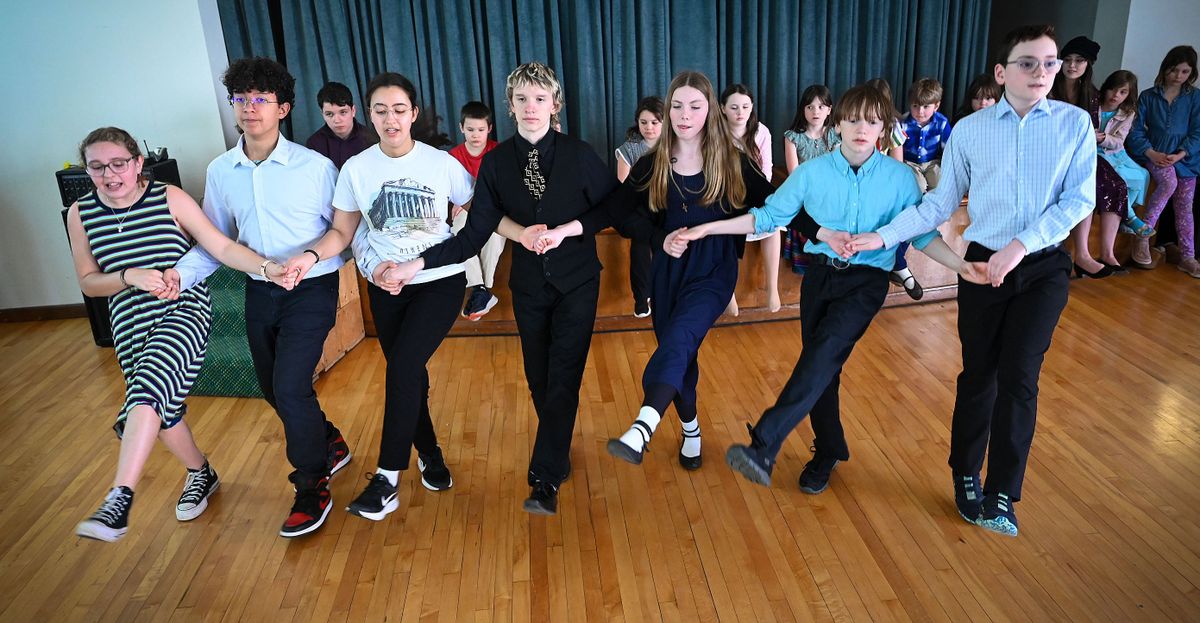
If you’ve seen the film “My Big Fat Greek Wedding,” you’ve seen the Kalamatiano, though you may not be familiar with the name of the joyous dance.
On Sunday, at Holy Trinity Greek Orthodox Church, the Opa Dancers kicked up their heels as they practiced the Kalamatiano and other traditional dances.
“I love the step, behind, step, kick the best,” said Liam Hicks. “I’m 7 and a quarter years old.”
The group includes kids from kindergarten through teens, and their performances are one of the highlights of the church’s annual Greek Festival.
John Treppiedi, 44, grew up dancing with Opa Dancers.
“As a kid, we mostly performed at our festival, to help show Greek culture to Spokane,” he recalled. “We actually marched in the Lilac Parade a couple of times.”
After attending university, he returned to Spokane and found the group was no longer active. For a couple of years, he taught a few high school kids the dances in preparation for the festival, but he longed to see the group expand.
“About 20 years ago, Sophronia Supica (now Wyrick) and I decided to make the group more formal again,” Treppiedi said. “We started regular practices, and were more intentional about teaching the dances we’d learned growing up. We even learned ‘new’ dances to teach the kids. Sophronia no longer teaches, but I kept on. We probably had 10-12 kids the first couple of years. We currently have about 25-30, if everyone attends.”
The dancers include his 13-year-old son and 10-year-old daughter.
Grace Gustafson, 12, has been dancing with the group since she was 5.
“Now, I get to call dances – that’s one of my favorite things!”
Abyssinia Krueger said her parents signed her up a couple of years ago.
“I thought it looked fun,” she said. “I love dancing.”
“Opa” can be most directly translated as “oops!” but is commonly used to express joy and celebration.
Joy was evident as the kids joined hands and formed a large circle to dance the fast-paced Hasapiko, a folk dance from Constantinople.
Elijah Briley, 13, started dancing with the group three years ago.
“It (the dances) can be hard when you’re new,” he said.
He enjoys hanging out with his friends during rehearsals, as does his brother, Noah Briley, 11.
Greek Independence Day is March 25, and Opa Dancers will be performing at the church on the 22nd.
“We take a break until after Easter, and then hit it hard to practice for the festival,” Treppiedi said. “In recent years, we performed at the Missoula Greek Festival, as well.”
Emme Teske relishes the challenge of fancy footwork.
“I really like the complicated songs,” she said.
As the more experienced dancers readied to practice the Tsamiko and the Pentozali, Nico Siebeking, 9, took a breather.
“I love to learn new dances,” he said. “I think it’s really fun!”
That’s exactly what Treppiedi hoped for.
“The most important thing is that they’re having fun while learning about culture and history,” he said. “As Orthodox Christians, we try to actively live our faith. Dancing helps create fellowship and a sense of community. Our parish is very American. The Opa dance group is one way of sharing our Greek heritage with the newcomers of the parish. It’s a great way for the kids to learn a little about Greece, while forming bonds that last a lifetime.”
James Krueger, 13, agreed.
“You feel connected after you dance,” he said. “Dance is a powerful way to learn about Greek culture.”