
Iran says major nuclear center hit in unclaimed attack
Iran said that one of its major nuclear centers was attacked again Saturday amid conflicting signals from the United States and Israel over whether the war was intensifying or heading toward an end.
The Israeli military denied that it had struck the site at Natanz, a major part of Iran’s nuclear program and the source of much of its nuclear fuel. The U.S. military declined to comment. The Iranian state news media and the International Atomic Energy Agency said that no radioactive leakage had been detected. Hours later, an Iranian missile struck a city in Israel near a nuclear center, injuring several people, in what Iran said was retaliation for the Natanz strike.
U.S.-Israeli airstrikes had targeted Natanz earlier in the war, with satellite images showing the destruction of entrances to an underground cavern that held centrifuges for uranium enrichment. The United States and Israel also attacked the compound in June.
As the war entered its fourth week, it remained unclear whether it would become a long-term conflict. On Friday, President Donald Trump said in a social media post that the U.S. was considering “winding down” the war with Iran, as it was “getting very close” to meeting its objectives. But the president has said multiple times that the war was nearly over, only for U.S. attacks to intensify.
Israeli officials have consistently told the public to prepare for a protracted battle with Iran, and on Saturday, Israel Katz, the Israeli defense minister, said in a statement that the U.S.-Israeli campaign in Iran would “escalate significantly” this week, without saying what the two militaries intended to attack. “We will not stop until all of the aims of the war have been achieved,” Katz said.
A main objective of both countries is to hobble Iran’s nuclear capabilities, but in his social media post, Trump softened his talk on how to deal with Iran’s nuclear fuel stockpile. He made no mention of seizing it and talked instead about making sure the United States was in a position to “powerfully react” if Iran tries to reconstitute its nuclear program.
The U.S.’ other preoccupation is to reopen the Strait of Hormuz. Iran has all but shut down shipping through the strait through which a fifth of the world’s oil passes. The resulting rise in oil prices has pushed the average price of gasoline in the United States to $3.92 a gallon, according to AAA, about $1 higher than it was before the war.
U.S. forces have been attacking Iranian drones and naval vessels in an effort to reopen the strait. In his post, Trump also said the problem of guarding and policing the Strait of Hormuz should belong to the countries “who use it,” claiming the United States does not, though any restriction in oil traffic drives up prices around the world.
As of Saturday, 22 countries, including Britain, France, Germany and Japan, had signed a statement signaling willingness to help secure shipping through the strait. The United Arab Emirates said Saturday that it had joined, making it the second Arab Gulf nation to do so, alongside Bahrain.
Adm. Brad Cooper, the head of the military’s Central Command, said Saturday that since the start of the fighting, the U.S. military had struck more than 8,000 military targets, including 130 Iranian vessels. “Their Navy is not sailing,” he said in a four-minute operational update video. “Their tactical fighters are not flying, and they’ve lost the ability to launch missiles and drones at the high rates seen at the beginning of the conflict.”
In a sign of U.S. anxiety over oil and gas prices, the United States on Friday temporarily lifted sanctions on Iranian oil currently at sea. The move could benefit Iran and underscored how little success the Trump administration has achieved in calming global markets rattled by the military campaign.
The Israeli military said it struck dozens of sites across Tehran overnight, focusing on factories that developed “critical components for the development of ballistic missiles.”
On Saturday, Britain and the United States said that Iran had fired two ballistic missiles the previous day at a joint U.S.-British military base on Diego Garcia, an island in the Indian Ocean, some 2,500 miles from Tehran.
A U.S. official, speaking on condition of anonymity to discuss sensitive matters, said that one missile failed midflight and that the other was shot down by a U.S. warship.
The official added that the launch had surprised the United States because of its range. Another stated objective of the war has been to hobble Iran’s missile capabilities.
Several people sustained minor injuries and at least two others were moderately wounded, including a 10-year-old boy with shrapnel injuries, after an Iranian missile hit Dimona in southern Israel on Saturday, according to Israeli emergency services. Israel’s main nuclear research center is near Dimona, but there were no reports that the site was hit. An Iranian missile also struck the city of Arad, about 25 miles from Dimona, injuring at least 33 people, several of them seriously.
After the Arad strike, Prime Minister Benjamin Netanyahu released a message on social media calling it “a very difficult evening in the campaign for our future.”
Iran’s military also threatened further retaliation against the UAE if any attack from its territory struck nearby islands, Abu Musa and Greater Tunb, that are disputed by both countries. The UAE is not participating in the offensive against Iran, but it hosts U.S. military bases.
In a post on the social platform X marking Eid al-Fitr, a major Islamic holiday marking the end of Ramadan, Iran’s president, Masoud Pezeshkian, said Iran was not seeking conflict with neighboring and Muslim countries, calling them “brothers,” and added that “the only beneficiary of our differences is the Zionist entity.” He then called for greater unity among Muslim nations.
Israel continued its campaign in Lebanon, striking the southern suburbs of Beirut early Saturday after the military issued warnings late Friday to residents remaining in seven neighborhoods. The military said it was targeting Hezbollah military infrastructure across the area “with increasing intensity.”
Early Saturday, footage shared on social media and television showed plumes of smoke and fire billowing after several locations were hit.
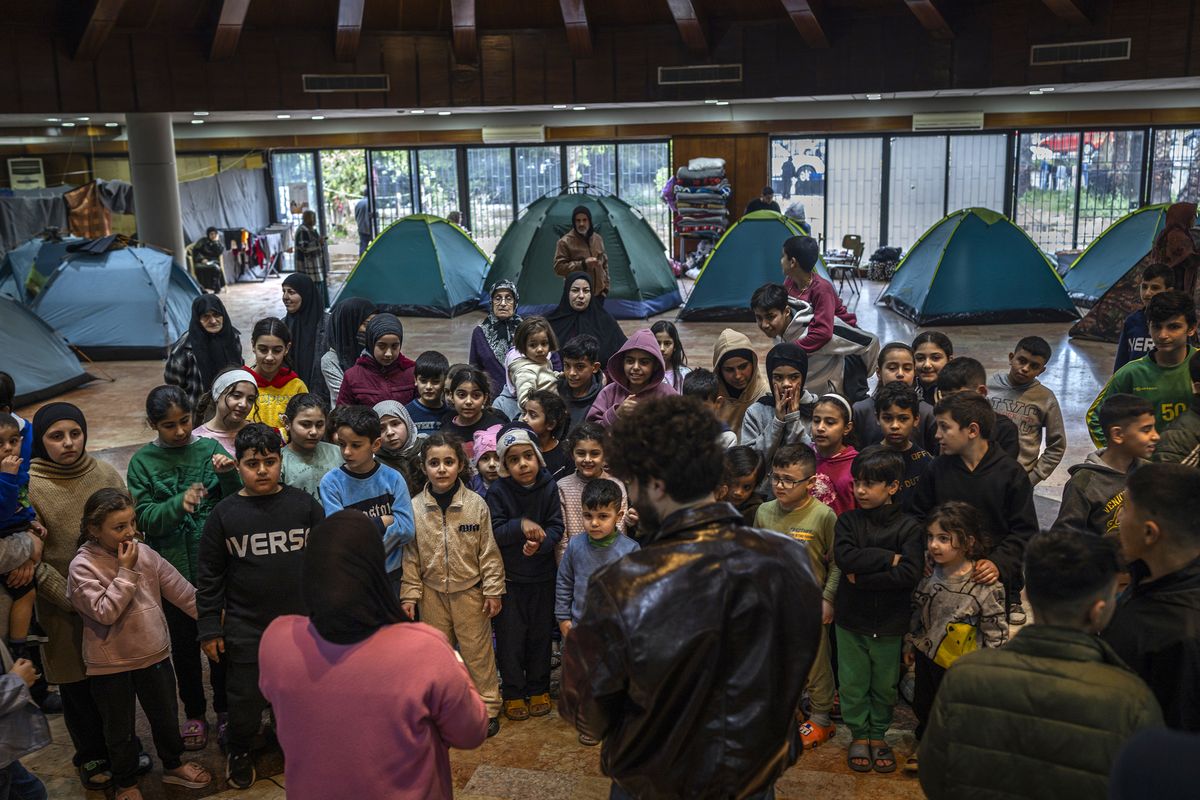
More than 1,000 people have been killed in Lebanon since the start of hostilities there in early March, according to Lebanon’s Health Ministry. More than 1 million have been displaced from their homes.
More than 1,300 civilians and 1,100 members of the military in Iran have been killed, according to an Iranian human rights group, the Human Rights Activists News Agency. Multiple high-ranking officials have been killed, including the supreme leader, Ayatollah Ali Khamenei, who has been succeeded by his son Mojtaba.
At least 14 people have been killed in Iranian attacks on Israel, officials have said. Thirteen U.S. service members have died.
This article originally appeared in The New York Times.