
‘All hell broke loose’: 104-year-old Pearl Harbor survivor in Moses Lake escaped two sinking ships in Pacific
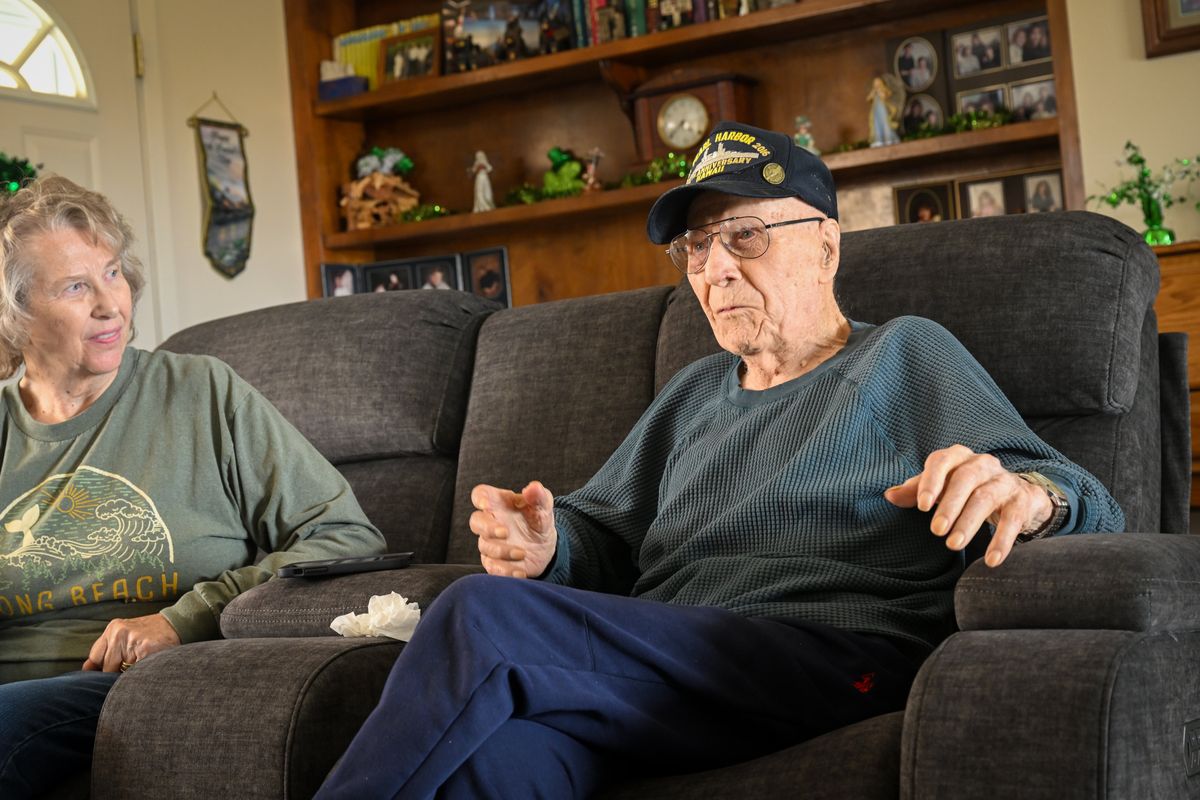
Geb Galle was in his U.S. Navy dress whites getting ready for church when he looked out a porthole of the USS Nevada and saw planes coming toward Battleship Row at Pearl Harbor.
The sailors heard, “Battle stations” soon after, said Lynda Palmer, Galle’s daughter.
It was Dec. 7, 1941.
Now 104 years old, Galle, a Moses Lake resident, and his fellow sailors were about to endure a flurry of bullets, bombs and torpedoes from a few hundred Japanese planes in a surprise attack that would kill more than 2,400 Americans and launch the U.S. into war.
Galle’s memories of that day 84 years ago have faded.
“I remember all hell broke loose and a lot of excitement going on,” Galle said March 12 from Palmer’s living room in Moses Lake.
Galle is one of about a dozen living Pearl Harbor survivors. He’s the last living crew member from the USS Nevada at Pearl Harbor.
The ship was moored behind the USS Arizona, which was struck multiple times by bombs and sunk, killing 1,177 sailors and Marines.
The Nevada, which was significantly damaged by a torpedo and bombs, was the only battleship to get away.
Palmer said her father, a machinist’s mate first class, worked in the engine room at the time and was commanded to set the ship into motion to escape the chaos.
The crew steered down the channel, but a torpedo strike prevented it from going farther, so the ship, leaking and on fire, beached at Hospital Point to prevent the channel from being blocked. Galle and others then got off the ship, Palmer said.
Still, 76 sailors and Marines on the Nevada died in the attack, according to the U.S. Department of Defense.
“They had to get out of the harbor or they would have had the same results as the Arizona,” she said.
Galle, who was 20 years old at Pearl Harbor, said he focused on what he had to do that day, which President Franklin Roosevelt said “will live in infamy.”
“When something like that happens and so much excitement going on, you respond to what you had to do at that moment,” Galle said.
Palmer mostly spoke for her dad during this month’s interview. She said her father a couple years ago could elaborate more on his experience during the attack.
But she said Galle did not talk about Pearl Harbor as she was growing up.
He started talking about it in 1970, she said, when the Pearl Harbor movie “Tora! Tora! Tora!” came out. Galle said the movie was a pretty accurate portrayal of that day’s events.
He entered the Navy in 1939 and served the duration of the war in the Pacific theater until 1945 when he returned home. Perhaps his most heroic action during his service was saving four of his fellow sailors on the USS Northampton, which sank almost one year after the Pearl Harbor attack at the Battle of Tassafaronga in the Guadalcanal campaign.
A U.S. Navy task force tried to surprise and destroy Japanese destroyers attempting to resupply Japanese ground forces on Guadalcanal, according to Naval History and Heritage Command. The U.S. located the Japanese ships and sank an enemy destroyer on Nov. 30, 1942. Japanese warships responded by firing torpedoes, sinking Galle’s ship and heavily damaging three others.
Palmer said Galle was about to abandon the sinking ship, but heard men trapped inside the engine room . She said a commanding officer ordered Galle to leave the hatch shut to prevent water from entering. Once the officer left, Galle ignored the order and let the men out so they did not drown.
Galled then jumped off the ship and took turns with his fellow sailors floating on a raft for a day and a half, Palmer said. Other sailors closer to the ship were rescued sooner, but Galle and others watched the ship sink from a distance and were not noticed until a plane flew over and spotted them.
She said her father recalled a large fish with a “flat snout” swimming by the raft as they floated in the ocean. He did not remember what kind it was.
At one point, Galle and his fellow sailors paddled toward an island but were shot at, so they turned back, Palmer said.
The PT-109, a U.S. Navy patrol torpedo boat, rescued Galle and the others. Lt. John F. Kennedy, who later became U.S. President, took command of the PT-109 a few months later, but he was not on the boat when it rescued Galle.
Palmer previously asked Galle if Kennedy was on the boat, and he said, “I don’t care. I wanted out of the water.”
Jason Robards Jr., a radioman on the Northampton who later became a distinguished Hollywood actor and Academy Award winner, also survived the ship’s sinking by treading water near the wreckage for hours until a U.S. destroyer rescued him, according to military.com.
Robards, who died in 2000, landed roles in classics like, “Long Day’s Journey into Night,” “Once Upon a Time in the West” and “All the President’s Men,” the latter of which saw him play Washington Post Editor Ben Bradlee.
Meanwhile, Galle served on the USS Mobile until the end of the war.
Palmer said her father served in almost every major battle in the Pacific.
At the 75th commemoration of the Pearl Harbor attack in 2016 at the National Memorial Cemetery of the Pacific in Hawaii, Galle pointed out 19 battles in which he participated on a wall at the cemetery.
Palmer said Galle witnessed American B-25 bombers, who were part of the Doolittle Raid, take off from the USS Hornet aircraft carrier four months after the strike at Pearl Harbor. The raiders bombed Tokyo in an initial retaliatory attack after Pearl Harbor.
She said she is not sure how Galle, who wore a blue Pearl Harbor 75th anniversary hat during the interview, survived the war.
“I wouldn’t be here if he didn’t,” she said with a laugh. “I feel fortunate that he did (survive). After learning about all the things that he went through, he’s a real hero to our family.”
After the war, Galle, who maintained refrigeration units on his ships during the war, applied those skills by opening a refrigeration and air conditioning business in Grafton, North Dakota, Palmer said. He sold the business in 1960 and worked for the Air Force as a civil engineer in Grand Forks, North Dakota, the state where he grew up.
Galle was born in Germany and came to North Dakota with his family in 1928 when he was 7.
He then moved with his family west to small towns in Idaho, Washington and Oregon, continuing to work as an engineer. He also worked for the U.S. Army Corps of Engineers at Bonneville Dam on the Columbia River. He retired in the 1980s.
Galle recently ran into a pension payment issue where the federal government failed to issue his monthly payments the last five months. Palmer said the government sent those backlogged payments to Galle over the last couple weeks. She credited U.S. Sen. Patty Murray’s office for helping resolve the issue. Palmer said she believes the payments stopped because the government may have believed her father was dead, given his age.
Galle’s wife of 66 years, Jean, died 13 years ago at the age of 84. The couple had five children, including Palmer. All are alive.
Galle also has grandchildren, great-grandchildren and great-great-grandchildren.
Now, Galle lives in a Moses Lake assisted living home. He uses a walker to get around.
Palmer said her father has always stayed healthy by walking and eating right. He often walked 4 miles a day in his 90s, she said.
Galle has a good attitude in the face of hardship, his daughter said, whether it was at war or at home.
“He’s happy where he’s at,” Palmer said. “He’s in a home right now. He says, ‘I get my three meals a day. I get a bed to sleep in. I’m happy.’ ”