
Colorful Colorado comes through with beautiful scenery, reminiscent of home
From the Windy City to the Mile High City – the second leg of our train trip found my sister and I traveling 19 hours from Chicago to Denver for a 48-hour visit. But, as I’ve mentioned in previous travel stories, we know how to pack a lot into a short amount of time.
Arriving at around 8 a.m., Ashley and I walked from Denver’s Union Station to the Hampton Inn and Suites Denver-Downtown Convention Center (550 15th St.). Though we usually stay in hostels, this hotel was significantly cheaper than the available hostels in town.
Originally planning to drop off our luggage until it was time to check in later that afternoon, a manager kindly allowed us to check in early as a room was available. It was a small kindness that really made our day, as it gave us a comfortable place to rest and recharge after a night on the train.
Around lunchtime, we walked to the Clyfford Still Museum (1250 Bannock St.), home to more than 3,000 works by the abstract expressionist. Born in North Dakota, Still grew up in Spokane and Canada.
As an adult, Still graduated from Spokane University, now the home of Valley Christian School, in 1933 and later taught at and earned his MFA from Washington State College, now Washington State University.
While at the state college, Still and colleague Worth Griffin founded the Nespelem Art Colony where he and his students created paintings that captured the lives and landscapes of the Colville Confederated Tribes.
We were there to see “Tell Clyfford I Said ‘Hi’ ”: An Exhibition Curated by Children of the Colville Confederated Tribes. For a deeper dive into the collaboration that resulted in this exhibition, read the accompanying story on D1. But in short, the exhibit was a beautiful celebration of Still, the Colville Reservation and the way the children of the Colville Confederated Tribes think and interpret the world.
After the Still Museum, we walked just next door to the Denver Art Museum (100 W. 14th Ave. Parkway), where I was looking forward to seeing “The Honest Eye: Camille Pissarro’s Impressionism,” the first major U.S. retrospective of the artist’s work in 40 years, as per the exhibition’s page on the museum website.
Denver was the only U.S. stop for the show, which featured more than 100 paintings – landscapes, figure paintings, cityscapes and still lifes – from nearly 50 museums and private collections from around the world.
The exhibit was everything my Impressionism-loving self was hoping for, but we also found ourselves drawn to “Sustained! The Persistent Genius of Indigenous Art.” The museum’s collections featuring art from around the world, including Africa, Latin America and Asia, was also very impressive.
After building up an appetite museum hopping, we walked to Bang Up to the Elephant (1310 N. Pearl St.), a vegan restaurant that takes its name from Victorian slang for “properly done” or “done with good intention,” for dinner.
Ashley ordered the Cassareep rice bowl, with crispy tofu, onions, pineapple, sweet red peppers and fresh tomato in a cassareep sauce (a Guyanese sauce made from cassava) served over coconut rice with steamed broccoli ($18.95) while I ordered the Coconut Curry bowl, with chickpeas, potatoes, sweet peppers and peas served over rice, plus a side of cornbread ($18.95).
There was an unexpected sweetness to the cornbread – I tasted a bit of ginger, which might explain it – and it was a delicious way to soak up the extra coconut curry sauce.
Though we went right around dinnertime, we didn’t feel rushed to eat and leave quickly. In fact, the low lighting and spacious dining room felt welcoming and like the perfect place to debrief after a long day.
The next morning, we walked to Union Station to meet our tour guide Aaron for a Red Rocks and Beyond tour with Aspire Tours. In a fun coincidence, Aaron is originally from Bellingham, so we ended up talking a lot about Washington while on the road from place to place, though Aaron did also share a lot of information about how the area we know as Colorado came to be.
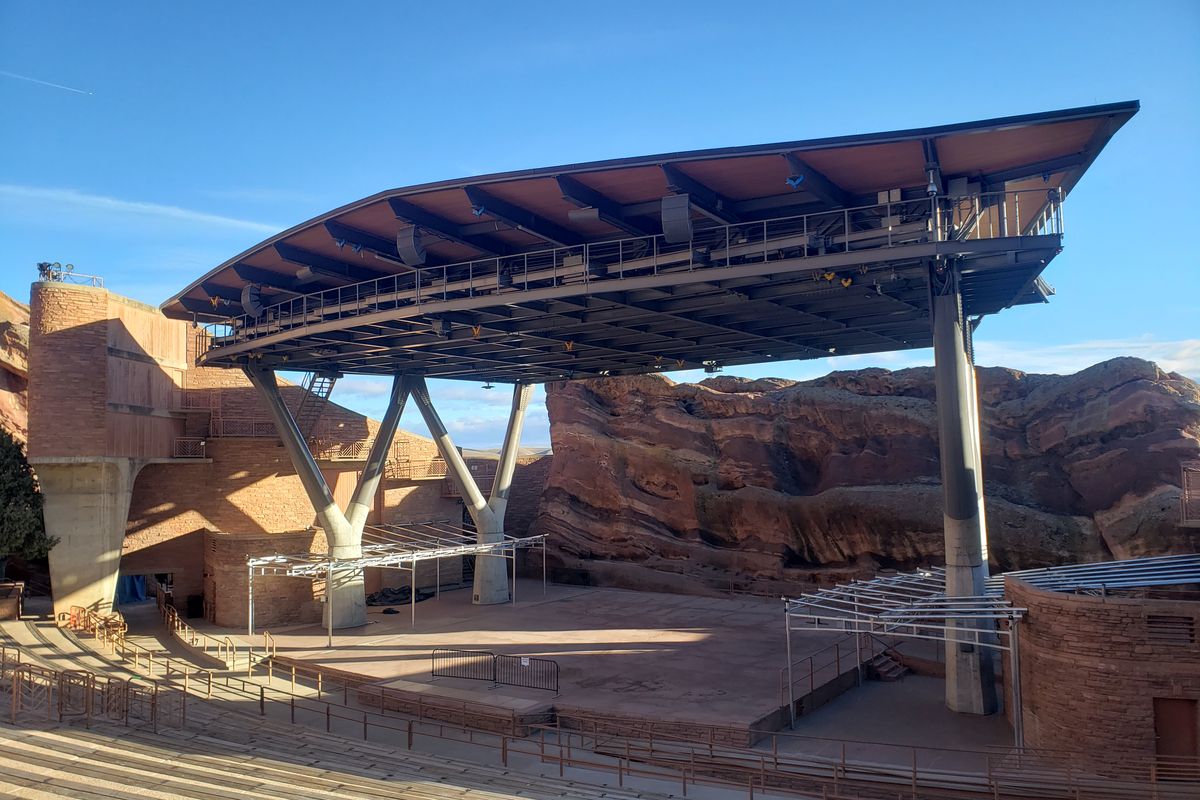
Ashley and I booked this tour specifically to see Red Rocks Amphitheater (18300 W. Alameda Parkway, Morrison), an outdoor venue that comes complete with naturally occurring perfect acoustics.
The rock started rolling on Red Rocks in 1936, when then-Denver Mayor Benjamin Franklin Stapleton and Parks and Improvements Manager George Cranmer got the OK to build the venue using the Civilian Conservation Corps. After receiving the approval, Stapleton and Cranmer chose architect Burnham Hoyt to design the amphitheatre.
Before stepping into the venue, we made a stop at the visitor’s center, where we learned CCC crews moved more than 10,000 cubic yards of earth and rock debris to construct the amphitheatre’s structure, turning a boulder-strewn field into a 9,525-capacity venue.
Another sign explained that Hoyt took inspiration from ancient theaters, including the Theatre of Dionysus in Athens, working to create a grand venue while also preserving the natural features of the park
Yet another sign explained that though the venue opened its proverbial doors in 1941, the naturally occurring Stage Rock had been welcoming musicians since the early 1900s. With that knowledge in mind, it was astounding to then walk the hallway which listed thousands of performances from musicians of all genres held at Red Rocks since opening day.
Stepping into the park for the first time was just as special as I thought it’d be. Ship and Creation rocks stretch high into the area from the base of Stage Rock, with 2.5 miles of seating area tucked in between.
Stretching beyond the venue are acres and acres of Red Rocks Mountain Park. Beyond that, you can make out the city of Denver and the Denver International Airport.
We had a little time to wander, so Ashley and I got as close to the stage as we could (we couldn’t go on the stage because of maintenance work) before walking back up to the plaza and taking in as much as our eyes could capture before we had to head back to the van.
As much as I love the Gorge Amphitheatre, seeing a show at Red Rocks is definitely on my bucket list.
From Red Rocks we traveled to Lookout Mountain, getting views of the Rocky Mountains, Great Plains and Denver. Aaron explained the mountain was once used as a watchtower for the Ute people, who, through a series of lit fires, could spread a warning to tribal members 10 to 15 miles away.
Lookout Mountain is the resting place of William Frederick Cody, aka Buffalo Bill, a soldier and marksman who, according to Aaron, earned his nickname while working to hunt bison to feed railroad workers. He would of course go on to become a famous showman of the Wild West.
After our stop at Lookout Mountain, we had time to explore the aptly named Gold Rush town of Golden. After grabbing a few souvenirs at YoColorado (805 12th St., Golden), Ashley and I bought vegan arepas ($12) from El Callejon Latin Food (1205½ Washington Ave., Golden) for lunch.
While eating, we walked to Clear Creek, the watershed of which a sign proclaimed covers more than 600 square miles, including five counties and more than 13 communities.
It was a quick visit, but I really enjoyed wandering the town, which reminded me a bit of Sandpoint’s main street.
Once dropped back off in Denver, at Aaron’s suggestion, we walked to the Colorado State Capitol (200 E. Colfax Ave.). If you recall, last year Ashley and I visited the U.S. Mint in Philadelphia, so a nerdy tour stop like this shouldn’t come as a surprise.
Though they usually host free tours, tours weren’t available the day we visited, so Ashley and I walked around ourselves.
According to the Capitol’s website, “the inside of the building is adorned with what is believed to be the entire known supply of Colorado Rose Onyx, a rare rose marble from a quarry near Beulah, Colorado.” The capitol floors are White Yule Marble from quarries near Marble, Colorado.
The rest of the building was just as ornate, including stained glass windows, a chandelier in the House and Senate chambers, portrait galleries and a large dome topping it all off. We especially enjoyed Mr. Brown’s Attic Museum, named for Henry C. Brown, a businessman and developer who offered 10 acres of land as a site for the proposed Capitol building.
The museum walked visitors through the process of building the Capitol as well as state symbols and emblems. The Western Tiger Salamander, for example, is the state amphibian, and folk/square dance is the state dance.
On the way out, we stopped to see the marker on the Capitol step used to show 1 mile above sea level.
After a delicious dinner of burrito bowls topped with green chile from Illegal Pete’s (various locations), yet another recommendation from Aaron, we browsed Tattered Cover Book Store in Union Station (1701 Wynkoop St.), a small yet surprisingly well-stocked bookstore, which also has various locations around town.
We spent the evening packing up and after one final hotel breakfast, walked to 16th Street, where we took the free shuttle down to the train station, ready to set off on our final leg of the trip to San Francisco.
I would have loved to explore downtown Denver even more, but with only about two days in Colorado, I knew we wouldn’t hit everything on our list.
You can draw a lot of comparisons between Colorado and Washington, both scenically and, from what I could gather, energetically, but Colorful Colorado is definitely a gem all its own.