
Denver museum calls on children of the Colville Confederated Tribes to curate Clyfford Still exhibit
In a 1937 letter to Herbert Kimbrough, dean of Washington State College’s School of Music and Fine Arts, abstract expressionist painter Clyfford Still wrote, “During the summer of 1936, while (colleague Worth Griffin) and I were painting on the Indian reservations in the State of Washington, we were struck by the abundance of valuable and colorful material that is offered the creative worker. We came to the conclusion that something should be done to bring this material more forcibly to the attention of the people of the state, and potential artists, in particular, in a way that is not possible in the class rooms at the State College…”
Still and Worth were seeking support to found an artists colony on the Colville Reservation, a place where Still, Griffin and a handful of artists would spend time studying the people and places of the reservation as inspiration for their work.
“Through sponsoring work of this kind,” the letter continues, “the State College becomes the first institution in the Northwest to recognize the importance of the Native material of this region … It is our belief that when the artists of the east and middle west become fully aware of the extent and importance of this material there will be an influx of painters into eastern Washington.”
In short, the project was approved, and Still and Griffin welcomed artists to the Nespelem Art Colony for four summers.
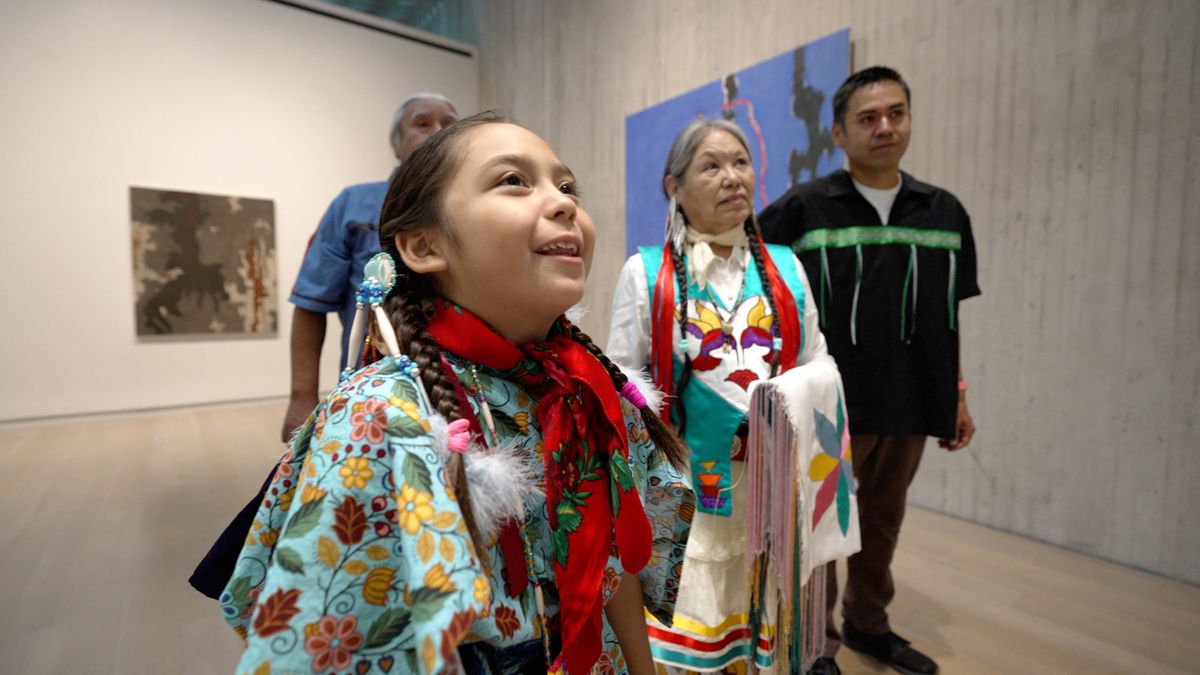
Ninety years after Still spent that first summer painting on the reservation, the artist and Colville community are once again collaborating through “Tell Clyfford I Said ‘Hi’ ”: An Exhibition Curated by Children of the Colville Confederated Tribes, which opened on Sept. 19 and runs through May 10 at the Clyfford Still Museum in Denver.
The young curators, from Hearts Gathered Waterfall School, Nespelem School and Nespelem Head Start, helped with everything from artwork selection and arrangement and object interpretation to gallery text and interactive experiences.
The works in the exhibit represent six themes the young curators identified: family and culture, connection, imagination, the outside, love, and paint and color. Many of the pieces are accompanied by a quotation from a student explaining why they liked the painting.
Kloey, a fifth-grade student at Nespelem School, chose a painting of a horse because it reminded her of her horse Pepper. Nikolai, another fifth-grade student at Nespelem, chose a painting of B Street in Grand Coulee, because a building featured in the painting reminded him of Siam Palace, a Chinese restaurant he visits with his family.
Mason and Vivienne, elementary students at Hearts Gathered Waterfall School, chose a painting with black and white stripes because it looked like zebra skin to Mason and a waterfall to Vivienne.
Toward the end of the exhibit, visitors can see photos of the young curators visiting the Clyfford Still Museum.
Bailey Placzek, curator of collections, catalogue raisonné research and project manager at the museum, said the exhibit is a decade in the making. After the museum opened in 2011, staff inventoried the more than 3,000 pieces in the collection and found about 100 artworks made during Still’s time at the Nespelem Art Colony.
Many knew of Still’s work with the colony, she said, but not everyone had seen the pieces.
“They depict individuals and the landscape around the Colville community, so we knew that was this really rich area that needed to be researched and explored,” Placzek said.
The museum reached out to Oregon art historian Patricia Failing in 2014, and she curated an exhibition featuring many of those 100 pieces. Michael Holloman, an art professor at WSU and an enrolled member of the Colville Tribe, then visited the museum.
Holloman asked about the possibility of the museum working with the Colville community in some way, which Placzek was immediately interested in.
The pair kept in touch, and in 2021, Placzek and Nicole Cromartie, director of education and programs at the Clyfford Still Museum, reached out to Holloman with a request to be connected with the Colville community for an exhibit the museum was planning about communities that had influenced Still.
In April 2022, the pair traveled to the reservation and met with John Sirois, the traditional territories adviser, who introduced them to the families of some of the people Still painted.
“That was one thing that I was so struck by once I started visiting that area is how much it makes you appreciate his works in a new way,” Placzek said. “Some of the landscape, the striking bluffs and the colors. At the end of the project, we had visited at least once during every season, and we felt it’s really amazing to connect those colors and the environment itself and the mood and the quality of the light, thinking how that impacted his career. That made such an impact.”
In November 2022, the pair invited Holloman and Sirois to speak at a program they organized. While together, the pair asked Sirois where they saw the tribe’s collaboration with the museum going.
“He and Michael looked at each other and immediately were like, ‘We need to involve the youth,’ ” Placzek said. “ ‘We want to involve tribal youth in this.’ ”
Having just completed curating “Clyfford Still, Art and the Young Mind” with youths from the Front Range, a region west of Denver, Placzek and Cromartie were on board right away. So the pair traveled to the reservation in July 2023 to get to know the community better. In January 2024, the pair traveled back to the region to ask the tribal council for assistance with the idea of a collaboration. The council put them in contact with school administrators.
The pair didn’t throw out the idea of an exhibition to the children right away. Instead, they introduced themselves, artists, the idea of an art museum and the art in the Clyfford Still Museum and asked the children “What artworks are you connecting with? How are you connecting with them?”
As the process continued, Placzek and Cromartie brought prints of the works Still made while at the Nespelem Art Colony and hung them up at the schools, asking the children to put a Post-It Note on the prints that spoke to them. They then gathered quotes from the young curators about why that painting resonated with them.
Every time Placzek and Cromartie visited the schools, they invited parents and members of the community to see the prints, as well.
“We definitely had some individuals come and say, ‘That’s my great grandfather. I’ve never seen an image of him as a young man, and now you’re working with my son,’ ” Placzek said. “These really special moments, how knowledge is passed through generations, and how we’re closing the circle on something that had begun more than a century ago with Still.”
Ted Moomaw, executive director of Hearts Gathered Waterfall School and an artist himself, heard those comments as well, noting there was an ancestral connection in Still’s work.
At the Clyfford Still Museum, the Grand Coulee Dam painting in particular is surrounded by quotations from the young curators, showing just how popular it was when deciding which pieces to feature in the exhibit.
“I live there! I live there!” said Virginia from Nespelem Head Start.
“I like Coulee Dam because I used to live there when I was two years old, and there is a lot of the ocean there, just like my name,” said Oshun, from the elementary classroom at Hearts Gathered Waterfall School.
“I feel connected to the art,” Rykiah, a fifth-grader from Nespelem School, said simply.
Moomaw was immediately interested in this collaboration, saying he is supportive of anything that connects children with art, especially in the region, which he said has little art exposure for kids.
While working at the Colville Tribal Language Program in Omak, Moomaw remembers going through historical records and seeing photographs of Still and the Nespelem Art Colony. He didn’t know how famous Still had gone on to become, but he was aware of his work in the area.
Moomaw said the students at Hearts Gathered Waterfall School were really excited to help when they understood what Placzek and Cromartie were asking.
“I do remember the energy of being excited when they realized what was going on, that their paintings that they chose were going to be exhibited in Denver, which, to them, could be across the world,” he said.
Moomaw and several children from each of the three schools did get to travel to Denver to see the finished exhibition. Moomaw said, while the exhibit was breathtaking, the best feeling was watching the children from Hearts Gathered Waterfall School interact with other young curators and visitors to the museum.
Many of the children, all clad in shirts that said “Curator,” stood next to their painting most of the evening and were happy to share why it was selected for the show.
One of the biggest takeaways for Placzek of “Tell Clyfford I Said ‘Hi’ ” and something she first noticed with the “Young Minds” exhibit, was that children approached Still’s abstract works with no fear. “This one looks like a river,” the children might say, or “This one looks like a UFO coming down to suck up this person.”
Placzek said it’s been a challenge for the curatorial team to figure out how to make Still’s giant abstract works approachable for the majority of visitors who may feel like they don’t have the art history background to know how to experience them, but they learned through surveys from the two youth-curated exhibits that having the perspective of the young curators on the walls helped.
“People see that and they’re like, ‘Oh, so if the museum is putting this interpretation of this abstraction on the wall from this third-grader, then obviously my readings and how I’m experiencing the painting is valid,” she said. “That’s what we’ve always wanted to do, because Clyfford Still didn’t title his works. He didn’t explain what they meant.
“He wanted each and every person to approach them from their own perspective, and having kids involved in the arrangement and the interpretation of them shows adults that their opinion and their interpretation matters and is just as valid as the critics.”
Placzek and Cromartie are still in touch with Moomaw and the rest of the community about potential future projects, including a board book that pairs Still’s work with the Okanogan language. The duo is also printing a catalogue about the exhibition for students who weren’t able to travel to Denver to see the exhibit.
Placzek and Cromartie heard from parents that many children began creating more artwork of their own after their time working on the exhibition.
Still would be happy to hear that, as it aligns with the dream he had for the Nespelem Art Colony and the goal to bring more art opportunities to the region, as written in his letter to Washington State College Dean Herbert Kimbrough: “We sincerely believe that such a project might form the nucleus of what could readily prove to be a vital, creative art movement in Eastern Washington comparable to those which have developed in Kansas, Iowa, Texas, Oklahoma and many other places.”
The young curators from Nespelem Head Start were Mark, Babe, Amari, Deliah, Yazmyne, Solara, Shoni, Alexander, Kelvin, Gi’onna, Fallynne, Evelyn, Remmi, Jeter, Alek, Sage, Paisley, Justin, Charlotte, Kyson, Blair, Daniel, Ida, Skyler, Aiden, Juniper, Amillya, River, Leland, Miya, Rylan, Illaka, Blake, Cassius, Jewelz, Malcolm, Cambria, Thomas, Joshua, Marvin, Quinn, Kayda, Ren, Judy, Tressa, Teagan, Edgar, Melody, John, Reign, Luka, Sindah, Asher, Jett, Kade, Tymber, Hendrix, Virginia, Phoebe, Ella, Easton, Caylin, Whitney, Samantha, Jett, James, Weston, Amarah, Tommy-Lee, Elissyia, Kade, Archer, Blair, Lane, Boone, Jules, Hannah, Kayaana, Fenix, Parker, Geraldine, Kuvara, Loudyn and Sawyer.
The young curators from Nespelem School were (fifth-graders) Brylee, Nova, Isabella, Colten, Nikolai, Carter, Noah, Kloey, Rykiah, Odile, Abel, Mary, Newton and Jraiya, (seventh-graders) Zola, Dacy, Whisper, Alastar, JJ, Brody, Keelye, Cyrus, Raymond, Chandler, Shayce, Jayla and Braydon, (eighth-graders) Ava, Evonne, Robert, Alec, Margaret, Dorla, TaHayma, Atom, Russell, Jerricka, Shyne, Alex and Jase.
The young curators from Hearts Gathered Waterfall School were Vivienne, Kara, Oshun, Hawkin, Kalahna, Ikayqn, tulmn, Bronex, Brexton, Leyla, Angela, Stormy, Audrey, Bear, Anika, Talia, Dalanie, Kingsley, Mason, Cleveland, Tomias, Khynder, Ruby, Elizabeth, Raven, Moreya, Brayen, Easton and Camden.
Finding beauty in colorado Two-day stop in Denver offers a chance to visit museums and take an excursion outside the city. Page 8