
This day in history: Spokane Weekly Chronicle announced end of publication. New report cards judged kids for manners, ‘cheerfulness’ and more

From 1976: The Spokane Weekly Chronicle announced it was ceasing publication on July 1, 1976, “96 years to the day after it was founded by three Spokane pioneers.”
The Spokane Daily Chronicle was not affected. The Spokane Weekly Chronicle was “an adjunct of the Spokane Daily Chronicle,” but was “no longer a practical sideline for a daily newspaper published by modern electric methods.”
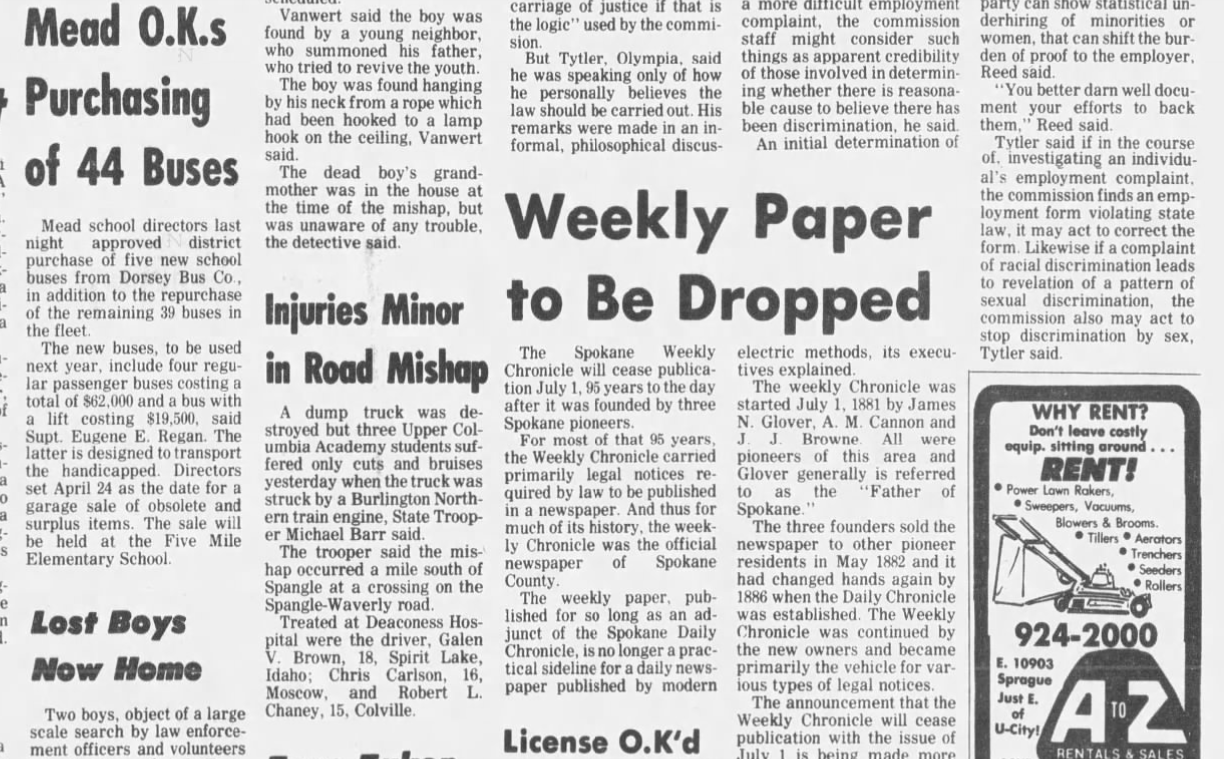
It was founded on July 1, 1881 ,by James Glover, A.M. Cannon and J.J. Browne. They sold it shortly after and in 1886, the Spokane Daily Chronicle acquired it.
It became “primarily the vehicle for various types of legal notices.”
From 1926: Some parents were not happy with the new report cards issued by the city’s grade schools, which assessed pupils on issues far beyond reading, writing and arithmetic.
The report cards also graded pupils on 10 points of “citizenship and character,” and these were the features “under fire.”
For instance, one of the points was “dependableness,” which included “honesty, keeping of promises and reliability.”
Another point was “courtesy,” which included “good manners, friendliness, cheerfulness, respect for the right others and fair play.”
A number of parents apparently visited principals’ offices demanding explanations for their children’s unfavorable grades on these subjects.
Also on this day
(From onthisday.com)
1853: Anti-slavery newspaper “The Provincial Freeman” is first published in Windsor, Ontario, edited by Samuel Ringgold Ward and Mary Ann Shadd Cary, the first Black woman publisher in North America.