
Terrain’s Carl Richardson helps tell an artist’s story as the preparator at Terrain Gallery
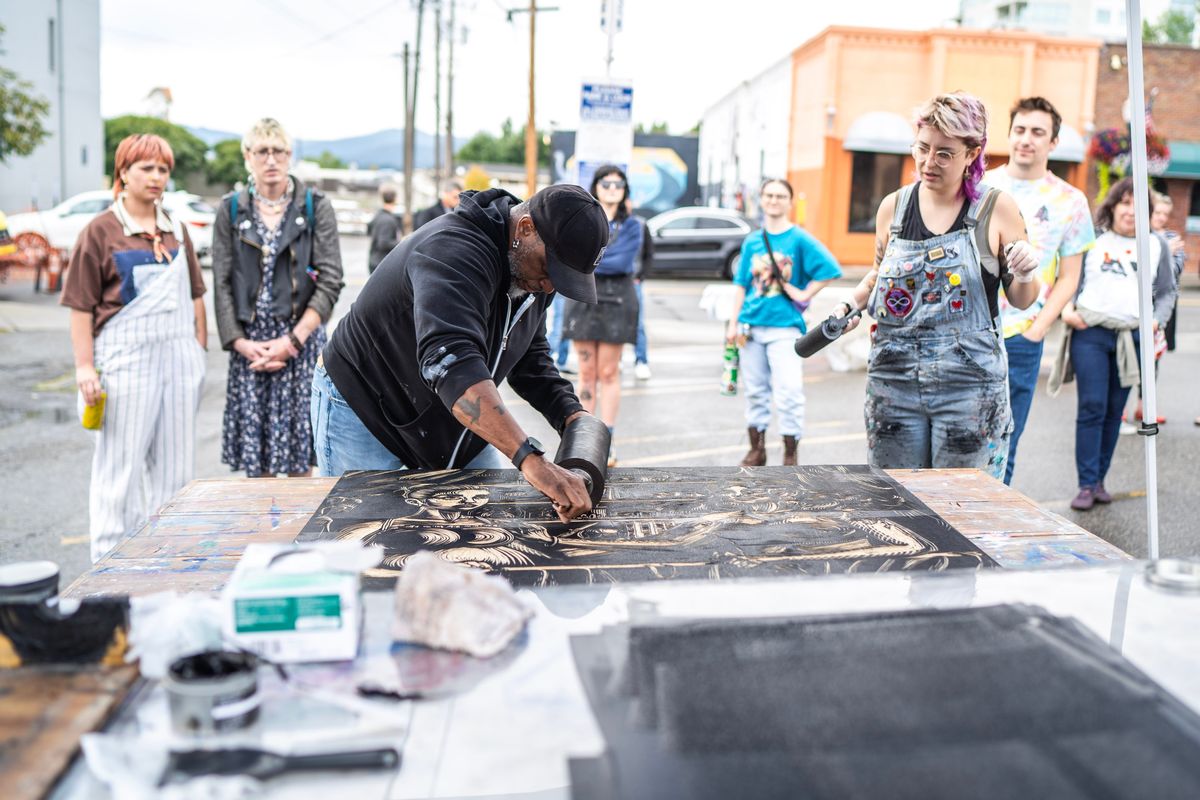
If you’ve taken in a show at Terrain Gallery practically since it opened in 2017, you’ve also seen the work of Carl Richardson.
No, he doesn’t have a permanent piece on the gallery’s walls, though he has shown at the gallery in the past. Instead, he is the one responsible for hanging each show, for ensuring that each piece the artist has dropped off is hung in a way that, when viewed as a whole, portrays the story the artist wants to tell and the sensation the artist wants viewers to feel.
Richardson has worked with Terrain Gallery since 2019. His most recent project found him hanging more than 60 pieces in advance of the Terrain Gallery fundraiser Friday at the gallery.
For the fundraiser, more than 50 artists have created a piece of art. Each piece is priced at $200, and 100% of the proceeds go back to the gallery.
According to Terrain, it costs more than $75,000 a year to keep the gallery open, with costs such as rent ($44,000 a year), graphic design ($4,200 a year) and gas and electricity ($2,160). The organization hopes to raise $20,000 through this fundraiser.
Long before his time hanging shows at Terrain, Richardson was a kid growing up in northwest Florida, following in the footsteps of his artistic and musically inclined older brothers and sisters.
His older sister Lillie in particular, now an actor, was a talented oil painter, and Richardson wanted to try his hand too. Richardson’s mother found an instructor named Mrs. Rogers, and he spent every Saturday from fourth through 10th grade at her studio painting.
Of the eight Richardson children, four decided to make their career in the art world, be it on canvas, in music or on stage and screen, while the other four chose more traditional paths. Interestingly, the four who work in the arts have all moved to the West Coast, while the four who chose those more standard paths stayed on the East Coast.
Richardson moved to Washington state to earn his MFA from Washington State University after graduating from Florida A&M University with a bachelor of science degree. He thought it would be a fun adventure and told his friends he would be back in Florida after graduation, but he fell in love with the slower pace of the West Coast and has called Washington home ever since.
Richardson said it was a culture shock moving from an historically black college and university (HBCU) setting to Pullman, but he was ultimately happy with his choice to move.
“The instructors at Pullman were great,” he said. “The class that I came in with was amazing, and there were no distractions. You’re here to make art, and there’s really not much else you’re going to do.”
After graduating, Richardson got a job teaching art at Spokane Falls Community College, a position he still holds today. Working at the college has been great, he said, because he’s surrounded by creative people who influence his work.
During his time at SFCC, Richardson worked with Patty Haag, who used to run the school’s gallery. She taught him the ins and outs of hanging and lighting a show, and Richardson would help her hang shows in the school’s gallery and hallways.
Fast-forward a bit to Richardson’s first experience with Terrain at an exhibit the organization hosted in Music City. After that exhibition, Richardson began volunteering at Terrain’s flagship event, hanging the show under the guidance of former preparator Roger Ralston.
When Ralston decided to step away from the work, Terrain co-founder and executive director Ginger Ewing asked Richardson if he’d like to take over. Richardson said yes because he loves numbers and organizing.
“It’s like a puzzle, and I love puzzles,” he said. “That’s one aspect of it. The other thing is, it gives me an opportunity to shine the spotlight on other people and help them in fulfilling their dream of having their first show or retrospective, or whatever it is.”
When approaching a new show, Richardson takes each piece and leans it against the gallery’s walls. He once heard an artist say a gallery show was like a dinner party. The people, aka pieces, next to each other might get along great because of their visual harmony, or the opposite might happen, where they look interesting together because of the contrast.
Richardson shuffles the pieces around until they feel right. At this point in his preparator career, Richardson said he trusts his instinct. When an artist is interested in helping hang their show, Richardson follows their plan, saying it’s his job to help make their vision come true.
“There is always that little bit of nervousness when the artist comes in on that opening of their show, so I usually ask ‘What do you think?’ ” he said. “I’m not saying that to get a compliment. I’m saying that to make sure that it meets their standards because it’s their show, so it should highlight their work. It should make them feel it’s their stage at that point.
“If I do it right, I shouldn’t be present in it at all. It should be that the work is able to stand by itself because it’s hung the right way, and then I can get out of the way, and the person can have their moment.”
With the Terrain Gallery fundraiser, artists, art patrons and the gallery itself are having their moment. Patrons get to go home with a piece of art from a favorite artist, the artists get a space in the spotlight and an opportunity to give back to Terrain and the organization can keep the lights on at the gallery.
Richardson is credited with the idea of the fundraiser after a COVID-era virtual auction. His thought was, “How can we use the space to sustain the space?” Because of their commitment to support local art and artists, Richardson had a good feeling that many artists would be happy to donate a piece of work.
Richardson said Ewing is responsible for the $200 price point, modeling it after an event she learned of called “100 for $100” that asked 100 artists to each create one work that would be priced at $100. Richardson said the $200 price point makes the art accessible for more people and typically results in a line of people down the block waiting to get in.
Many think there is a large staff making these events happen, Richardson said, and while there is a bigger team helping out now, the early days of Terrain lied squarely on Ewing’s and operations director Jackie Caro’s backs.
Looking over all the pieces the artists have donated for the fundraiser, Richardson said he thinks the only medium not represented is video art.
Though the fundraiser is far larger than the monthly shows he hangs at Terrain, Richardson plans to use the same technique of placing pieces next to each other and readjusting until things feel right. He doesn’t want the show to feel crowded so he is working hard to give each piece space.
In his eyes, the fundraiser is a small version of Terrain’s flagship event, which is held in October and features hundreds of works of art.
It’s a big puzzle, but it’s one Richardson, who is usually singing along to music as he works on a show, is glad to figure out.
“The gallery, hanging the show, I always tell people ‘That’s my happy place,’ ” he said.