
Inland Northwest farmers face rising fertilizer, diesel costs from Iran war
WASHINGTON – A month after the United States and Israel launched a war with Iran that has sent the price of fertilizer and other agricultural input costs skyrocketing, President Donald Trump told hundreds of farmers gathered outside the White House on Friday that he had their backs.
“Rain or shine, no one has more grit or greater spirit than the American farmer,” Trump said, before admiring a golden tractor parked on the rainy South Lawn. “We love the American farmer. I just gave you $12 billion. I don’t know if you know that or not. You make enough money, it doesn’t matter to you, right? But we just provided $12 billion.”
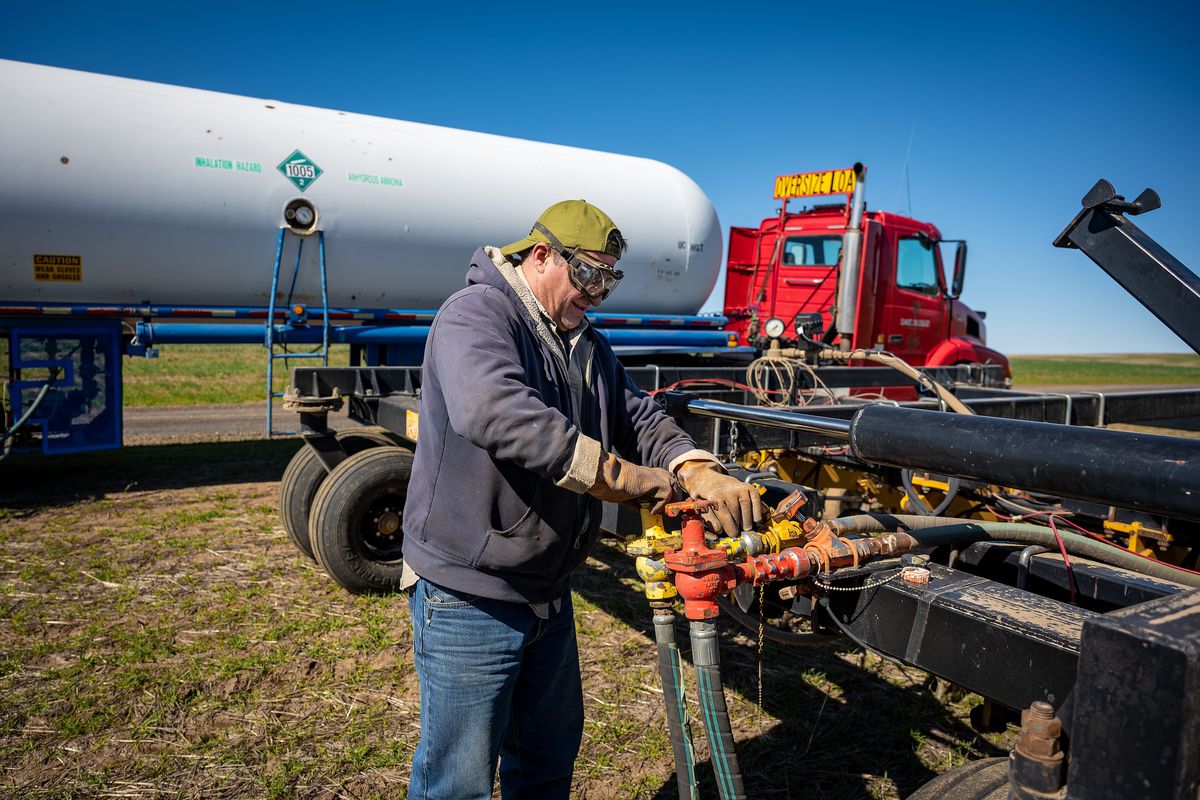
Trump announced that $12 billion bailout in December to help farmers and ranchers weather the economic storm caused by the taxes he placed on imports from nearly every country in the world, which prompted key U.S. trading partners to respond with their own tariffs on American exports. But growers in the Inland Northwest say they need more help to deal with the additional fallout from the war in the Middle East, especially fertilizer and diesel prices that have spiked since the war began.
“It’s a huge concern, because everything’s just going up drastically at the moment,” said Kevin Klein, who grows wheat, barley and canola near Sprague. “I’m currently in the process of putting my spring crop in, but I’ve locked in a lot of my inputs for that already, so I know where my cost is on that. When I plant my fall and winter wheat, and I have to fertilize in midsummer for that, that’s where those prices are going to be astronomical from where they are right now.”
Klein, who plants more than half his acreage in spring and uses less fertilizer per acre than farmers who get more rainfall, said he may be better prepared to withstand the economic shock than wheat growers on the Palouse and other relatively high-yield parts of the region, those who plant more of their crops in fall and winter, or those who waited until the last minute to buy diesel and fertilizer. Even so, he worries about the longer-term impact of the war on growers who were struggling to break even amid rising costs and business conditions that made Washington last in the nation for farmers’ take-home pay in 2024.
“For the farm industry in general, the timing couldn’t be worse,” said Doug Brock, executive director of the Far West Agribusiness Association, which represents companies that sell fertilizer and other products in Idaho, Washington, Oregon, Nevada and Utah. “The growers are already facing high input costs as it is, and this hitting right at planting season has been a huge deal.”
In 32 years in the business, Brock said, he’s never seen such a widespread and severe disruption to the products on which farmers and ranchers rely.
“It’s everything from the dry-land wheat guys, to irrigated agriculture, the high-dollar crops, potatoes, onions, tree fruit,” he said. “Heck, even the dairy and beef guys – it affects everybody. So I don’t think there’s any one group that’s just hurting. They’re all hurting from this.”
Although the U.S. and Israeli militaries quickly established air superiority and have pounded Iran from the skies, the government in Tehran has responded by effectively closing the Strait of Hormuz, a narrow waterway through which about 20% of the global crude oil supply and nearly a third of the world’s fertilizer passed before the war began.
Much of the natural gas produced in the Persian Gulf region is processed into urea and other solid forms of fertilizer that can be exported more easily than the gas itself. Babak Hafezi, an adjunct professor of international business at American University, said the strait’s closure – coupled with strikes from both sides of the war on oil and gas infrastructure – could set off a “domino effect” that leads to higher prices for food, energy and nearly anything else that needs to be transported around the world.
“Even if this war ends very, very quickly, we still have massive amounts of supply chain disruption akin to what happened during COVID,” he said. “In the domestic economy, we could actually see trucking – which has been hemorrhaging jobs for the past two years – even hemorrhaging more jobs because it becomes cost-prohibitive to ship things long distance via trucks.”
The national average price of a gallon of regular gasoline jumped a full dollar since the war began, from $2.98 on Feb. 26 to $3.98 on Thursday, according to AAA. AAA’s records show diesel prices shooting up even faster, to $5.38 on Friday up from $3.76 a month earlier. The price of urea futures rose more than 66% from $465.50 per ton on Feb. 27 to $695 per ton on Thursday, according to the commodities tracking website Trading Economics.
Unlike in poorer countries, Hafezi said, the United States will have access to food, fuel and other goods impacted by the war. But the destruction of petrochemical facilities means Americans are likely to pay more for those things for three to five years until infrastructure is rebuilt and global trade is rebalanced, he estimated.
A coalition of agriculture groups led by the American Farm Bureau Federation sent a letter to Trump on March 19, asking the president to include additional aid for farmers and ranchers in a request to Congress to pay for the war that will reportedly exceed $200 billion. Politico reported on March 5 that GOP lawmakers were considering adding $15 billion to that package, which Republicans would likely need to pass through the budget reconciliation process because nearly all Democrats oppose the war.
“More recently, as planting season began in earnest across much of the U.S., the closure of the Strait of Hormuz sent fuel and fertilizer prices skyrocketing – further straining a farm economy that already had its back against the wall due to record inflation, trade uncertainty, rapidly declining crop prices and catastrophic natural disasters,” the groups wrote. “Maritime freight disruptions from the ongoing conflict in Iran pose significant consequences to food security here at home and around the world.”
At the event celebrating National Agriculture Day, which he designated by executive order on Tuesday, Trump announced some additional measures aimed at helping farmers and ranchers, including enhanced loan guarantees and deregulation intended to let farmers use cheaper, lower-grade diesel.
Alex McGregor, chairman of the McGregor Company, a Colfax-based agricultural retailer, said there are other actions that could immediately take pressure off farmers. The president could eliminate duties on phosphate imports from Morocco, as the National Association of Wheat Growers highlighted in a report published Tuesday, or remove tariffs on nitrogen from Trinidad and Tobago.
“One of the challenges of the last three years or so has been that commodity prices have been weak for almost every commodity that we produce in agriculture, almost every crop, and costs have been high,” McGregor said. “And now you throw into it the closure of the Strait of Hormuz, and that is really troublesome in a lot of ways.”
If the war’s effects last beyond the current planting season, farmers may pivot to crops that are less dependent on fertilizer, said Tim McGreevy, CEO of USA Pulses, which represents growers of lentils, chickpeas and other dry legumes. Because those pulses fix their own nitrogen in the soil, they don’t require nitrogen fertilizer during the growing season, he said, but it can be hard for farmers to pivot quickly to another crop.
“You have these choices,” McGreevy said. “Should I plant a chickpea or dry bean? Should I plant canola? Should I plant wheat? Should I plant barley? All those are decisions that are being made right now at the farm level. And so it’s possible that farmers could choose to increase their pulse acreage because of the increased input costs. That’s the decision they may make, if it works within their cropping system.”
Some crops require specialized equipment and fixed overhead costs that make such a pivot less viable, said Chris Voight, executive director of the Washington State Potato Commission.
Potato growers generally try to buy about half of the fertilizer and fuel they need in advance, which may limit the short-term impact of higher input prices. But they don’t have the option of simply planting less to keep costs down this spring, he said, because they’re already locked into contracts to produce a certain amount of potatoes.
Like other crops, Voight said, what happens to the Northwest potato industry will depend largely on how long the war and its effects last.
“What’s going to happen in June and July?” he said. “Will the war be over? Will the prices come down? That’s kind of what we’re hoping for. Right now, I think we’re OK, but the big question mark is going to be what’s going to happen later in the year.”