
‘It’s the story of humanity’: NASA prepared for Wednesday launch of historic Artemis II moon mission
A cosmic reunion more than 50 years in the making is just around the corner.
NASA is preparing for a 3:24 p.m. Pacific Wednesday launch of the Artemis II mission, which will carry three American astronauts and one Canadian on a slingshot round trip of the moon – the furthest human spaceflight in history, as the agency barrels forward with plans to establish a lunar presence and send humans to Mars.
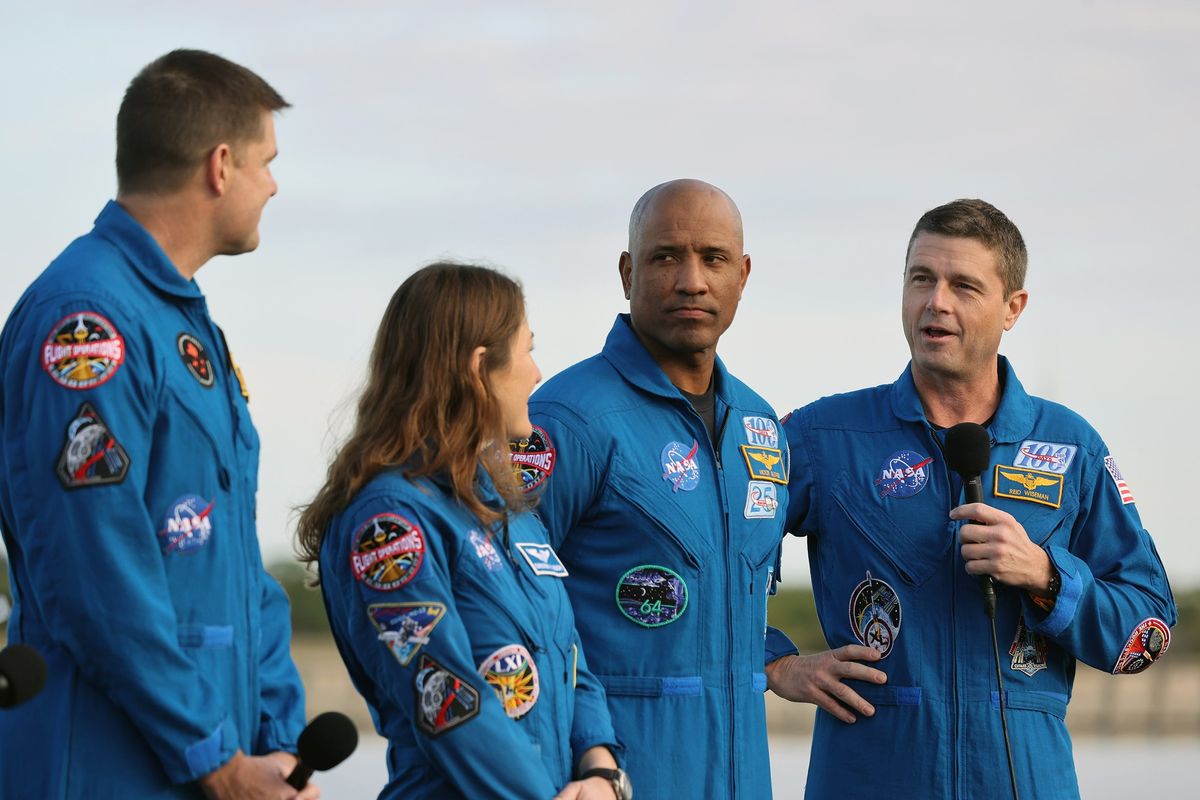
Commander Reid Wiseman will lead the mission. He is joined by fellow NASA astronauts Victor Glover, pilot, and Christina Koch, mission specialist. Jeremy Hansen, mission specialist, is the lone Canadian Space Agency astronaut on the nearly 10-day mission.
“We have to go for all and by all in order to answer humanity’s call to explore,” Weisman said as the crew arrived at the Kennedy Space Center on Friday.
Artemis II will carry mankind farther than any launch before, more than 4,000 miles beyond the moon in a looping, figure-eight flight path measuring around 685,000 miles in total length. NASA will provide live coverage of the lunar fly-by expected to occur on April 6, as well as the splashdown in the Pacific Ocean on April 10, through the agency’s YouTube channel and free streaming service, NASA+.
The crew will ride in the Orion spacecraft, which already took an unmanned flight around the moon in the Artemis I mission. The 11-by-161/2-foot capsule will be affixed to the top of a more than 300-foot-tall rocket, separate, then begin an elliptical orbit around Earth where the crew will stay for a couple days to conduct systems checks.
Washington-based Boeing was the contractor responsible for much of the moon rocket, or Space Launch System. Two earlier planned launches in February and March were delayed after issues with the helium and hydrogen systems were identified and repaired.
NASA associate administrator Amit Kshatriya said Monday that all systems look good ahead of Wednesday’s launch. The weather also looks promising. If Wednesday’s launch is scrubbed, there are additional opportunities every day up until April 6.
“The vehicle is ready, the system is ready, the crew is ready,” Kshatriya said. “And behind this flight stands a campaign: landings, a lunar base, of nuclear propulsion into deep space, that begins – not ends – with what happens on Wednesday evening.”
The mission will mark several firsts in human spaceflight and in distance, as well as for those aboard. Glover will be the first Black man to travel over the moon’s surface; Koch will be the first woman; and Hansen will be the first Canadian. All four crew members said in a Sunday news conference that while the superlatives are an interesting aspect of the mission, the milestones are not about “celebrating any one individual,” as Koch put it.
“If there is something to celebrate, it’s that we are at a time when everyone who has a dream gets to work equally hard to achieve that dream, and we’re at a time where we recognize the importance of it,” Koch said.
Glover said his thoughts about the firsts exist in a dichotomy between happiness and hoping that one day society does not need to remark on them. It fills him with joy that young women can look up to Koch and set their sights high, and that young people of color can look to him. But to him, it’s about the bigger picture.
“It’s the story of humanity,” Glover said. “Not Black history, not women’s history, but that it becomes human history.”
Hansen said he hopes his journey inspires not only those in the Commonwealth, but all international residents.
“It’s shocking to me, but pleasantly surprising, how many people show up and are going on a mission with us,” Hansen said. “It’s not just three Americans and a Canadian, it is people literally around the world. It’s a beautiful thing, and we’re going to go do something very real, very challenging, and that’s what will make it inspiring.”
Artemis II will be the first crewed flight out of the program, which seeks to send astronauts to the surface of the moon as part of Artemis IV by early 2028, where mankind will explore the lunar South Pole for the first time. The agency plans to send a manned mission to the moon ever year afterwards.
President Donald Trump issued an executive order in late 2025 seeking to ensure “American Space Superiority” that has added fuel to the fire in returning to the moon, establishing a lunar outpost and sending mankind to Mars. Artemis III, added in response to that directive, will be a test flight of the Orion capsule in low orbit to see if it will be able to dock with a lander made by private companies like SpaceX, Blue Origin or Boeing.
By late 2028, NASA hopes to begin constructing a moon base that will enable an eventual trip to Mars. From that base astronauts will attempt to solve the problems expected to arise with a trip to Mars, including food and water, communications and power generation. On the latter, Trump’s directive seeks to establish a nuclear generator on the moon, as the agency explores fission to efficiently travel farther into the solar system.
To achieve the lofty goals of the Artemis program, expedited by Trump’s desire to see them reached before the end of his term, NASA will need commercial partners, agency leaders said last week at a media event entitled “Ignition” as they shared details on future efforts.
“We have a mandate,” said Lori Glaze, an acting associate administrator at NASA. “We’re doing everything we can to focus all of our energy, our resources, into trying to establish that enduring presence on the surface of the moon.”
The Orion will use the moon’s gravity to swing back down to Earth. While aboard, the crew will conduct several experiments that will help ensure the viability of Artemis IV and subsequent missions, including experiments looking at their own cells, radiation effects on technology and the necessary exercise and operational psychology, Glover and Weisman said.
“Even though this mission is not going to the surface, we are starting some of the processes that we think are going to help them be successful, physically, emotionally and mentally,” Glover said.
Many look up at the moon and wonder, but even fewer can gaze upon the glowing orb and consider it a destination. Koch touched on the significance of the moment Sunday.
“It is our strong hope that this mission is the start of an era, where everyone, every person on Earth, can look at the moon and think of it also as a destination,” Koch said.