Prospect Colt Emerson’s $95 million contract worth risk for Mariners | Commentary
I saw why Colt Emerson is a $95 million man.
And why he’s worth the risk that comes with his colossal contract.
In the sixth inning of Seattle’s 8-7 Cactus League win over Cleveland on Feb. 26, Guardians reliever Doug Nikhazy unfurled an 82-mph sweeper that didn’t sweep nearly enough. Emerson — the Mariners’ prodigious 20-year-old prospect — redirected a rope over twisting center fielder Angel Martínez.
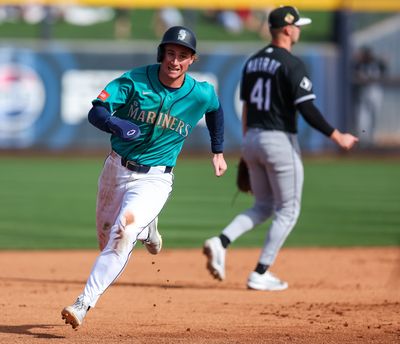
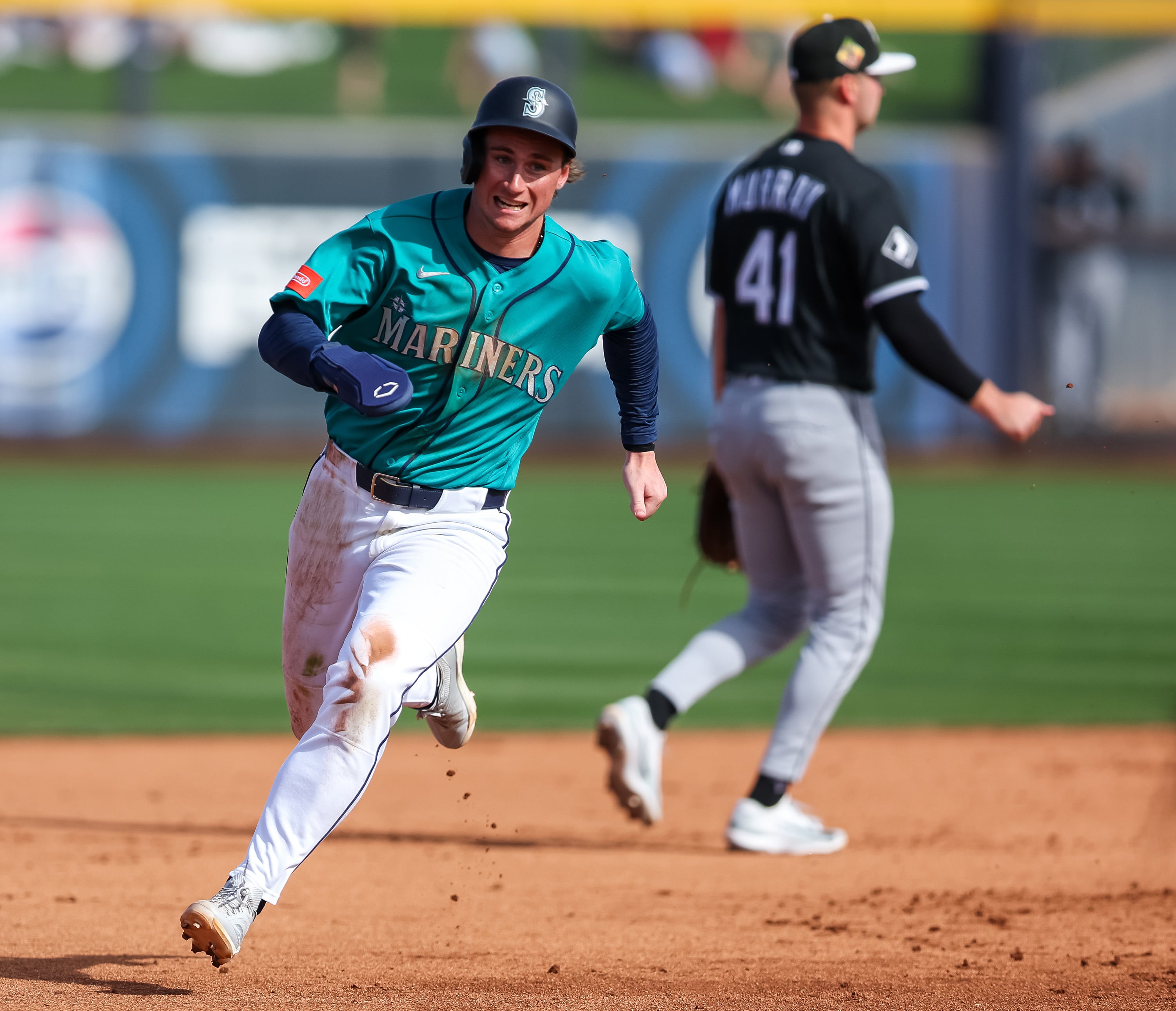
As the blistered baseball whimpered to the wall, the 6-foot, 195-pound Emerson entered overdrive. A swirling cyclone, he lost his helmet barreling around second base before diving headfirst into third. He was a blur of arms and legs and budding ability, caked in infield dirt. From the time his bat touched the baseball until when he dived into the dirt, the RBI triple took 12 seconds.
Emerson went 2 for 3 that day — sizzling a 96.9-mph single, a 101-mph lineout and the aforementioned 101.8-mph triple. The barrel rate, the athleticism, the motor … it was all on display.
As well as the maturity he’ll need to make it under the merciless microscope waiting in MLB.
“He threw a curveball in my damage zone, and I hit it,” Emerson said with a smile and a shrug. “Out of the box, I’m always going to run hard. I got a chance to show off some speed. Any chance I get, I’m going to play hard and be a winning player.”
The Mariners are betting that will continue to be the case for years to come.
On Tuesday, Seattle bet big on its shortstop of the future — agreeing with Emerson to an eight-year, $95 million deal. The contract includes a ninth-year club option, a full no-trade clause and escalators that could take the total to $130 million. It’s the largest contract awarded to a player without an MLB at-bat.
That’s a lot of money.
But the risk here is more than that.
The Mariners must also manage a potentially uncomfortable clubhouse dynamic, as the 20-year-old Emerson — who will remain in Triple-A Tacoma for the time being — makes more per year than franchise mainstays Logan Gilbert, George Kirby, Bryan Woo, Brendan Donovan, Andrés Muñoz and J.P. Crawford (who he’s expected to eventually succeed at short). The team’s typically immaculate chemistry is critical in maneuvering the dips and detours in a six-month marathon.
It’s on the Mariners’ leadership — manager Dan Wilson, standouts Cal Raleigh and Julio Rodríguez, etc. — to ensure Emerson’s dollar signs don’t upset the team’s existing equilibrium. And upon promotion, it’s on Emerson to earn the respect of his coaches and teammates and work like he’s making the major-league minimum.
Mariners president of baseball operations Jerry Dipoto and general manager Justin Hollander undoubtedly understand the risks. In 2019 they awarded a six-year, $24 million extension to first baseman and former first-round draft pick Evan White, whose defensive brilliance had yet to play past Double-A. Though he earned a Gold Glove with Seattle in 2020, White’s career was quickly sunk by injuries and offensive inconsistency. He last played in the majors in 2021, was traded to Atlanta in 2023 and is a free agent.
Or, consider another player projected to be Crawford’s successor. The Phillies drafted Scott Kingery in the second round in 2015 and awarded him a six-year, $24 million contract before Kingery reached the majors. After the two split time at shortstop in 2018, Crawford was traded to Seattle, and Kingery — put simply — never panned out. He’s accumulated a career 0.0 WAR in parts of six MLB seasons.
Likewise, there is no guarantee that Emerson will succeed where previous prospects wilted. Because injuries cannot be predicted or entirely prevented. Because the talent gap between Triple-A Tacoma and T-Mobile Park is exponentially more massive than the 35-mile drive. Because it requires a rare fortitude to withstand the pounding pressure that comes with being a premier prospect making that money. Because adversity, for athletes who have only ever succeeded, is an unfamiliar foe. Because Emerson, a Rainier, isn’t even old enough to buy one in a bar.
Another possible concern: for a relatively frugal franchise, Emerson’s extension pulls more money from a pot that should be used to extend Gilbert, Kirby and Woo in the seasons to come. Given Seattle’s pot is smaller than many others, the $11.8 million per year (on average) earmarked for Emerson matters.
So, then: why is he worth it?
Because, if Emerson becomes the player Dipoto and Hollander envision, the deal becomes a massive bargain on the back end. The Mariners can bypass arbitration and Emerson’s first three years of free agency, cementing their franchise shortstop in Seattle. And by doing it now, before other premier shortstop prospects such as Pittsburgh’s Konnor Griffin and Detroit’s Kevin McGonigle, they set the bar in a market that will only inflate. They spent today to save tomorrow.
The hope is to land a luxury: superstar production at a digestible price. See Braves right fielder Ronald Acuña Jr. — who signed an eight-year, $100 million contract in 2019. The five-time All-Star and 2023 NL MVP will earn $17 million this season, with club options in both 2027 and 2028.
That salary sits 94th in MLB — less than the likes of Andrew Benintendi, Taijuan Walker, Joc Pederson, Kris Bryant, Anthony Rendon and Yusei Kikuchi.
At age 19, Emerson combined to slash .285/.383/.458 with 16 homers and 78 RBI in 130 games last season across High-A, Double-A and Triple-A. He’s 13 for 36 (.361) with three homers, three doubles and 11 RBI in a nine-game sample size at Tacoma in 2025 and 2026.
But given the contract and accompanying vote of confidence, you better believe Emerson will be in Seattle sooner than later. And given Crawford’s impending free agency and diminishing defensive range at age 31, Emerson will almost certainly be the Mariners’ starting shortstop in 2027.
For Emerson, this is immediate, guaranteed, life-changing money. For the Mariners, it’s a big bet on a swirling cyclone.
Which, I think, is better than watching one blow away.