
Dishman Hills members share concerns about merger with Inland Northwest Land Conservancy
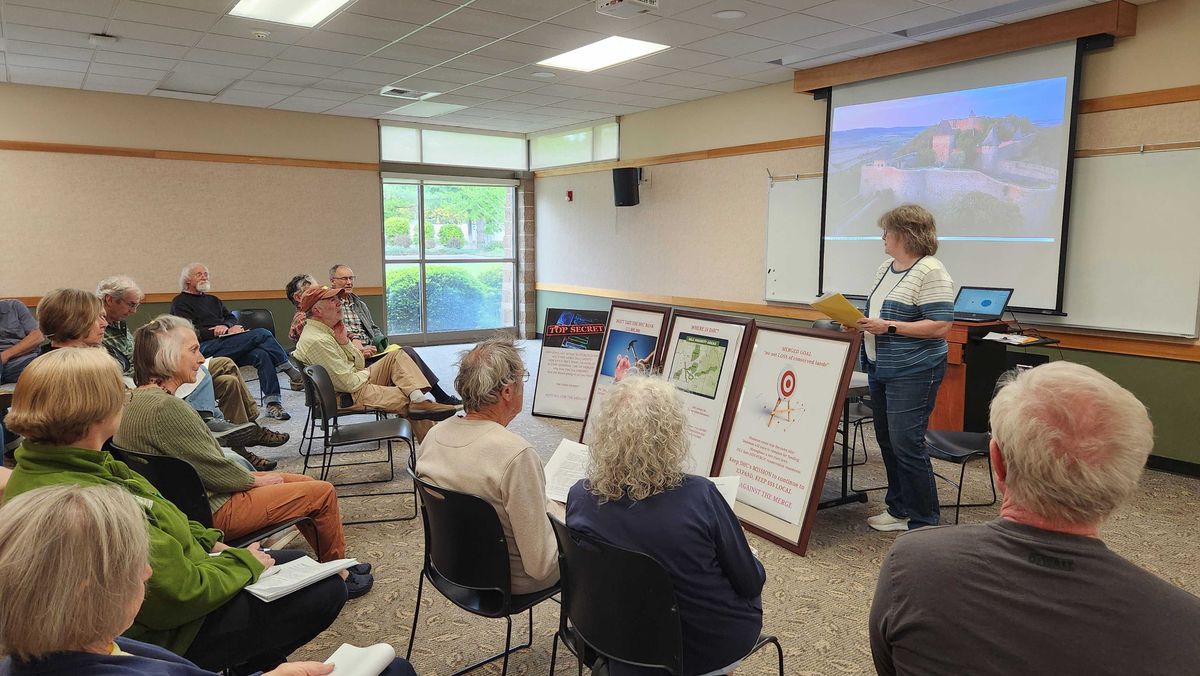
A month and a half after the Dishman Hills Conservancy and Inland Northwest Lands Conservancy leadership announced a potential merger, Dishman Hills members held an event urging fellow donors to consider the risks of such a move.
The nonprofits have discussed a merger on and off behind closed doors for decades, with leaders pointing toward similar mission statements and an increasingly strained land acquisition strategy on the Dishman conservancy’s side. Members were notified of the possibility at the end of March.
Many of those who attended the May 14 meeting criticized both organizations for what they said was a lack of transparency surrounding the discussions and shared concerns for the future of the Dishman Hills, which would essentially be absorbed by the larger lands conservancy.
“So, since DHC will be absorbed into the more regional and larger INLC, and given the substantial differences in their missions,” longtime Dishman Hills volunteer Steve Davenport said, “I have real concerns about how this merger will affect the local mission of DHC.”
The mission of the Dishman Hills Conservancy is to connect people to nature through conservation, education, recreation and stewardship while protecting the Dishman Hills. The Inland Northwest Lands Conservancy’s mission is to conserve, care for and provide connections with lands and waters essential to Inland Northwest life.
Members questioned whether the INLC would sell Dishman Hills land.
Bruno Caprez, who along with his wife Valaurie is one of the largest donors in the 60-year history of the Dishman Hills Conservancy, said in a presentation he was worried the Dishman Hills conservation area would fall behind the Land Conservancy’s other, larger priority areas, and that money made from any sales of Dishman Hills property would be reinvested in other locations.
“Anything I say, I’m definitely not against INLC. They’re a great organization,” he said of the land conservancy, but “one of my biggest problems is taking money that people have donated over the last 60 years, that have said ‘I like DHC, I like Dishman Hills,’ donating it to Dishman Hills, and then taking that and putting it someplace else.”
The Dishman Hills Conservancy is the oldest land trust in the state and functions by purchasing lands for conservation.
INLC also buys land and helps other agencies secure land for conservation. But about 60% of its strategy relies on conservation easements on private property, Executive Director Dave Schaub said.
Some members further shared consternation with the lack of clarity on who was considered a voting member in the Dishman Hills Conservancy (some people register as a couple) and the overall lack of communication between leadership and members concerning the proposed merger.
Schaub and Dishman Hills Conservancy Executive Director Ruth Gifford attended the Thursday meeting. Schaub said casually dropping news that the groups were considering merging was a “mistake” borne out of not developing a “fully formed communications and engagement strategy.”
“And so it was sort of announced and it landed like a ton of bricks,” he acknowledged.
He and Gifford clarified that donations made toward the Dishman Hills would remain allocated for that purpose in the event of a merger. Further, Schaub said that people would still be able to make a donation in the name of acquiring more land for the Dishman Hills area.
“Any donor can restrict a gift of any size by simply putting that in writing,” he said, adding that the organization’s website just doesn’t support that as a feature. Instead, agreements can be made via phone or in person.
Schaub said that his time on the Dishman Hills Conservancy board that prepared him for his current role at INLC.
“When I was interviewed for that position as the executive director, I said to the board, ‘if you hire me, I’m gonna do the work that Dishman Hills is doing, but I want to do it across our region because the way to get more land conserved is to connect people with places in their backyards, places that they love, places that they can get out and experience,’” he said. “And so what I would like to say is that I really see you, and I hear you, and I’m with you as a member of Dishman Hills and a conservation advocate for our region.
“We’re all on the same team. We’re all trying to see more of our beloved lands protected.”
To Gifford, a merger would ensure the Dishman Hills Conservancy can survive in an urbanizing environment.
“The ‘why’ in this is so many more things than a website that doesn’t clearly state who are members are, because I don’t have the staff to change that,” Gifford said, emotion in her voice. The Dishman conservancy has two employees, including Gifford. “So I need you to think about the future of DHC. That a merger, for us, means extending the life of this organization.”
After merging, the DHC land would remain as-is for recreational use, Gifford said. The only thing that would change would be an emblem on the sign.
But stakeholders remain cautious.
“I personally think we have to be very careful moving forward with any kind of change,” former DHC executive director Jeff Lambert said. “Because once one organization disbands or is no longer in existence, it’s pretty dang hard to undo.”
Members of both nonprofits must vote on the merger before it can occur. No timetable has been set.