
This day in history: Native peoples demanded action to prevent another ‘salmonless summer.’ Spokane leaders debated who controlled Riverfront Park

From 1976: Spokane’s new Riverfront Park was still a work in progress, but now a “deepening dispute” had erupted over who had control of the park.
Was it the Spokane City Council? Or the city’s Park Board?
City Councilman Wayne Guthrie believed that the park should be placed under the jurisdiction of the Sports, Entertainment, Arts and Convention Advisory Board, which is answerable to the city council. But the Park Board president said the city charter clearly gives his board control of all city parks.
Meanwhile, the park’s development was in danger of stalling.
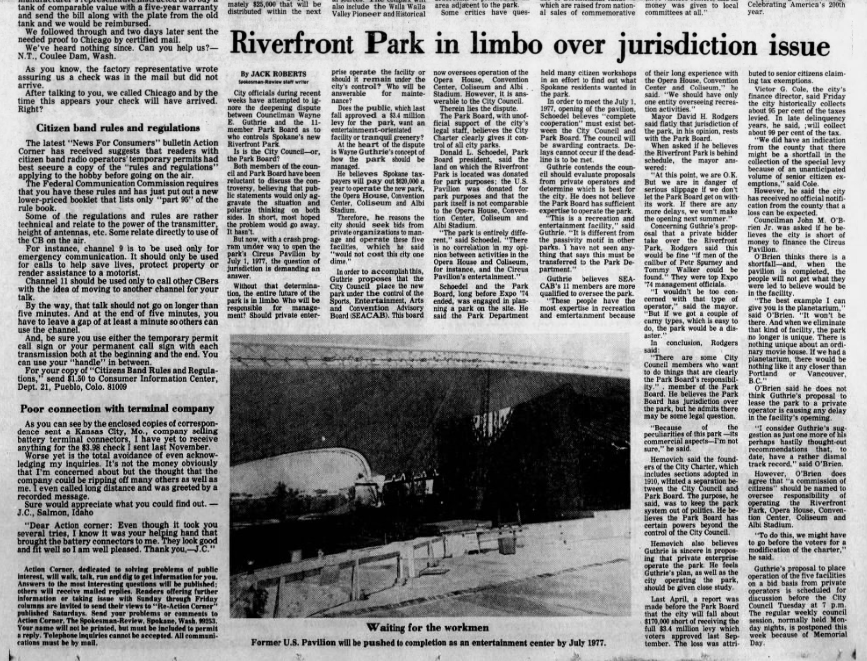
“But now, with a crash program under way to open the park’s Circus Pavilion by July 1, 1977, the question of jurisdiction is demanding an answer,” said The Spokesman-Review. “Without that determination, the entire future of the park is in limbo.”
Mayor David Rodgers said he believed the city should “let the Park Board get on with its work.”
Rodgers said he feared that otherwise, the park might be turned over to a “couple of carny types.”
From 1926: Members of the Methow-Okanogan tribes feared another “salmonless summer” and petitioned the federal Indian agent to intercede on their behalf to let them fish in their traditional spots.
“You white men have had your talk, now let me say a few things,” said Billy Tom, a tribal spokesman. “In the beginning, God made this earth and in it he planted the camas. He made the rivers and in them put salmon and trout. No white men or any other men did that – just God. Then he put the Indians here in this country – not any white men – just Indians. He told them that this was their land – and the camas and the salmon was their food for them to use as long as the sun shines. Then you white people came. You took most of this land and left us with small pieces … but now you won’t let us take any salmon.”
The Indian agent offered to do what he could to help them obtain salmon.