
March 5, 2011 in Idaho
Forest has ‘too many trees’
Coalition hopes to thin Colville National Forest
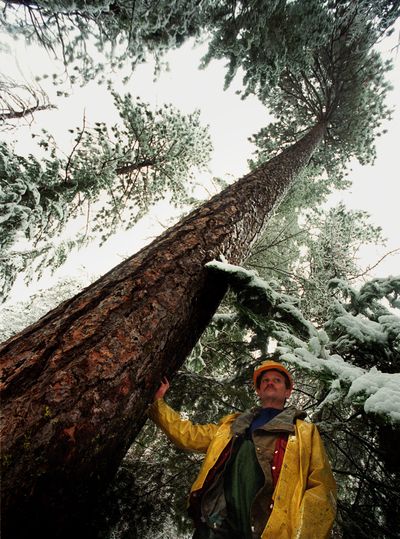
Can cutting trees help save a forest?
In northeastern Washington, a broad coalition of loggers, environmental groups, government officials and others think so. They’ve put together a forest restoration grant proposal that would step up timber harvests in the Colville National Forest over the next 20 years.
The grant request seeks $31 million for extra projects in the forest. The work would create an estimated 530 full- and part-time jobs in Stevens and Ferry counties over the two decades.
Most of the restoration logging is aimed at thinning dense stands of trees on the 1.1 million-acre forest. The tightly packed trees are the legacy of decades of fire suppression in the Colville National Forest, as well as past high-grade logging practices that cut the valuable timber and left the rest.
“You’ve got thickets of small-diameter trees that are 50, 60 or 70 years old,” said Mike Petersen, executive director of the Lands Council, a Spokane conservation group. “They’re choked, and they’re unnatural.”
Better spacing would reduce the risk of disease, insect attacks and high-intensity wildfires. Open stands would also help the trees weather the effects of climate change, which is expected to bring hotter, drier summers to the region.
“Having trees is a beautiful thing,” said Russ Vaagen, vice president of Vaagen Brothers Lumber Co. “But when you have too many trees, you’ve got a forest that’s going to fall in on itself. It’s like any overpopulation situation.”
Petersen and Vaagen are part of the Northeast Washington Forestry Coalition, an 8-year-old endeavor to find common ground on forest management. The coalition includes the timber industry, conservationists, local business owners and others.
Coalition members wrote the grant proposal in cooperation with the Colville National Forest, the Confederated Tribes of the Colville Reservation and the Washington Department of Natural Resources. Improving the vigor of trees in the national forest will benefit the tribe and the state, which own neighboring lands.
In late February, the $31 million grant request received a green light from the Forest Service’s Region 6, which covers Washington and Oregon. Now, the proposal heads to Washington, D.C., to compete for funding with restoration projects submitted by other national forests. A decision is expected in May.
The close collaboration by diverse parties has produced “what we feel is a highly competitive proposal,” said Laura Jo West, supervisor for the Colville National Forest.
If the proposal is funded, the Colville National Forest would harvest an additional 210 million board feet of timber over the next 20 years. In recent years, the forest’s annual harvest has averaged between 35 million and 60 million board feet of timber.
The 210 million board feet equates to about 42,000 truckloads of logs. The timber harvested would be a good fit for local sawmills that have switched to processing small-diameter timber, the Lands Council’s Petersen said.
All the material could be processed in the region as lumber or plywood, or chips or sawdust for pellet, pulp or biomass plants, Vaagen said.

Spokane7


berrybestfarm on March 05 at 7:32 a.m.
It’s always heartening to see groups traditionally opposed to one another finding common ground for the greater good.
Dennis Patterson—Deer Park
Ninch on March 05 at 7:54 a.m.
These are all local people working toward solutions that benefit their communities and surroundings. The key is to keep it local instead of having mandates/edicts and sitmulus/incentives handed down from the national level by politicians and bureaucrats with their one-size-fits all viewpoint. Local organizing to develop a restoration proposal for federal funds for a U.S. Forest empowers Ferry and Stevens County residents and is a model on how economic “stimulus” should be done.
BTW: The Colville National Forest covers a huge area and I have personally observed the overgrown forests that have come about because of fire suppression.
johnclarke on March 06 at 8:02 a.m.
Good thing forests have us to help them grow better, since they apparently can’t grow on their own.
“forest restoration” ha ha - and they want gubmint money ! Now that all the other trees have been clear cut, let’s move on to National forests AND get $31 million to boot.
Edw on March 06 at 8:54 a.m.
Silvaculture forestry is the best option. This is the old school model that works to create a healthy stand of timber, reduce fuel loads and expand a healthy environment for all wildlife. Pre-commercial thinning and a limited commercial thinning practice is far better than allowing it to just be burnt. Making wood products that sequester CO2, create and maintain jobs year round, protect our watershed from the ravages of fire, reducing it’s long term ability to store and release water slowly over the year are some of the benefits.
I do hope this is the direction things are going in this effort. The amount of the grant seems excessive, but if that is what it takes to keep the project going I would have to support it. I would hope that during the process of the grant being applied it would become self supportive again. I would encourage this aspect as I would suspect that the bureaucracy around this would try and make it only last as long as the grant, thus keeping the dependence on the lazy non-productive socialist bureaucrats employed.
There is also the danger of the economic feasibility of this being stressed by loading on regulations that have to carry the bureaucrats and artificially drive up the cost of doing business. I would hope there would be volunteer watchdog goop of people in place to help curb the bureaucratic suck and promote the self-supportive economic model to carry on.
The local community that functioned around this practice has been stressed economically in the past forcing local mills that supported this kind of resource management out of business. The cost of this grant to re-invent the wheel is a quantitative result of the earth first movement. Perhaps in the future the youngsters coming out of the academic environment will have the respect for what has been tried and true and work to be in harmony with the entire community including wildlife in a compassionate manner, rather than throwing out the baby with the bath water, One can only hope
Edw on March 10 at 9:40 a.m.
Johnclarke
Other local folks and I do not want clear cut logging, as this is devastating to the environment. Local folks are very attune to living in harmony with the environment and are part of it. The problems happen when large government / business make linear management decisions for forest practices based on the bottom line. Being stewards of the forest is our responsibility, as mankind’s presence on earth has become so pervasive. We as humans use wood products, that is a fact, this includes everything from toilet paper to massive timbers. If the local Colville etc. National forest are not managed for the wood fiber, plantations in the Southeast and even invasive species of trees in Africa are allowed to flourish destroying the natural environment there. The gross impact of making building materials for structures, like the one you are in right now, made of metal or plastic have a much more devastating impact on the global environment.
The fact is that properly managed forest do function better in being able to clean the air of CO2 sequestering it, that is another global environmental issue. The forest do grow better when they are spaced at a distance where light and moisture can reach the entire forest including the forest floor. When unattended they can grow so tight that they as individual trees struggle for available light and moisture staying small as a result. The ground under is void of most life as little else can grow there.
I do not know what planet you live on where ALL THE OTHER TREES are clear cut perhaps it is that way in the city where you live, so I can not respond to that. The vast open areas of devastation on the Colville national forest are as a result of forest fires being ALLOWED to burn, driving up the value of timber for the, large timber companies supplying grants for their minions to appeal all logging sales on the Colville National forest etc.
I do not know what gubmint is, perhaps it is your local slang. But I would encourage you and others that throw out your uninformed quips about issues that you do not know much about, to think globally and act locally from an informed base of understanding including the view from the local people, that you would subjugate with your collective ignorance.