
Tribe pledges funds for lake
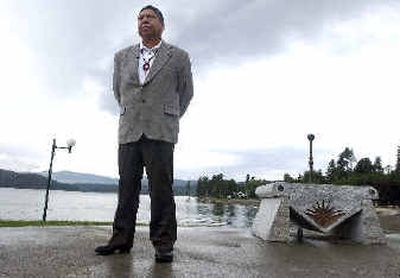
Coeur d’Alene Tribal Chairman Ernie Stensgar stood at Independence Point on a cool, overcast Tuesday morning and, with the waters of Lake Coeur d’Alene behind him, pledged $5 million in tribal money to address water quality issues.
Stensgar challenged the Idaho and federal governments to match the $5 million, creating a fund assuring the lake remains healthy despite tons of toxic mining wastes that prompted the federal Environmental Protection Agency to declare the Coeur d’Alene Basin a Superfund cleanup site two years ago.
State and local governments and business interests had lobbied hard that the lake itself not be listed as part of a Superfund cleanup. The stigma of such a listing, the argument went, would be a crippling blow to the region’s tourism-based economy.
The EPA agreed that if Idaho and the tribe would monitor Lake Coeur d’Alene water quality through a separate lake management plan, eventually the lake could be “de-listed” from the Superfund cleanup.
But there has been a rub between the tribe and the state over funding a plan; it has created enough friction during the past two years that, by late morning Tuesday, Stensgar issued the tribe’s challenge.
“I am glad the tribe is finally throwing down the gauntlet. They are walking the talk,” said Barry Rosenberg, executive director of the Kootenai Environmental Alliance and one of the few spectators at the announcement.
The friction burst into open flame two months ago, when the Idaho Department of Environmental Quality announced it would go ahead and push for the adoption of its own lake management plan if it couldn’t work on one jointly with the tribe.
Stensgar and other tribal officials said in June – and again Tuesday – they oppose the adoption of any plan when there is no money to fund any actual cleanup.
“The tribe’s position is simple: If there is no money, there is no plan,” Stensgar said.
Tribal officials plan to discuss money issues for Lake Coeur d’Alene cleanup and monitoring with the Idaho congressional delegation and state officials.
Ed Tulloch, regional water quality manager for the DEQ’s Coeur d’Alene office, said Tuesday afternoon, “The state is in total agreement that to have an effective management plan you have to have adequate funding sources.”
But, Tulloch said, his agency has been hammered in recent years as Idaho’s Legislature has cut state budgets.
“We have to have a funding source that can be sustained,” Tulloch said. “But when we have the fiscal situation that has befallen the state of Idaho over the last few years, there is always a question how something like lake protection and water quality protection will fare given the financial crises.”
Tulloch said the DEQ would prefer one plan to monitor water quality threats for the entire lake, instead of the state and the tribe having separate plans for waters under their sovereignty. The state and tribe largely have the same cleanup objectives. Tribal officials have no quarrel with technical staffers like Tulloch.
“This has nothing to do with science. This is all about Superfund stigma,” said Phil Cernera, restoration coordinator for the Coeur d’Alene Tribe. Cernera swept an arm south and pointed at expensive houses dotting the conifer-covered hillsides above Kidd Island Bay in the distance.
“Has not this community grown like wildfire in the last 15 years? Are there not millionaires coming to build houses here?” Cernera asked. “There is no stigma.”
Cernera said tribal officials fear there is politics behind “keeping the lake out of the (Superfund) cleanup plan, then creating a lake management plan that is just a paper document, and then getting the lake de-listed.”
“We have pollution on the bottom of the lake, and more pollution is coming in every day,” Stensgar said.
Heavy metals such as cadmium, zinc and lead have washed down the Coeur d’Alene River for the past century and more from Silver Valley mines and mills, with an estimated 77 million tons covering the bottom of Lake Coeur d’Alene. The metals need to be monitored for effects on water quality and human health, and hot spots need to be cleaned up, Stensgar said.
“We need a plan with realistic timetables on it,” he said.
“We have no choice,” said Bob Matt, director of the tribe’s lake management department. “If local folks want control of this lake, they have to step up and do their part.”