
Under your babyproof roof
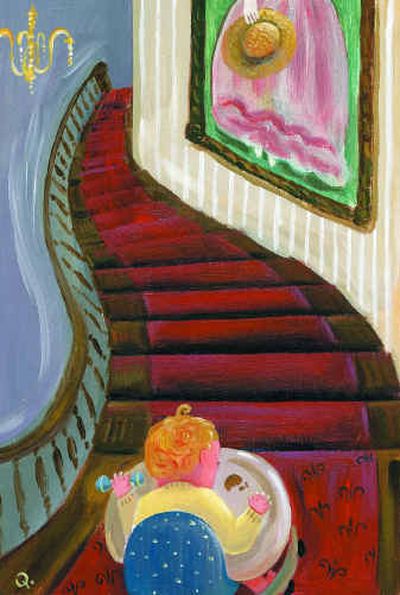
There are some safety hazards that parents of babies and toddlers find obvious: the jug of drain cleaner under the kitchen sink, the razor on the edge of the bathtub, the stairs. Then, there are the hazards parents miss. The same ones curious babies seem to have a dangerous knack for finding.
“Electrical outlets are probably the best example,” says Bob Baker, owner of Kids Safe Childproofing, a Shelton, Conn., company that helps parents scout out home danger zones. “You would be amazed how many people take all kinds of precautions, but do nothing to protect their electrical outlets. The little plastic things you stick in them cost about 10 cents each, but I’ll go into homes and be shocked to see they don’t have them.” Another one is dried pasta: “Whenever I’m looking through a house, if I open the cupboards the kids can reach, I’ll find things like dried pasta or dog and cat food,” says Charlie Conway, managing director of Fairfield County Safe Kids, a nonprofit program. “Dried pasta is really a choking hazard, but when I quiz parents about that, they almost never guess it. The same thing for dried dog food.”
Enter the professional childproofer.
Baker has been visiting homes in Fairfield County, Conn., for five years, providing inspections and pointing out potential hazards. Parents also can buy safety devices and pay Baker to install them.
His fees range from a few hundred to a few thousand dollars, although he says most families spend about $500.
“What parents pay for when they get a good childproofer is a trained pair of eyes and somebody who knows exactly how to install these things,” says Baker, who admits that some products, such as cabinet locks, are not too tough to install. “But I can do in a half-hour what can take someone unfamiliar all day.” Conway says demand for childproofing services has increased so much, his organization plans to offer a similar service sometime during the next three months. Its fees have not been established yet and it is not booking appointments right now, but it is selling safety products it has used and tested.
“Parents are very safety-conscious these days, but they are also overwhelmed with all kinds of good and bad advice,” says Conway. “I think with our background as safety experts we can provide good, objective advice.” Indeed, Conway noted at a recent safety seminar for expectant parents at Greenwich Hospital, not every family needs every safety gadget on the market.
“Part of it is knowing your child,” says Conway. “Some are into everything, some never try to open a cabinet or stick their hand in a toilet. You can have very different kids in the same family. So you really need to respond to each child.” Toilet locks, he notes, are one of those safety gadgets that can be optional. “I’ll be the first to admit, a locked toilet is the last thing a guy wants to see at 2 a.m.,” he says. “But if you have a kid who thinks the toilet is like the sand and water table at preschool, then you need one.” You might not need to tether your bookcases to the wall, “unless your child thinks they are the jungle gym.” The most vigilant parents might want to take every precaution.
“One of the things I tell parents to do is have two inspections, one when the child starts to crawl, another when he starts to walk,” says Baker. “At those two different stages you are going to have different needs.”
There are a few safety items the inspectors say they wouldn’t go without. For Baker, it’s covers for electrical outlets. Among Conway’s favorites is a rubber duck that contains a thermometer to gauge the temperature of bath water. “You can’t rely on your own hands,” he says. “Adults have a difference tolerance for hot water than babies do.”
At a recent seminar, Conway took parents on a household tour and made safety suggestions for different rooms. Baker adds a few of his own suggestions to the list.
In the kitchen
Cabinets: Cleaning products are the obvious dangers and must be moved out of arm’s reach. So, too, do choking hazards including, dog and cat foots, pasta and nuts.
At the table: Be vigilant around hot beverages and with tablecloths, they can be pulled by a curious toddler, bringing down a cascade of hazards.
Consider installing cabinet latches and or magnetic latches (Safe Kids favors these). Consider to switching to placemats instead of tablecloths for a while.
The stove: Keep highchairs away from stoves, turn pot handles in while cooking and install knob covers, which allow you to turn on burners, but keep little hands away.
Buckets: Like toilets, they are a drowning hazard. Buckets with liquids should never be left unattended and always promptly emptied.
In the bath
The medicine cabinet: Be as careful with nonprescription drugs as you would be with narcotics. Many remedies look and taste like candy, and they have lots of kid appeal. Be especially wary of vitamins, which can be highly toxic to young children. Another tip from Conway: “Never equate medicine with candy.” And take note that the American Academy of Pediatrics no longer recommends the use of Ipecac syrup to induce vomiting.
Toilets: A small child’s center of gravity is in his upper body, so he is in real trouble if he falls in. “With small kids, the fear is drowning, with bigger kids it’s flushing things down the toilet,” says Baker.
Consider installing toilet locks.
The bathtub: Never leave a child unattended. Be mindful of slips and scalding hazards.
Use a thermometer to take water temperature before baths; never put a child in water that is hotter than 120 degrees. Conway notes that testing water with your hands is not ideal. Also consider putting decals made of a slip-resistant material on the tub bottom to prevent slippage.
Living spaces
Conway recommends crawling around on your knees — as a baby might — to seek out hazards from a child’s point of view. Look for sharp objects, cords and anything that can go into the mouth.
Consider wall straps for bookcases and armoires, and wall-mounted containers for blind cords, which can be a strangling hazard. Consider placing bumpers or edge guards on coffee tables. “These are all items that sort of depend on the kind of child you have,” say Conway, who warns parents against, “spending thousands of dollars on things they don’t need.” Smoke alarms: Put one in each bedroom and have at least one on each floor of the house, says Conway. Also install carbon monoxide detectors, he says.
House and yard plants: Some are hazardous if ingested. Consult with your garden center or florist for advice on what’s safe and what’s not.
Stairs: Attach gates at the top and bottom of stairs to keep kids safe from falls.
Other tips: Take a first aid or CPR class. Post emergency numbers, including one for poison control, by the telephone. Keep pocketbooks out of arm’s reach; they are filled with sharp objects enticing to toddlers. If money isn’t an issue, consider buying a portable defibrillator. Conway says they are a valuable household safety device; easy to use and potentially life-saving, if you’ve got the $2,000 to spare. Gate and lock pools. Conway recommends floating alarms, which can be triggered when an unattended child enters the water.