
First all-female team monitors bear population
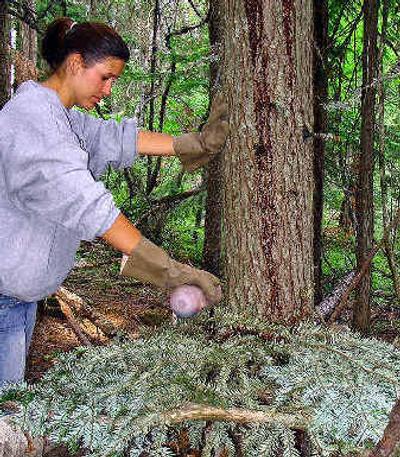
EASTPORT, Idaho — Rotting roadkill, cow blood and fish guts are the tools that Barb McCall and Kerri Lippert carry into the woods near the Canadian border.
Those smells attract bears, and it is the job of the two young women to catch, collar and release up to 20 of them this summer.
“I’ve always liked horses and dogs,” Lippert, 22, said while climbing through thick brush to check bear traps. “But I wanted to work with more exciting animals; ones that could eat you.”
McCall and Lippert are the first all-female bear-trapping team in the Idaho Department of Fish and Game. Every morning they get into a state pickup truck and crisscross Forest Service roads, looking for the next catch.
On a recent work day, the two checked seven traps they built and stocked with hacked-up deer carcasses. The smell of decomposing flesh extended in all directions, meant to attract bears to the spring-loaded cable snares.
Once a bear noses its way into the trap, it steps on a trigger and is snatched by the ankle. The women check on each trap every morning.
They approach the traps, armed only with an industrial-sized container of pepper spray to thwart any surprise encounters.
But when an angry black bear is there, the women tranquilize the animal. Then they measure and weigh each bear, install a radio collar, and yank a tooth to gauge its age. They slip away before the bear awakens, groggy but unharmed.
They name each bear they catch. One that woke up after being under for only 10 minutes was named “Antsy.”
The middle of summer is a poor time to catch bears, the women say, because the animals roam into high-elevation areas to feast on tasty huckleberries. To try and compete, the trappers have used anise oil, skunks, cow blood and fish guts to lure bears.
The bear trapping is needed because a new highway is being built through previously forested areas. Idaho Fish and Game wants to know if bears are using three new wildlife underpasses built beneath the new road, instead of lumbering into dangerous traffic on the highway.
The pair, working full-time, have caught five bears since the project began in early July, but they didn’t expect to hit the jackpot in the middle of summer. Most of this year’s work has gone into selecting appropriate sites and building the traps for use next spring, when bears will be more active at lower elevations.
To build a trap, logs are stacked 3 or 4 feet high in a funnel leading to a tree. A cable is attached to the tree and a 1-foot-wide hole near the entrance hides the trigger for the snare. They cover the hole with dirt and leaves. A series of sticks placed on the ground forces the bear to step in the trap hole. In the back of the trap, which now resembles a cave, the women place their bait and wait for a hungry bear to wander in.
Wayne Wakkinen, a wildlife biologist who oversees the project, said the department’s search for bear trappers turned up about half men, half women.
“The guys who grew up hunting and fishing just plain old aren’t qualified anymore,” he said. “There’s not a lot of people who know how to trap bears.”
Wakkinen, who said he picked the women because they were the most qualified for the job, said McCall was also certified to handle the tranquilizer drugs. He joins the pair occasionally to catch up on their progress.
The two live in an RV trailer next to a stream on Forest Service land. While the outdoors lifestyle is enjoyable, McCall said sometimes all she wants is a shower.
The job has its drawbacks. Deer and horse flies gnaw constantly at exposed flesh, for example.
But the two recent college graduates with wildlife degrees said they couldn’t imagine doing anything else
“This is the reason I got into wildlife,” McCall said.