
Lake CdA state’s top fishing spot

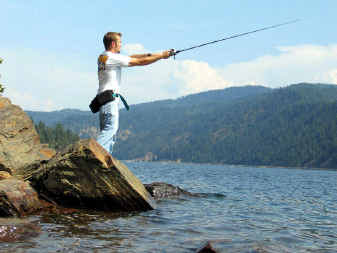
Lake Coeur d’Alene lures scores of beachgoers, party barge passengers and tourists seeking a soothing watery view.
But the best action seems to be below the waves.
A recent state economic impact study ranked the lake as Idaho’s top fishing destination, with 92,000 anglers spending at least a day on the lake last year and a total of $6.6 million. Statewide, anglers spent $438 million in 2003, with about a third of the money going to restaurants and grocers.
The hottest fishing spots in previous years typically have been Cascade and Brownlee reservoirs in the Boise area, said Mark Gamblin, state fisheries manager for the Idaho Fish and Game Department. The recent shift is the result of a lingering drought in southern Idaho combined with improved management of Lake Coeur d’Alene’s fishery, he said.
Those fishing the lake are relatively thrifty, spending an average of about $70 per day compared with an average of $112 per day on other lakes and streams, according to the survey of 25,000 anglers. The average price for a day on the Henry’s Fork of the Salmon River was about $350.
The big draw for Lake Coeur d’Alene is kokanee salmon, a landlocked species with tasty, blood-red flesh. The fish are relatively easy to catch, said Justin Kimberling, of Fins and Feathers sporting goods in Coeur d’Alene. A small boat, a weighted line and a kernel of canned corn on the hook are all that’s needed, he said.
“Kokanee are pretty easy to catch once you figure them out,” Kimberling said.
The key is finding the right depth. Once anglers find this level, the fishing is good, with some people reaching their daily limit of 25 fish in an hour, Kimberling said.
Although fishing slowed in late July, the kokanee are biting again and in two or three weeks, the fishing “should be explosive,” Kimberling said. And the eating will be sublime.
“I don’t care how you eat them – bake them, fry them, grill them, can them – they’re really good,” he said.
The burgeoning kokanee population is partially due to prime natural conditions, but fisheries managers also take some credit. The last time Lake Coeur d’Alene was the state’s most popular fishery was 1979, when about 580,000 fish were harvested, said Ned Horner, regional fisheries manager for the Fish and Game Department. This was back in the days of boom-and-bust fishing, he added. The high populations resulted in stunted fish and frustrated fishermen.
Chinook slamon, a predator of kokanee, were introduced to the lake in the early 1980s in an attempt to stabilize kokanee numbers. Fisheries managers have since tried to optimize kokanee populations by adjusting the annual stocking of chinook. Horner believes their efforts have paid off.
“This year it’s been just a phenomenal fishery with not only decent-sized fish but also good harvest numbers, too,” he said.
Nature doesn’t always cooperate, though. Floods in 1996 and 1997 flushed many of the kokanee out of the lake. The population quickly rebounded and buzz among anglers began building about two or three years ago. Barring another major flood, Horner believes the lake’s kokanee and chinook fisheries will maintain their stability.
Fish and Game officials hope the study will lend credence to the idea that a healthy environment supports a healthy economy. Part of the fish’s success has come from protecting spawning habitat and creating new spawning areas more than 20 years ago during the construction of the Interstate 90 overpass, said Chip Corsi, regional supervisor of the Fish and Game Department.
Corsi hopes the study will play a role in guiding development around the lake. “It helps to level the playing field with some of the other economic interests that are eyeballing a key piece of habitat for whatever reason.”
Being able to fish near home was one of the reasons that prompted Brian Griffith to leave Southern California for North Idaho. Griffith lives in Post Falls and spent part of Monday afternoon fishing near Higgens Point.
“You’d never be able to do this down there,” he said, casting his lure into the waves. “I wasn’t really having a good day at work so I thought I’d come outside for some fishing and hopefully save my Monday.”
The fish weren’t biting, but Griffith said he subscribes to classic bumper sticker wisdom: A bad day fishing is still better than a good day at work.