
Golden opportunity vanishes
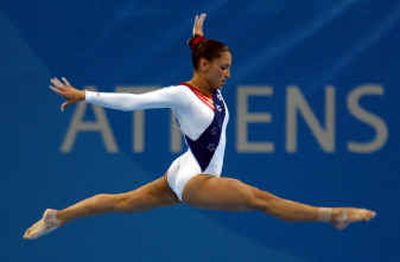
ATHENS — The critical eye, firm hand and warm embrace of Bela Karolyi have molded women’s gymnastics for the past three decades, producing the perfection of Romania’s Nadia Comaneci in 1976 and the sparkle of America’s Mary Lou Retton in 1984.
Tuesday at the 2004 Olympics, he was relegated to the role of spectator as the six U.S. gymnasts hand-picked by his wife, U.S. national team coordinator Martha Karolyi, marched into the Olympic Indoor Hall to reclaim their country’s place among the world’s gymnastics elites.
But with their two stars faltering at critical moments — Carly Patterson committed a costly error on the uneven bars and Courtney Kupets, competing with a sore leg, had a misstep on her floor routine — the heavily favored U.S. women walked off with silver. The gold medal went to defending Olympic champion Romania, whose gymnasts drew gasps for their virtuosity on the balance beam and floor. Russia claimed bronze.
While U.S. head coach Kelli Hill stressed the positive, noting her squad had just snapped an eight-year Olympic medal drought, Karolyi hardly needed words to express the obvious as he embraced his wife afterward. “It was a courageous and strong performance,” Karolyi told her, his tone more consoling than celebratory. “It is nothing to be ashamed of.”
Turning to Hill, he offered simply, “It’s OK. It’s OK.”
It was a riveting competition, with the lead changing hands between Romania and the United States three times. Kupets propelled the United States into first place with the night’s best performance on the uneven bars (9.662) but was forced to withdraw from the balance beam competition because of her sore leg. With only a few moment’s notice, alternate Mohini Bhardwaj stepped in and delivered a solid 9.40 on the trickiest apparatus, preserving the U.S. medal hopes.
The separation among the top three countries remained so razor-thin until the last routine — with Romania on the floor exercise — that the U.S. women, who had finished their routines moments earlier, had no idea if they were in line for gold, something less or nothing.
For Kupets, winning silver was hardly cause for disappointment.
“That’s what you think about when you go to the Olympics — people winning gold,” Kupets said. “But that shouldn’t be how it is. We have a medal, and that’s just awesome. It’s the coolest thing I think we could ever accomplish here, so we’re proud of ourselves.”
The U.S. women arrived in Athens with enormous expectations after being shut out of the medals at the 2000 Olympics. U.S. gymnastics officials responded by overhauling the way the country prepared its elite athletes, putting Martha Karolyi in charge. She brought the girls together for monthly training camps to push and inspire one another and soon had more elite gymnasts than she knew what to do with. Ten world championship medals followed, including the country’s first team gold at the 2003 World Championships. The squad assembled for Athens was hailed as the best U.S. Olympic team ever.
The U.S. opened on vault, its weakest event, but acquitted itself thanks to Bhardwaj and 26-year-old Annia Hatch. Romania was slightly better and took the lead, by 0.050 points, after the first rotation.
Up next was the uneven bars, and Patterson stumbled badly by pausing to summon her strength during the routine. Judges deducted heavily for her lack of fluidity. Kupets got the U.S. back on track, but the Americans marched on to the balance beam without her, sending Bhardwaj to take her place. Bhardwaj turned in a polished routine, but the U.S. lost ground because her routine wasn’t as challenging as Kupets’.
No country’s gymnasts shine on the devilish balance beam like Romania’s. They dazzled, with Catalina Ponor eliciting cheers for her daring, style and grace.
That left the floor exercise to sort out the medals.
Russia’s rail-thin Svetlana Khorkina, competing in her third and final Olympics, drew rousing applause for her stylish routine but couldn’t lift her country above bronze.
Kupets was up first for the United States and showed no sign of injury on her tumbling passes. Her downfall was a relatively simple dance move — a leap that followed a pirouette. Kupets got off balance on the pirouette and couldn’t complete the jump, causing judges to pare back her score to 9.187.
Bhardwaj and Patterson followed, but neither displayed the degree of difficulty or showmanship that the Romanians did.
Once again led by Ponor, who scored a 9.750, the Romanians ended with a flourish, claiming gold with 114.283 points to the Americans’ 113.584. Russia had 113.235.