
Hard work helps overcome challenges
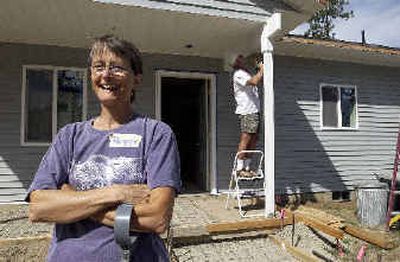
PEGGY CAPES WAS CERTAIN she could accomplish just about anything with hard work. The brace on her left leg from her foot to her lower thigh was invisible to her. She’d worn it since 1948 when she was 3.
Polio had hit her before her second birthday and it had left a big footprint. But Peggy was so young that its effects seemed normal to her.
Her parents had taught her self-sufficiency and the potential of hard work and education. Peggy lived her adult life according to those lessons. She took care of other people, helped them overcome hurdles in their lives.
So when post-polio syndrome descended on her a dozen years ago, exaggerated her limp and stole her energy, Peggy found herself needing help over hurdles, and it hurt. But Habitat for Humanity erased most of the sting.
“I was a professional in the community. To be out of the closet as a person in need is hard,” she says. “But the help I gave people for so many years all came back to me. It’s just amazing.”
Post-polio syndrome is a nasty postscript to polio. It hits about 25 percent of polio survivors 10 to 40 years after the disease runs its initial course. Peggy’s friend and co-worker at Kootenai Medical Center had post-polio syndrome and recognized it in Peggy.
Peggy directed the emergency room social work department at KMC. She’d earned master’s degrees in education and social work and developed the KMC program. Early in the 1990s, Peggy noticed that an office that she often visited on the other side of the hospital had begun to seem so far away.
Her friend recommended a rehabilitation center that tested for post-polio. Peggy sat on the information.
“If you don’t know about it, it isn’t there,” she says. “I didn’t want to know things were changing in that direction.”
She finally went in 1992 because her energy was obviously low and her limp was worse. She returned with a diagnosis, crutches that corrected the limp and a suggestion she use an electric cart in the hospital. She was crushed.
“I had pretended I had no disability for years,” she says.
Peggy pushed past her pride and discovered an electric cart helped so much with her job. She continued to work until she couldn’t recover from her exhaustion. A month off didn’t do the trick. Friends advised her to apply for Social Security disability benefits. Peggy was still in her 40s. She couldn’t imagine not working.
“I’d worked so hard to get where I was,” she says. “If I don’t do this, then who am I?”
She applied for disability in 1996 and immediately was approved – a rare occurrence. For two years, Peggy worked on her wounded psyche and body in the healing waters of Boulder Hot Springs in Montana. The birth of her first grandchild brought her back to Coeur d’Alene in 1998.
She moved in with friends and cared for their children in exchange for rent because disability paid her only $800 a month. But she needed the privacy of her own place. Part-time work and a housing subsidy to help with rent seemed the answer. Idaho Housing granted her the help, so Peggy rented a low-cost apartment. She took a job with the Coeur d’Alene School District in a developmental preschool and started her own business caring for seniors.
With a healthier budget, Peggy decided to look for a home of her own. But even lower-end houses in Coeur d’Alene were too much.
“I wouldn’t buy a home I couldn’t pay for,” she says.
A friend suggested Peggy contact Habitat for Humanity. The nonprofit organization helps working-poor families build and buy their own homes.
“I figured it was for indigent people who couldn’t do it on their own,” she says. “That wasn’t me.”
She dropped the idea of owning a home. Then her friend repeated her suggestion about Habitat. Peggy called the organization two years ago. Habitat wasn’t taking applications at the time but called Peggy a few months later to encourage her to apply. She did apply, but couldn’t shake the thought that other people needed the help more than she did.
Habitat’s selection committee interviewed her, checked her credit, which was good, approved her application and assured her she wasn’t taking a house away from a needy family. Long-time Habitat volunteers Warren and Deb Fisher adopted Peggy. They helped her prepare for her life as a homeowner. Peggy was so impressed with the Fishers, who invited her to their home for dinner monthly, that her perspective of Habitat changed.
“The basic tenet of Habitat is to eliminate poverty housing worldwide, one family and one house at a time,” Warren says, as he adds the finishing touches to a door in Peggy’s emerging house. “But its second tenet is building community, and this house facilitates that.”
The location Habitat offered Peggy was Rathdrum. She’d wanted to stay in Coeur d’Alene but not enough to lose her chance for a home. Habitat of North Idaho usually builds three homes a year, but the whole process takes about two years. Peggy began planning to leave Coeur d’Alene.
The lot Habitat had bought was long and narrow. Its usual house plan wouldn’t fit. Deb helped Peggy adapt a house plan to the lot size and her needs with design software.
“This is not typical,” Deb says. “Peggy and I sat at a computer and moved things around. After we added a window to the living room, we noticed that it looked out on a shed. So we moved the shed on the plans.”
Habitat requires new homeowners to invest 250 hours of volunteer labor in the program. Peggy was limited physically. She never had owned a hammer. But her hard-work ethic kicked right in. She dropped her crutches and shoveled at houses already under construction. She laid floors, raised walls, even pounded shingles on a roof with Warren’s support. She installed insulation, Sheetrock and door jambs, careful to portion out her energy so she could continue to work.
“I don’t see how anyone who has a Habitat house can’t adore it with all the work they put into it,” Peggy says.
She worked 500 hours, then volunteered for the Habitat committee that helps select families for new houses.
“I know what those people are going through,” she says. “I will continue to volunteer for Habitat. It’s an incredible organization.”
She plans to move into her new two-bedroom ranch home Sept. 19, the day after a dedication ceremony. Hallways and doorways are wide enough to accommodate a wheelchair, although Peggy doesn’t know that she’ll need one. She already knows where her vegetable and English gardens will go. Volunteers even built a small cat door to the outside in her laundry room. And Rathdrum has grown on her.
“I’ve developed a love for Rathdrum. It’s a sweet town,” she says. “I like living in a small community.”
She never doubted that she could accomplish anything with hard work. Habitat proved she was right.