
Just checking up
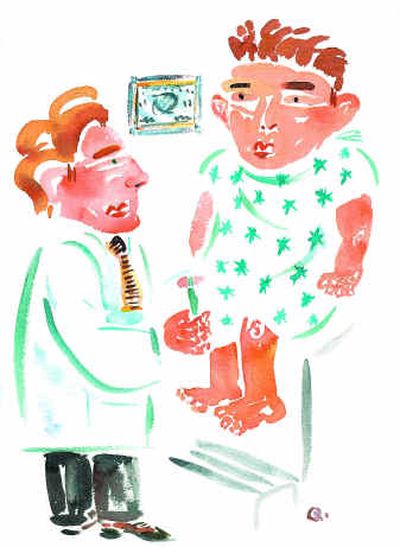
THE ANNUAL PHYSICAL — that yearly head-to-toe once-over by the family doctor — appears itself to be getting a check-up. Increasingly, doctors are recommending that most healthy people don’t need an annual exam. “If you feel great, especially if you’re young and have no symptoms, the doctor is not going to discover anything untoward …,” says Dr. Brian Budenholzer, a family physician at Group Health’s South Regal Medical Center.
But, Budenholzer and others say, unnecessary tests can wind up leading to more tests and anxiety because of lab errors or false-positive results.
“America has overdone things for so long we think not overdoing it is underdoing it, and that’s a bad thing,” he says. “It doesn’t do anyone any good. … That boosts health-care costs. That causes layoffs at hospitals. That unnecessary care, in terms of the effect on the net population, produces more harm than good.”
That doesn’t mean you should never see the doctor. Far from it, experts say. It just means that the one-size-fits-all physical exam is no longer the best medicine.
The popularity of annual physicals dates back to the early 20th century, when the government started screening World War I recruits, says Dr. Carolyn Clancy, director of the Maryland-based Agency for Healthcare Research and Quality.
“A number of abnormalities they found weren’t terribly relevant” such as flat feet, Clancy says. “Still, the idea had a lot of appeal, sort of like bringing your car in.”
In later decades, though, doctors have begun thinking more in terms of early detection and prevention of specific diseases, she says.
“Once you start doing that, the concept of an annual physical really has less meaning,” Clancy says.
For example, Clancy’s agency recommends that men should have their cholesterol checked every five years, starting at age 35. But men who smoke, have diabetes or have a family history of heart disease should start getting cholesterol tests at age 20. And women who have normal Pap smears year after year may only need to have the cervical cancer screening test every three years.
“For the average woman not a high risk, getting a Pap every three years will be the equivalent of getting one every year,” Budenholzer says.
The American Medical Association has no policy on when or how often people should undergo checkups, preferring to leave that up to the discretion of individual physicians. The same is true for the U.S. Preventive Services Task Force, a group sponsored by Clancy’s agency.
“There’s no magic number here,” Clancy says.
Insurance plans vary widely, but most will pay for preventive care. Most Premera Blue Cross plans have a preventive-care benefit, spokesman Chris Jarvis says. And Group Health covers “well-care visits” under most plans, spokeswoman Jean Waght says.
In general, doctors say, a patient’s 50th birthday is a good time to get checked for several conditions. That’s when most women, those without significant risk factors, should start getting mammograms. And it’s also when both men and women should get screened for colorectal cancer.
All doctors have different ideas on regular checkups, however.
Dr. Jolene Berg, a family practice physician in Coeur d’Alene, likes to see her patients at least once a year.
“A physical isn’t necessarily going to be defined the same way for every person in every age group,” Berg says. “But I think it really gives me a chance to get to know a person well and get to have a picture of their total health.”
Berg spends much of her time talking to her patients about their medical history and about their lifestyles, she says. She counsels them to make behavioral changes, such as losing weight or quitting smoking or wearing their seatbelt.
She uses those findings to help her determine which blood tests and screenings to order.
“I really try to direct what I do for each individual person,” Berg says. “I don’t routinely say everyone coming in for physicals needs to have all these blood tests done ahead of time.”
The U.S. Preventive Services Task Force uses scientific evidence to determine which screening tests are useful and how often they should be performed.
For example, the group of private-sector experts found insufficient evidence for or against routine screening for prostate cancer. The task force found that such screenings can detect early-stage prostate cancer but found mixed and inconclusive evidence that detection makes a difference in the patient’s health.
Plus, they found that screenings frequently lead to false-positive results, unnecessary anxiety and further tests.
Clancy tells the story of a colleague who had an abdominal scan in which doctors found what they thought was a pancreatic tumor.
The man thought he might die at any time, Clancy says. He and his wife went for an around-the-world cruise. But he has since had more scans, and nothing has grown or changed.
The mass was simply an abnormality of his anatomy.
But, Clancy says, “The anxiety there is amazing.”
Doctors stress, though, that patients must take an active role in their care. They should be aware of their medical history, and they should know when their lifestyle puts them at risk for certain conditions.
“Don’t just wait for the doctor-as-maestro to conduct this little symphony,” Clancy says.
And, of course, if you think something’s wrong with your health, don’t wait.
“If you cough for a month or two or three, there’s something wrong,” Budenholzer says. “It’s better to go in and get it checked out. …
“Anytime you’re having any kind of persistent or recurring symptoms, getting in to seeing your physician is a good idea.”