
Guantanamo war crimes trials begin
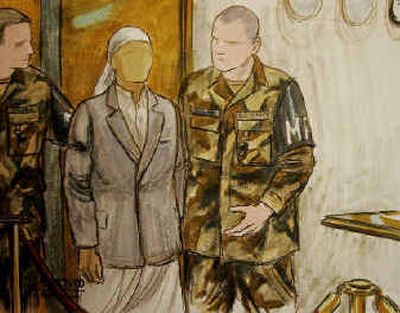
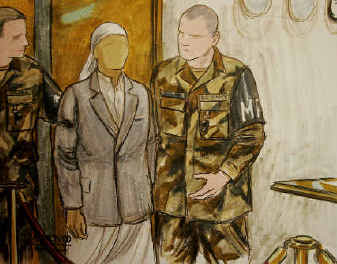
GUANTANAMO BAY NAVY BASE, Cuba – Opening the first American war crimes trials in 60 years, the U.S. government on Tuesday charged a Yemeni who worked for years as Osama bin Laden’s chauffeur with conspiracy as a member of the al Qaeda terror network.
Tuesday’s military commission session marked the first time a captive held in this terror prison has been publicly displayed and formally charged.
Through his lawyer, Salim Hamdan, 34, has admitted to driving al Qaeda leader bin Laden around his farm in Kandahar, Afghanistan, but he denies U.S. allegations that he joined his boss’s worldwide network before or after the Sept. 11, 2001, attacks. The charges don’t accuse him of any specific violence or planning any attacks.
At first seeming dazed, Hamdan, who’s been held captive at Guantanamo for more than two years, flashed a grin when he was led into court, unshackled but guarded by two soldiers.
He stood beside his Pentagon defense lawyer while he heard the charges against him read in Arabic. After he was asked a series of yes or no questions about whether he understood that the charges included conspiracy to murder, attack civilians and commit terror, he grinned again.
The charges carry sentences of up to life in prison.
Pentagon charge sheets allege that Hamdan, who has a fourth-grade education, a wife and two daughters, transported weapons to al Qaeda operatives, trained at an al Qaeda camp and drove in convoys that carried bin Laden.
Navy Lt. Cmdr. Charles Swift, Hamdan’s Pentagon paid defense lawyer, has said his client is eager to prove his innocence and in the meantime has challenged the legitimacy of military trials in civilian U.S. courts.
The daylong courtroom sparring, particularly between Swift and the presiding officer, Army Col. Peter Brownback III, reflected the controversy that surrounds these trials, designed by the Bush administration to combine pre-World War II military justice and post-Sept. 11 security rules that permit both secret and hearsay evidence.
“We’ve spent a lot of money to get six people here to look at Mr. Hamdan across this table,” Brownback said of the five commission members and single alternate who will decide the law and facts in the case. “We’re here so six people can carry out the president’s order – to provide a fair trial for Hamdan.”
Aside from formally charging Hamdan, the focus of the day was the defense questioning the suitability of the six U.S. officers chosen by a Bush administration appointee to judge the accused terrorist.
Two served in the late-2001 U.S. invasion of Afghanistan – one on the ground and another at Central Command headquarters in Tampa – as senior officers in operations that captured thousands of detainees and toppled the Taliban. Hamdan was captured there and transferred 8,000 miles by air bridge to this Navy base in southeastern Cuba.
A third, a Marine colonel on the panel, revealed that a member of his reserve regiment was a firefighter killed in the World Trade Center attack. He attended the funeral and went to Ground Zero two weeks after the attack.
“It was a sad sight, a lot of destruction there… . I would imagine that everyone who saw it was angry,” said Col. Jack K. Sparks Jr., chief of staff of the Marine Corps Combat Development Command.
The alternate, Army Lt. Col. Curt S. Cooper, admitted under questioning that he had not read the Geneva Conventions that protect the rights of prisoners of war around the world.
“Do you know what the Geneva Convention is, sir?” Swift asked.
“Not specifically, no sir, that’s being honest,” Cooper replied.
He said he planned to go back and read the three conventions. “Actually, there are four, sir,” Swift replied.