
Farmer preserving native Oregon prairie
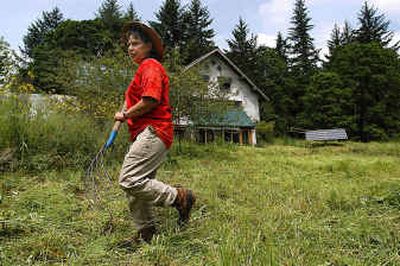
PHILOMATH, Ore. — The Oregon iris, opening its lavender petals under the mild spring sun, came as a surprise to Frank and Karen Morton.
“We were convinced we had a clearcut, and we were going to cure it,” said Frank, half of the duo who bought 54 acres outside Philomath in 1988.
What they had instead was an entirely different predicament — native Oregon prairie, a habitat so scarce it’s considered one of the rarest of North American ecosystems.
And there it was, an iris native to the prairie popping out of the dried grass.
Already committed to the idea of land stewardship, the Mortons decided to do what they could to preserve their bit of prairie, especially after a visit from ecologist Ed Alverson of The Nature Conservancy, who proclaimed it the most intact example of a Willamette Valley prairie.
Not many people would recognize the oak-and-grass landscape maintained for thousands of years by aboriginals, who set fires to keep the productive environment intact. The arrival of Euro-American agriculture and development in the early to mid-1800s put a stop to burning, and much of the native prairie was plowed under, leaving the land as we know it today.
But it wasn’t so long ago that the landscape of the Willamette Valley was swept with grasses, dotted with oak trees and, in spring and summer, quilted with wildflowers. Bare-stem lomatium erupted like yellow stars amid the tangle of grasses. Larkspur, shooting star, Oregon sunshine, pink checkermallow, lupine, aster, fawn lily, columbine, Clarkia, Brodiaea, all lent their colors and textures to the prairie.
Scientists think the prairies evolved naturally in the hot, dry climate that arrived about 10,000 years ago as the last ice age ended. The prairie would have begun changing again 4,000 years later when Mount Mazama erupted, carving Crater Lake and shifting the climate to cool and moist.
Left to its own devices, this oak savannah-type prairie would have eventually progressed into a full-fledged forest. But somewhere along the evolutionary train, humans learned to manage the land with fire. In the Willamette Valley, the Kalapuya and their predecessors were hunter-gatherers rather than farmers. Even so, they knew how to keep natural succession at bay in order to maintain the best food sources.
“Burning was all about food,” said Frank Morton. “The natives were completely in tune with the landscape, very ecologically sophisticated.”
They burned to make it easier to collect seeds, bulbs, roots and berries. Sometimes the burning had direct results, such as herding deer or other prey into confined areas to make hunting easier. Or it aided in the collection of grasshoppers and other insects, which were eaten by Indians.
Although hunting was the major reason for burning, collecting tarweed was right up there, too. A major food source for the Kalapuya, tarweed plants are covered with a pitchy substance that makes collecting the seeds a messy proposition. The natives set fires that would burn off the resin, slightly parch the seeds but leave the plant standing. The fire destroyed any grasses or other plants that might get in the way of seed harvest.
“As soon as the fire was done,” Frank said, “long lines of women with large baskets that hung to the ground would walk through the field using rackets to smack the seeds into the basket. They’d pound the seed, which was high in protein, and make a cake out of it that they used as a trade good. They took it to the falls at Oregon City.”
Regular burning provided indirect blessings, too. It encouraged the growth of tender grasses and other plants favored by the large animals the native people hunted. By using fire, they could plan not only to have prey around, but also exactly where the prey would be.
Regular fires also meant many species of plants — oak, hazelnut and berries among them — would produce bigger harvests the following year. Most of all, fire encouraged fleshy annual plants, which were easier to harvest, easier to eat and provided more nutrients than woody plants.
Harvest, however, is not what motivates the Mortons to maintain their piece of prairie. They own Shoulder to Shoulder Farm and make a living selling organic vegetable seed to companies such as Johnny’s, Territorial, Nichols and Burpee. They did, for a while, sell seed from many of the native plants growing on their property. But, as Frank puts it, “You can’t buy this meadow in a can.”
What he means is that native prairies are not something we can easily create, which makes the less than 1 percent left in the Willamette Valley all the more precious.
“Much less than 1 percent, actually,” corrects Mark V. Wilson, associate professor of botany and plant pathology at Oregon State University.
Once Frank Morton realized they’d bought a part of Oregon’s ancient history, he couldn’t wait to find out all about it. He lets scientists collect specimens or study his land — as long as they share information. Early on, he taught himself about the plants and wildlife that populate the prairie and got hold of one of Wilson’s many research papers.
“I found out that you can take an area infested with tall oat grass, rose and poison oak, and if you mow it three times a year, you can break up the life cycle of the invasive species without breaking up the life cycle of the native species,” said Frank.
So that’s what he and his wife and two kids do now. At first, they cleared by hand. In the areas where they mow, native species are re-establishing themselves without being reseeded or replanted.
Frank stands atop a knoll he calls the center of diversity.
“There are 40 species right here. We’ve cut a lot of brush. It was nearly a monoculture of English hawthorn and wild roses three years ago when we began the battle. Now, though, it comes up like grass, and we can mow it.
“We’re living in a wild community without dominating it,” he said. “We’re as much a product of the ecosystem as any of these grasses or flowers,” he said