
Golden comeback

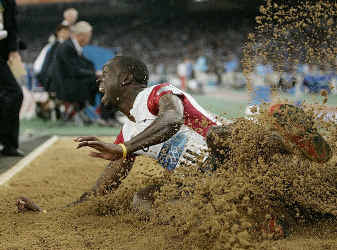
The biggest smile in track and field got a little bigger Thursday night, and the long jump is solidly back in American hands.
Dwight Phillips – the world’s best jumper by leaps and bounds, and maybe the happiest guy in the sport – lived up to his billing with a 28-foot, 2 1/4 -inch effort to win the gold medal.
The United States made it an unexpected 1-2 finish when John Moffitt, the NCAA champion at LSU this year, went a personal-best 27-9 1/2 for the silver.
It was a comeback for the Americans, who four years ago in Sydney failed to medal in the event for the first time since the boycotted games in Moscow in 1980.
“The long jump is back,” Moffitt said. “Watch out.”
Phillips put the competition away with his first jump, falling just a half-inch shy of the personal best he set three weeks ago in Linz, Austria. Not bad for a guy who doctors said might not walk again when he was hit by a motorcycle and broke both legs as a 14-year-old.
His two big jumps this month are the best in the event since 2000. His winning mark was the Olympic best since Carl Lewis went 28-5 1/2 in 1992 for the third of his four long jump golds.
The event has been in the doldrums for years, and Phillips aims to bring it back, not just in the United States but everywhere.
“It feels good to go beyond the limits I dreamed of as a kid,” Phillips said. “Now I have new goals.”
The U.S. has won the long jump gold in all but four Olympic Games.
“To go 1-2 in the Olympic Games, and follow in the footsteps of those great jumpers – such as Mike Powell, Carl Lewis, Bob Beamon, Ralph Boston – now you’ve got Dwight Phillips and John Moffitt,” Phillips said.
U.S. blanked in canoe-kayak
A splash at the finish line made for an Olympic highlight and a day that the U.S. canoe and kayak flatwater team would rather forget.
With a last desperate stroke that rocked his kayak so hard he fell into the water, Frenchman Babak Amir Tahmasseb edged America’s Rami Zur at the finish line and ended the U.S. team’s best hope for a medal.
Zur’s fourth-place finish in his 500-meter single kayak (K-1) race – he needed a top three to advance – was the most frustrating moment for the American team, which failed to get a boat in the finals.
They’ve now gone three Olympics without a medal, a streak that left the U.S. program’s executive director, David Yarborough, shaking his head in disbelief at how far the team had fallen since 1988, when Greg Barton was part of two gold-medal winning boats.
Egypt’s champ a real throwback
On a day when Olympic Greco-Roman wrestling ushered out familiar champions of old and welcomed some unconventional new ones, Egypt’s Karam Gaber looked out of place.
With all of the backflipping, vaulting and suspended-in-midair artistry during his two brief trips to the mat, shouldn’t this guy be over in gymnastics, comparing tricks with Paul Hamm?
Gaber, never before a world champion but now an Olympic wrestling gold medalist like few before, incorporated a new statistic into one of the world’s oldest sports: hang time.
Gaber – he goes by that name, though he was called Karam Gaber Ibrahim at the Olympics – threw around former world champion Mehmet Ozal of Turkey and silver medalist Ramaz Nozadze of Georgia like they were those stuffed practice dummies that neophyte wrestlers use in training.
Appropriately enough, Gaber celebrated his gold medal victory with a cartwheel and a backflip. Not even his coach was immune from the treatment after running onto the mat; Gaber picked him up, tossed him over his shoulder and pinned him, too.
USOC asks Bush to pull ad
President Bush’s re-election campaign refused a request by the U.S. Olympic Committee to pull a television ad that mentions the Olympics.
Bush campaign spokesman Scott Stanzel said the ads will continue through Sunday, the final day of the Athens Games.
“We are on firm legal ground to mention the Olympics to make a factual point in a political advertisement,” Stanzel said.
The USOC asked the campaign to pull the ads on, committee spokesman Darryl Seibel said. The ad shows a swimmer and the flags of Iraq and Afghanistan.
Some of the players on the Iraqi Olympic soccer team have complained about the ad appearing as part of a political campaign.
The International Olympic Committee and the USOC have the authority to regulate the use of anything involving the Olympics.