
Schools join food fight
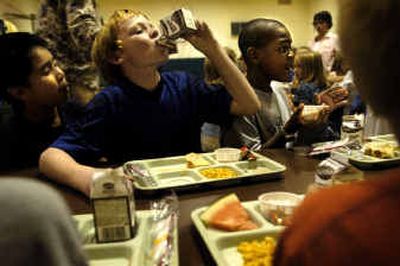
Woodland Middle School’s snack vending machine is stocked with graham cracker sticks, yogurt-covered pretzels and popcorn.
But something else caught 11-year-old Jesse Larrison’s eye as he left school after registration Wednesday. He turned to his mom, Julie Larrison, and started pleading, “Can I have 50 cents? Puh-lease? They have Laffy Taffy Smooth!”
Though the Coeur d’Alene school no longer sells pop in its vending machines – only juice and water – candy bars and potato chips are still available, offered alongside healthier options. As long as sugary and salty snacks are still available, many say students like Jesse will continue to indulge.
That likelihood, coupled with an increasingly obese student population, has led some schools to eliminate pop, candy and chips from their vending machines. Post Falls’ new River City Middle School will open with “healthy” vending machines, and junk food will be eliminated from machines at the district’s existing middle school. The district, which doesn’t have vending machines in its elementary schools, is considering a move to healthier foods in its high school machines, as well.
North Idaho and Spokane school districts have launched new efforts to address the national problem of overweight children. The Centers for Disease Control and Prevention concluded recently that poor diet and sedentary lifestyles are creating an unhealthy population that’s likely to overtake smokers in the category of preventable deaths.
In response, area school officials have reworked what’s offered to students in vending machines and school lunches.
Spokane’s Central Valley students will get leaner – but maybe not tastier – french fries this fall.
“We are working on cutting out use of the deep fryer,” said Gary Pannell, director of food services for the district.
“We’re using a baked fry, and there are two or three different fat-free potato products we’re looking at.”
Steve Briggs, business manager for Coeur d’Alene schools, said that as childhood obesity rates have increased, so have discussions of the role schools play in diet and nutrition. More schools are at least discussing, if not committing to, healthier snacks and beverages.
“Study after study indicates while schools are not responsible solely for the change, we have the opportunity to impact it in a positive way,” Briggs said. “We are working in the direction, if not removing the machines, at least making healthier choices available for our students.”
Rachel Binger initially didn’t like the nutritional changes that swept through her school in April. One day Cheetos were sold for lunch, then they were gone.
“Usually you get chips and a cookie for lunch,” said Binger, a 14-year-old who was an eighth-grader at Spokane’s Sacajawea Middle School last year.
But Binger said the newly offered salads were nice. And once a few students got salads, she said, it seemed like everyone wanted one.
Mike Yovetich, principal at River City Middle School in Post Falls, anticipates sales might be slower with healthier snacks.
“Kids will see their Snickers bar isn’t there, and they’ll get something else,” Yovetich said. “They’ll either move on to something else or keep their money in their pocket.”
Although vending machines turn a profit for schools, Yovetich said student health is top priority.
Three Coeur d’Alene schools recently received grants to test a change in vending machine offerings. SeAnne Safaii, a dietician with the State Department of Education, said the hope is that results will show healthy foods can be just as profitable for schools as unhealthy foods.
According to a May report from the Center for Science in the Public Interest, many schools “have improved the nutritional quality of school foods and beverages and not lost money.” Among those listed in the report are several in California and other states, and one in Whitefish, Mont. Some schools have reported increased vending profits, reported the national group that calls itself a “nutrition advocacy organization.”
Idaho schools are only subject to one federal regulation when it comes to vending machines. If a vending machine is in a school cafeteria or other area where food is being served, it can’t be turned on during mealtime. If the vending machine is in a hall just outside a cafeteria, or elsewhere in the school, sales aren’t limited in any way.
While there’s no official tally of how many vending machines are in Idaho schools, Safaii said all of the state’s high schools and middle schools have at least one vending machine, as do most elementary schools.
Earlier this year, Idaho’s Department of Education released its Recommendations for Promoting a Healthy School Nutrition Environment. They include requiring all foods and beverages sold in vending machines to meet the definition of a “healthy food.” For beverages, that means 100 percent fruit and vegetable juices, low-fat or fat-free milk or flavored milks and water.
The report suggests fruits, vegetables and low-fat dairy products “should be promoted as the best practice in foods offered or sold to children.” Snacks that would meet the “healthy food” definition include animal crackers, energy bars, baked chips, canned fruits in light syrup, saltine crackers, pretzels and raisins.
The Coeur d’Alene Charter School tried out vending machines stocked with milk and yogurt, but Principal Nels Pitotti said the effort was unsuccessful.
Students didn’t buy the dairy products fast enough to prevent spoiling. And the machines didn’t work right – partly because of student pranks.
“The kids would put a quarter in, open the door and stick someone’s tennis shoe in there,” Pitotti said. “Then it would cost someone money to get their shoe back.”
Jack Hern, owner of All-American Amusement and Vending, said he likes to stock vending machines with a mix that includes alternatives to pop and candy. But pop and candy sell fastest, he said.
Hern said he was recently flipping through a magazine from the 1950s and came across an article on health foods being sold in vending machines.
“There was a big clamor and uproar,” Hern said. “It was the same story, different decade. They’ve always been trying to make changes to offer healthy alternatives for kids.”
If kids can’t get junk food at school, Hern said, they’ll just find it somewhere else. He advocates for variety – and leaving chocolate on campus.
“It’s about choice and personal responsibility,” he said.
But Lee Lingard, father of a Woodland sixth-grader, said schools have an obligation to provide a healthy environment.
“It’s a great idea to get away from the soda and caffeine,” he said. “I’m all for it.”
Even if schools have a mix of healthy food and sugar snacks, Lingard said students will probably gravitate toward junk food.
“That’s why we’re the fattest country in the world,” he said.