
Nebraska in for a system overhaul
LINCOLN, Neb. — Newt Gingrich switches to the Green Party, John Deere plans to make greeting cards instead of tractors, Madonna enters the convent, Nebraska football ditches option attack in favor of West Coast offense …
All of these ridiculous notions are false except the last, and still, to believe that one, you had to jump on a plane and see it with your own two retinas.
First, the closest thing to “West Coast” in Nebraska is Scottsbluff, and the most significant aerial shows in the area have taken off from Strategic Air Command headquarters, not a Cornhusker’s hand.
Did you know that a Nebraska quarterback has never thrown for 300 yards in a game?
That’s never, as in not ever.
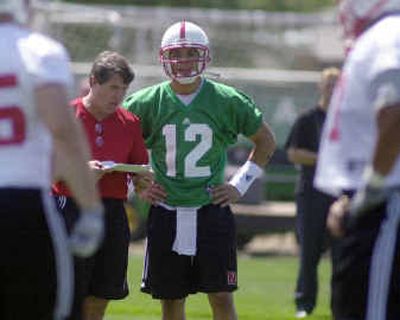
Incredibly, though, the reports are true, sure as first-year Coach Bill Callahan, late of the Oakland Raiders, sat in Memorial Stadium recently after a quick-paced, pass-happy practice orchestrated with the precision of a Busby Berkeley musical.
“This is a shift in philosophy,” Callahan explained over the warmup burps of Nebraska band tubas.
Make that a seismic shift.
Of all the radical departures in the history of sport, this one may top all.
After decades of tilling the soil with a corn-fed, ground-oriented football philosophy that reflected a conservative, land-locked people, Nebraska has junked it all and gone Hollywood.
All this because of a 2003 season that ended disastrously at … 10-3.
If you’re having a tough time digesting how the previous coach, Frank Solich, a Cornhusker lifer and Tom Osborne’s handpicked successor, could be tossed into the silo after leading the program to its 35th consecutive bowl appearance, well, that makes you and a lot of other people.
The man responsible for this philosophical overthrow, Athletic Director Steve Pederson, tried to explain himself.
“The record doesn’t always mirror what’s really happening,” Pederson said.
A few months ago, Pederson might have ventured out only incognito.
Many Nebraskans were, frankly, not pleased with the way Pederson handled the firing of Solich and the subsequent coaching search, during which he kept fans that are some of college football’s most knowledgeable largely in the dark.
Bill Doleman, a native Nebraskan and host of a radio talk program called, “The Average Joe Sports Show,” says Cornhusker fans will not forget how Pederson left them “twisting in the wind” during a coaching search that lasted more than a month.
That said, Doleman added that the hiring of Callahan was brilliant.
Callahan “saved the University of Nebraska from embarrassment,” Doleman said.
Passage of time has allowed Pederson to venture outside freely.
Simply put, he said, it was time for change at Nebraska, even if it didn’t feel like it.
Pederson said it was his responsibility as a native Nebraskan to make the calculated decision to break the championship chain of history that began with Bob Devaney in 1962 and ended late last year with Solich’s firing.
The Nebraska coaches in that span, Devaney, Osborne and Solich — had a combined record of 414-88-5.
More than that, the coaching transitions here always had the feel of a father’s passing on the family business to a son.
Devaney won two national titles before, in 1973, bequeathing the program to Osborne. Twenty-five years later, after winning his third national title in 1997, Osborne stepped aside only after he was assured Solich, his longtime assistant, would take over.
Solich went 58-19 in six years, taking the team to the national title game in 2001, yet Pederson sensed a program on the downslide.
He saw no Big 12 titles since 1999, a leaking boat in terms of recruiting and, last year, blowout losses to Kansas State and Texas.
In 2002, Nebraska finished 7-7, its first non-winning season since 1961.
Last year’s bounce-back season was not enough to change Pederson’s vision.
A Nebraska graduate and former associate athletic director, Pederson returned to Lincoln in December of 2002, after a six-year stint as athletic director at Pittsburgh.
He wasn’t coming back to change the wallpaper.
What he sought was a modern makeover — and there was pressing precedent.
Oklahoma, Nebraska’s archrival and once an option team, changed to a pro-style offense under Bob Stoops and won the national title in 2000.
It was tough to argue against the idea of Solich’s deserving another year, but Pederson thought it best to make a proactive strike.
“What I didn’t want to do was let us get to the point where the decision made itself,” he said.
Solich was canned after Nebraska defeated Colorado on Nov. 28, and Callahan, 48, wasn’t hired until Jan. 9 — an uncomfortable period of wondering for Cornhusker fans.
Osborne, now a congressman from Nebraska’s 3rd District and a man many believe will become the state’s next governor, was publicly critical of Pederson’s move.
“I knew this decision wasn’t going to be popular with him,” Pederson said.
Nebraska players spent most of December in shock.
“A lot of players just didn’t know what to do,” junior tight end Matt Herian said. “We didn’t have a lot of direction.”
Initially, there were rumors — false — that Steve Spurrier was in town.
Pederson then made a play for Arkansas Coach Houston Nutt but, when that didn’t work out, he hired Callahan, two years removed from an AFC championship at Oakland but more recently removed by Al Davis after going 4-12.
Callahan, an outsider from Chicago, accepted the Nebraska job after considering it for only 48 hours.
He studied for his job interview the way a college kid crams for an exam.
Known as being meticulously organized and a serial note-taker, Callahan went so far as to study “The Old Farmer’s Almanac” to acquaint himself with local weather patterns.
There was no question Callahan was going to junk the option in favor of the pro-style offense he ran with the Raiders.
“I have great respect for what they accomplished here, but I’m a firm believer that you don’t coach what you don’t know,” Callahan said. “I don’t know that game.”
Callahan’s first-year challenge is monumental. He is teaching a passing system to players who were recruited to run the option.
Callahan has a six-year contract to make the West Coast system work.
“When I came in, I asked the kids to keep an open mind, to stay open to what we wanted to present to them,” Callahan said. “I asked them to give us a chance to earn our respect, because I felt, coming in as an outsider, that we had to earn their respect. I didn’t come in here pompously and try to wave the NFL flag around or anything like that.”