
Dr. John on the spot
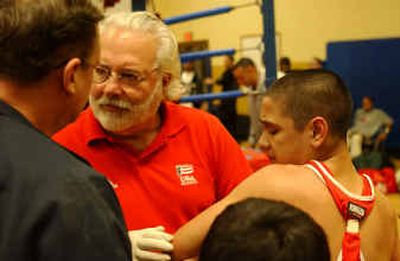
Considering the way a boxer’s head gets smacked around during a bout, it’s a good idea that John Demakas is sitting ringside.
Not only is Demakas a physician, he’s a Spokane neurosurgeon.
“Who better,” Dr. Demakas asked. “I grew up watching the Friday Night Fights with my dad, and I enjoyed it. I even tried it and got TKO’d in a smoker at Gonzaga University in 1964. That ended my career in boxing, but I really enjoyed the sport.”
Demakas says he generally prefers amateur sports to the professional variety, so he has regularly volunteered his expertise to the sport.
“I’ve been involved with amateur boxing pretty consistently since 1985,” he said. “And I’ve been on the sports medicine committee over a number of years for USA Boxing. And I’ve been the team physicians on a number of international events, including a couple years ago down in Cuba and for the World Championships.”
Demakas and two other local physicians will be ringside during the U.S. Women’s National Boxing Championships which begin today at the Spokane Fair and Expo Center.
Bouts begin tonight at 7 p.m. Spokane’s Andrea Kallas has her first bout in the 119-pound division against Valerie Evans. Seattle’s Allison Porter, Miss Washington, fights Wednesday night against Cythia Talmadge.
In amateur boxing, the ringside physician has the power to stop a fight if he or she feels a fighter is in danger of injury. Fortunately, Demakas said, he’s seen the risk of injury decline since he began his involvement.
“I guess I caught amateur boxing at just the right time in the sense that steps had been taken, such as headgear, and were coming into vogue,” he said. “There was a lot research being done and the protection of the boxers was paramount.
“In almost 19 years of doing this now, I think I’ve probably gotten up and stopped the fight myself, maybe two or three times. More often than not, when I’m getting up, the referee is already stopping it because we’re both seeing the same things.”
At ringside, a physician is watching for tell-tale signs of danger, Demakas said.
One of the first things a doctor watches for, he said, is whether or not the combatants are evenly matched.
“I’m watching to make sure that the kid knows what he’s doing and that he’s not outmatched,” he explained. “If he’s outmatched, I’m going to watch and make sure that he’s protecting himself. Sometimes, if the kid is really outmatched, we’ll call the kid over. They may be ashamed to say anything, so we’ll take the heat and call the match. They’ll generally come over and thank you for doing that.”
Aside from that, the physician is monitoring the boxer’s skill level.
“The kids that aren’t outmatched, you’re looking at how well they’re protecting themselves,” he said. “You’re watching how they hold their mouthpiece in their mouth — if they’re keeping their mouth closed. If they keep their mouth open, the mouthpiece becomes much less effective and much less protection against concussion. It also means they’re starting to get winded. And you watch their legs. If they get hit, their legs are going to go. You watch the arms, because they’re going to drop as they get tired.”
When it comes to injury, amateur boxing is not the most dangerous sport out there, Demakas said —despite its reputation.
“There is data out there that suggests alterations in neuropsychological function in soccer players who are heading the ball,” he said. “When you look at life-altering injuries in amateur athletics, No. 1 is gymnastics, and I have a daughter doing that. These girls, the ones who attain any degree of ability in the sport, sustain joint problems throughout their lives.
“The statistics out of the Olympic Training Center in Colorado Springs, the neurological injuries were not in boxers, but in gymnasts, ice skaters and in wrestlers, and most of those were spinal. Not that there haven’t been injuries; there have been. But they tend to be extremely unusual.”
Demakas said he’s tried to talk his daughter into taking up the sport — without success.
“I think it’s a great sport. I think it’s a great sport conditioning-wise,” he said. “I think it’s a great sport in creating a better image of yourself. When you look at conditioning, boxers are right up there with marathon runners. This is a great conditioning sport.
“And No. 2, you’re by yourself in there. It’s not a middle-class sport, and I don’t know how to say that in a politically correct fashion. The majority of these kids who are boxing come from single-parent families. Got the inner-city kids, their coaches become their mentors and their father-figure.”
This women’s tournament is the first national event of its kind he will have worked, Demakas said, although he was part of the sports medicine committee when women first were allowed to fight under the banner of USA Boxing.
“I think as a group, women tend to be better technical boxers than the men do,” he said. “The guys are out there hot-dogging from the beginning, and I think the girls are less inclined to do that. They tend to be good, solid, technical punchers.”