
Gagne’s record sparks debate about best streak
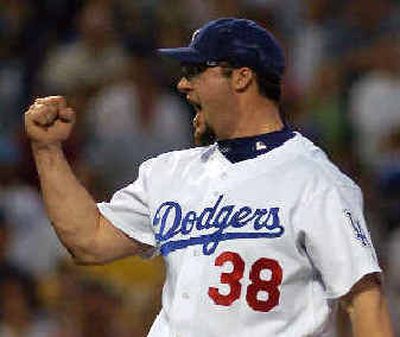
Los Angeles Dodgers closer Eric Gagne consistently has dominated batters for nearly two seasons, fueling not just a record but a debate about how his 76 consecutive saves rate with other great streaks in Major League Baseball history.
Joe DiMaggio’s 56-game hitting streak, Orel Hershiser’s 59 consecutive scoreless innings and Cal Ripken’s 2,632 consecutive games played are part of baseball lore.
In that regard, Gagne has no shortage of appreciation from his peers in shattering the previous record of 54 consecutive saves by Tom Gordon with Boston in 1998-99. Gagne’s streak, dating to Aug. 28, 2002, was two more than the best save streaks of the New York Yankees’ Mariano Rivera (27), Philadelphia’s Billy Wagner (26) and Anaheim’s Troy Percival (21) combined.
“I’m jealous as can be of him,” Wagner says admiringly. “I’m happy if I can get five or six saves in a row. But he has set a standard that no reliever is going to do again. It’s almost like (DiMaggio) getting at least one hit in 56 consecutive games, but it’s different because these don’t come day after day. He might get two (saves) one week and then have to sit five days. It’s not like a hitter who goes out there every day. He has to be ready when he’s called to go out there.”
Gagne, 28, makes no apologies for being primarily a ninth-inning pitcher. The talent in the Dodgers’ bullpen allows that luxury.
“Everybody has a role, and that’s why we’ve been successful,” the hard-throwing, Canadian-born right-hander says. “If I have to, I’ll go in the eighth inning or in any situation. I thrive on pressure situations. I love it. But the bullpen we have is so deep. I don’t pitch more because I don’t have to.”
But given that the save only became an official statistic in 1969, that the criteria have changed and that relievers are being used more judiciously, some suggest Gagne’s streak is more hollow than hallowed.
“I’m not going to ever take anything from a tremendous accomplishment,” says former Dodger closer Mike Marshall, the National League’s Cy Young Award winner in 1974. “But if you’re pitching with a three-run lead and you get to start an inning where there’s no trouble to start with, that’s not that big of a deal. Just about anybody on the ballclub should be able to do that.”
Gagne (pronounced gahn-YAY) is the N.L.’s reigning Cy Young winner after leading the majors last year with 55 saves, tying him with Atlanta’s John Smoltz for second on the all-time single-season list (behind Bobby Thigpen’s 57 for the Chicago White Sox in 1990). Gagne also became the first to complete a 162-game schedule without blowing a save chance.
That followed his conversion of his last eight save opportunities in 2002, when he led the N.L. with 52 saves, and made him the only pitcher with two 50-save seasons. During his streak, including 13 more saves this season through Friday, he had a 0.78 ERA, allowing just seven earned runs and 40 hits with 131 strikeouts in 801/3 innings.
Gagne’s only slip-up during his streak is a blown save in last year’s All-Star Game that didn’t count officially. “I don’t even remember it,” he says.
Nonetheless, comparisons resonate from a previous era of Cy Young Award-winning relievers who routinely entered games with runners on base and usually pitched two, three and sometimes four innings.
By contrast, Gagne has pitched two innings just twice during his streak. In his 55 save situations last year, he entered the game with a one-run lead 24 times, a two-run lead 11 times, a three-run lead 18 times and a four-run lead twice and inherited 10 baserunners all season. This season he has entered with a one-run lead five times, a two-run lead three times, a three-run lead three times — and even once with a five-run lead that qualified for a save because the potential tying run was in the on-deck circle when he entered.
Wagner says the specialized role of today’s closer is no less pressure-packed despite Gagne making it seem as easy as 1-2-3.
“He throws a lot of strikes, he doesn’t walk a lot of guys and he doesn’t give up a lot of hits so he doesn’t have to be concerned,” Wagner says. “He’s honed his craft to the point that if he’s having an off day, he’s got two or three other pitches to compensate for one off pitch.”
In becoming just the ninth reliever to win a Cy Young award, Gagne made 77 appearances last year and was 2-3 with a 1.20 earned run average, the lowest ERA among major league pitchers with 75 or more appearances. His 14.98 strikeouts per nine innings broke the major league record of 14.95 set by Wagner, with Houston, in 1999.
Dodgers manager Jim Tracy compares Gagne’s streak favorably to any of the others, and even puts it in the same class with Ted Williams hitting .400 in 1941. “I don’t know that there’s anybody else out there that can do it,” Tracy says.
Hall of Famer Rollie Fingers pitched 17 years in the majors (1968-85) and threw 125 innings a season in his first six years as a closer.
“If he would have been in situations like myself or (Goose) Gossage when we were pitching three or four innings to get a save, he may not have gotten that many in a row,” Fingers says.
“Guys get more opportunities to get saves these days. When I pitched, you almost had to fight the starting pitcher to get into a ball game. I’d pitch 120 innings a year and get 20 saves. … It’s just the way the game has changed. But it’s still impressive he’s been able to go out there that many times and do the job without giving up the tying run, the winning run or blowing a save. I’d let him pitch on my staff.”