
Sketch artists
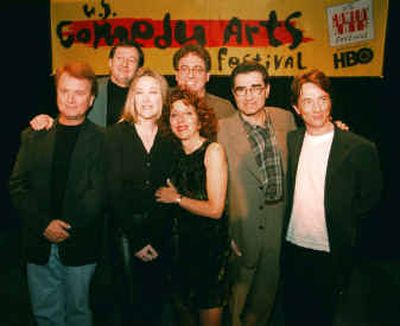
In the late 1970s, a group of improv comedy actors from Chicago and Toronto teamed up to star in one of the greatest sketch comedy series ever seen on North American television.
“Saturday Night Live”? No. “SCTV.”
Like Beatles vs. Stones and “Star Trek” vs. “Star Wars,” debating the relative merits of “SNL” vs. “SCTV” has become a classic argument for any serious pop culture aficionado.
“SNL” has the longer, more commercially successful legacy, but it’s been historically uneven, creatively limited by its format and often run more like a platform for bad movie spin-offs.
“SCTV” hasn’t been easily viewable on American television in more than a decade. But last week’s release of “SCTV: Network 90” — a DVD collection of some of the series’ best episodes — should remind comedy fans of the abundant splendor of Stan and Yosh Shmenge, “The Sammy Maudlin Show,” “The Great White North,” “Dr. Tongue’s 3-D House of Stewardesses” and all the other classic “SCTV” sketches.
Actually, “SCTV” owes its existence to “SNL.” Most of the classic “SNL” cast members came from the Second City theaters in Chicago (John Belushi, Bill Murray) and Toronto (Dan Aykroyd, Gilda Radner), and Toronto theater manager Andrew Alexander was terrified that more would follow.
“I had a very talented group on the stage at the time,” he says, “and I thought, ‘My God, ABC or CBS are going to grab the core group of my people and I’m going to be out of business.’ So we came up with ‘SCTV’ as kind of a defensive mechanism.”
Alexander and the other producers cut a deal with the Toronto-based Global TV Network and hired a cast featuring some of the finest comedians of their generation: John Candy, Joe Flaherty, Eugene Levy, Andrea Martin, Catherine O’Hara, Harold Ramis and Dave Thomas. (Ramis left after one year, and Rick Moranis and Martin Short came later.)
After a long brainstorming session, it was decided to model the series around the working day of a low-rent television station, since TV parodies had gone over so well in the stage shows.
Some characters translated neatly from stage to screen, like Levy’s bumbling reporter Earl Camembert and Flaherty as the more popular anchorman Floyd Robertson, who moonlighted as the lame children’s horror movie show host Count Floyd (“Pretty scary, eh, kids?”).
Others were invented for the series, like Flaherty’s Guy Caballero, the Lionel Barrymore-esque station owner who could walk but sat in a wheelchair “for respect,” or Moranis and Thomas as the Molson-swilling, back bacon-eating Canadian stereotypes Bob and Doug McKenzie. (Despite Thomas’ and Moranis’ initial misgivings, the McKenzies have survived in various forms for 25 years, including a turn as cartoon moose in last year’s “Brother Bear.”)
While the original “SCTV” was a half-hour show on Canadian television, the “Network 90” DVD collection — the first in a planned series that should eventually include all 185 “SCTV” episodes — features the 90-minute shows that aired on NBC in 1981.
” ‘Saturday Night Live’ was coming out of one of its weakest years ever,” says Alexander, “and (NBC’s) Brandon Tartikoff felt, ‘I’m going to grab this show and this group of people, because it could be my bench strength.’ ”
But several cast members were worried about the move, he says, both because of possible creative interference and the challenge of doing 90 minutes instead of 30.
To fill all that extra time, sketches from earlier seasons were teamed with original material, and at NBC’s request, musical guests like Dr. John, Southside Johnny and Roy Orbison were added. Rather than treat the musical performances as a separate element, the bands were incorporated into sketches — like a Jekyll and Hyde story where Short’s nerdy Ed Grimley transformed into the strapping John Cougar.
One thing didn’t change in the transition from Canada to America: The fictional executives and stars of SCTV remained grossly incompetent, and completely ignorant of their limitations. Candy’s sleazeball host/director Johnny LaRue was always trying to put expensive crane shots into projects that didn’t need them. O’Hara’s aging sexpot Lola Heatherton couldn’t really sing, dance or act, but she covered by telling every man she met that she wanted to bear his children.
“A lot of our own ineptness was reflected in the writing,” says Alexander.
The celebrities being expertly impersonated didn’t come off much better. In one memorably bizarre sketch, Thomas played Richard Harris warbling “MacArthur Park” — and stiffly dancing during the interminable bridge — on the “American Bandstand” clone “Mel’s Rock Pile.”
Moranis’ Merv Griffin was a purring toady with an enormous derriere. (It was the latter point that upset the real Merv, according to Flaherty.)
While certain characters and sketches are very much of their era, like an entire episode about the Moral Majority, much of “SCTV” was ahead of its time.
Moranis created gadget-loving veejay Gerry Todd two years before MTV. “The Brooke Shields Show,” a talk show with O’Hara as a bubble-headed teenage Shields, is Jessica Simpson with a sense of irony. Thomas’ ranting critic Bill Needle is just Bill O’Reilly 20 years early.
Thomas doesn’t think much of “SCTV” was deliberately forward-thinking.
“It’s like predicting, ‘There will be lightning sometime in the future,’ ” he says. “There’s 400 channels blasting away, and eventually someone’s going to hit on what we were doing.”