
Cassini in orbit over Phoebe

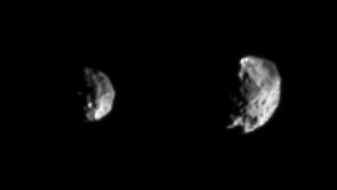
PHILADELPHIA – Today, after seven years of traveling through the solar system, the Saturn-bound spacecraft Cassini will finally reach one of the Saturnian moons – an odd ball called Phoebe.
If all goes as planned, the craft will take the first-ever close-up pictures of Phoebe and then spend four years exploring cold, ethereal Saturn, its famed rings and more of its 31 diverse moons. Many, including Phoebe, are interesting worlds in their own right.
“The fun thing about Phoebe is we have no idea what it should look like,” said Cornell University astronomer Peter Thomas, a member of the mission’s imaging team. To date, the sharpest pictures of Phoebe show just a blurry sphere, while Cassini’s shots promise to reveal whatever hills and valleys mark its dark, reddish surface.
If all goes as planned, the next four years will bring hundreds of images from NASA’s heavily equipped $3.3 billion spacecraft. Cassini will orbit 74 times around the giant ringed planet, the sixth from the sun and nine times the diameter of Earth. Scientists expect to see close-ups of several moons as well as the stormy surface of the planet and its gossamer rings.
By today, the first pictures of Phoebe should be reaching Earth. Phoebe orbits in the opposite direction from Saturn’s other moons and rings – this retrograde motion implying that this body wasn’t born along with Saturn but was subsequently captured by the giant planet’s gravitational field.
“Where it came from is a bit of a mystery,” said Steve Squyres of Cornell University. Scientists speculate that Phoebe could have started its life as an asteroid or the nucleus of a comet – one more than 10 times bigger than Haley’s comet. “Maybe this will be our first close-up look at a cometary nucleus,” said Carl Murray of Queen Mary University of London, a member of the Cassini imaging team.
Others suggest that Phoebe is an object called a centaur – a hybrid that’s part icy comet, part rocky asteroid. Astronomical centaurs originate from out near Pluto’s orbit and migrate toward the sun. On the surface they are dark – apparently tarred with the kind of organic matter that makes up the building blocks of life.
Cassini will visit a few other moons, including mysterious Iapetus, with one face reddish black, the other snow white; Enceladus, with its promise of ice volcanoes that erupt with water, smoothing over parts of the cratered surface; and giant Titan, bigger than the planet Mercury and the second-largest moon in the solar system.
For all scientists know, oceans and continents lie under Titan’s nitrogen-rich atmosphere, which some have compared to thick smog. Cassini carries radar and infrared cameras that can look beneath the haze.
On Christmas Eve, the spacecraft will drop a small lander, called the Huygens Probe, down to Titan’s surface, where it may hit land or bob around in some frigid liquid-methane sea, there taking the world’s first pictures from the surface of another planet’s moon.
Cassini will also get the world’s first bird’s-eye view of the rings, which have fascinated astronomers and sky-watchers since Dutch astronomer Christiaan Huygens and Italian Giovanni Cassini identified and observed them in the late 1600s. (Galileo misidentified the rings as projections, like cup handles.)