
Water-loving bird
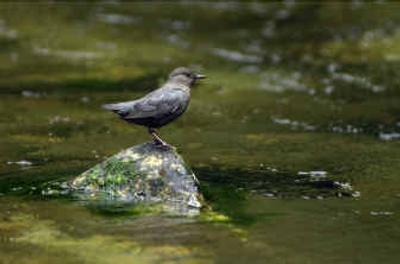
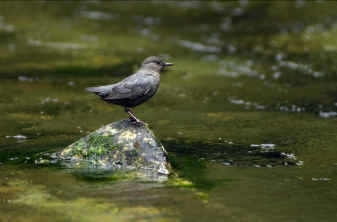
I was 16, and in my first season of birding, when I had a life-altering encounter with a water ouzel. Now don’t go running to your field guides, because if you don’t know what an ouzel is, you won’t find it there.
But back then, my outdated edition of Peterson’s Field Guide to Western Birds had that wonderful name listed for the odd little bird I chanced to see that day.
A small group of my friends and I were hiking down a rapidly flowing stream in one of the many side canyons of the Columbia River Gorge. At one point we reached a deep, crystal clear pool.
In the early spring it was far too cold to swim and there were only sheer rock walls as banks, but on one side previous explorers had cut foot and hand holds into the rock, allowing a perilous passage above the pool. One misstep and it would be an icy plunge.
At the time we all wished that someone else would make a misstep that would end in a tremendous splash, but we all made the passage safely. Midway, however, I happened to look down and saw a sight that almost made me let go in total astonishment.
At the bottom of the pool, which was probably six feet deep, there was a small black bird walking over some light colored rocks. The bird was walking, six feet under water!
This experience, along with a handful of other first-time wonders, turned a high school biology assignment of finding 100 different bird species in a year into a life-long passion. And even now, many years later, I still view the water ouzel with wonder.
By the way, turn your field guides to American dipper and you’ll see the odd little bird to which I refer. But to me, it will always be the water ouzel (I just had to look it up — ouzel comes from the Anglo-Saxon word osle which means blackbird, thus the apt name “water blackbird”).
Despite their old name and their uniform darkness, dippers are not at all closely related to the blackbirds. Other aspects of their physical appearance and behavior led most people to conclude until recently that dippers were most closely related to the wrens.
Dippers have wren-like, stubby bodies; short, stubby tails and short, stubby wings; they bob (or dip from the knees, the whole body, as fast as one dip per second) incessantly; and their song is like that of a wren, but with the volume turned way up. Recent genetic work, however, has shown that dippers aren’t closely related to the wrens either.
In fact, as the only truly aquatic passerine (the group of birds often referred to as the song birds or the perching birds — the birds that comprise the last half of the field guides and that are found after the woodpeckers), dippers are unique in many ways and do not fit in with any other group (although genetically they are most similar to thrushes — the robin, for example).
Probably the most unique aspect of this bird is its total dependence upon, and considerable adaptation for, life in the fast lane — in their case, fast moving mountain streams. Dippers never stray far from this fast and cold water habitat. Their food is in it (literally), their nests are near it (practically in it), and they don’t migrate away from it (unless it freezes solid, then they move just far enough to find a little open, running water).
As with the other passerines, dippers can sing. But uniquely, probably due to the noisiness of mountain streams, they sing very loud, and both males and females sing very loud year-round. Often the only hint of a dipper that I’ve had in the spring when streams are especially fast and loud is its overpowering voice above the roar. Then I might spot the bobbing little black stub among all the motion of the stream.
Due to this constant noise, communication for a dipper pair (which is thought to mate for life — dating in such an environment must be tough) is difficult. Singing loudly, year round, and by both partners would be obviously important.
Dipping also may be a part of the solution — body language that sends a message beyond the ability of sound. Another is probably the white feathering of their eyelids — the only contrasting feathers they possess (other passerines do not even have feathers on their eyelids, but we’ll come back to that). When agitated, dippers will blink up to 50 times a minute, sending an obvious signal that something is up.
Beyond communication, dippers have two primary sets of adaptations that allow them to function as no other passerines can.
First of all, to make efficient use of their watery habitat, dippers are built to swim. Their toes are not webbed, but their wings are designed to propel them underwater. They fly as well under the water as they do above it. In fact, dippers don’t miss a beat in shooting from under the surface to full air flight — they look like a missile being fired from a submarine.
Next, and most amazing to me, is the dipper’s ability to walk under water. Loons and grebes are efficient under water due to a lack of buoyancy — they have relatively dense bones and don’t trap much air in their feathers. Dippers, however, are very buoyant.
To overcome this buoyancy and walk under water, they have long, strong toes that grip the substrate, and their paddle-like wings are angled to give both forward and downward momentum as they flap through the water. This system works well enough to allow dippers to move against a current that would knock a person off their feet.
And they can stay down for as long as 10 seconds on a breath. To accomplish this, dippers have a higher concentration of hemoglobin (the molecule in the blood that carries oxygen to the cells) than is found in other passerines, and they can adjust their heart rate in the same manner that deep-diving whales do.
Among other adaptations for functioning under water, dippers have clear eye membranes they bring up to use as goggles when they are either flying or walking below the surface. They have lenses that immediately changes shape to adjust for seeing in either air or water. And they have flaps over their nostrils that they close against the water when diving.
To make all this work in cold water, dippers have a whole other set of insulating adaptations. Over any given part of their body, they have twice as many feathers as other passerines. They have a preen gland 10 times as large that they use in long bouts of preening to oil these feathers. This oil keeps chilling water away from the skin and traps air between the feathers.
As I mentioned before, dippers even have insulating feathers on their eyelids. To further increase their ability to stay dry and warm, dippers also have a dense layer of down under their feathers not found in the other song birds. And finally, they have a metabolism more efficient at generating heat.
Thus, dippers are well-suited to feed exclusively in this watery habitat. They may fly or walk underwater. They may walk along the bank, head submerged. They may float on the surface, head submerged. They may float on the surface, picking bugs from the surface. Rarely, they may even fly-catch over the surface. But always, they are near the water.
In this water they find a vast array of food items including insect larvae of many kinds, worms, water bugs, clams, snails, fish eggs and even small fish. Many of this prey they find under rocks. Again dippers are uniquely adapted with a beak that is flattened, curved and notched to form a tool for overturning rocks.
Dippers are so closely tied to their very specific habitat, one they share, by the way, with trout, that they are considered an indicator species — a species that thrives or declines as the quality of its habitat increases or decreases. Dippers, being relatively more conspicuous than their competitors, the trout, or their prey, they thus indicate the relative quality of an area by their abundance or scarcity.
As go the dippers, so go the trout.
Thus, dipper numbers have suffered in the same way that trout populations have suffered over the years of declining mountain stream quality. As these streams have been restored to the benefit of trout, so have they benefited dippers.
And another aspect of man’s forest management has benefited dippers. Dippers have nests that are as unique as every other aspect of this bird. They build a 12-inch diameter ball of twigs and living moss, lined with dried leaves, and watered by their precious stream. This they place in an area protected from predators by a ledge, a sheer rock wall, or often by a waterfall.
But such suitable sites are scarce in the stream habitat. These days, however, dippers have found the beams that support the bridges over these streams to make an excellent substitute. In areas of satisfactory stream quality, bridges have increased dipper populations dramatically.
Dippers are not large and they are not conspicuously marked. They don’t flock and they don’t migrate. They live in out-of-the-way places. A pair may claim as much as two miles of stream for its home territory. Thus, dippers are not readily seen. In my experience, though, long before I read about the nesting habits of dippers, I had found forest bridges over fast moving streams my best bet for finding this unique song bird.
Even in the non-nesting season, since they like to stay close to home, that’s where I find them. In fact, this last January I was able to find dippers in all five of the northern-most counties of North Idaho in just this way.
A few years back I was introduced to a black Labrador retriever that had amazing abilities in the water. The owner told me its name was Ouzel and was shocked that I was able to make the connection to the black little bird with amazing abilities in the water. I told her that I will always be thankful to that biology teacher and that Columbia River Gorge water ouzel that forever altered the course of my life.