
Leaving roots behind
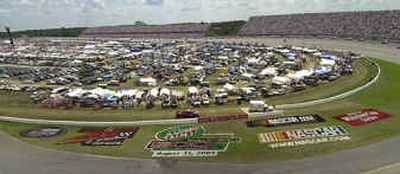
NASCAR will pack up and leave this little town forever.
The 2005 Nextel Cup schedule will no longer include North Carolina Speedway, better known as “The Rock.” And nearby Darlington Raceway in South Carolina, stock car racing’s original superspeedway, will have just one race.
For a sport that was born among moonshiners hauling whisky through mountain hollows and came of age on sun-baked Southern speedways, the announcement Friday was another milestone in NASCAR’s move away from its roots.
“We can’t pick the racetrack up and move it,” said Chris Browning, executive vice president of North Carolina Speedway.
Plenty of factors chipped away at The Rock in recent years. Attendance was mediocre, which is never a good sign in a sport where sellouts have become the rule. Its rural location offered few amenities, meaning most fans were unable to stay near the track.
It also is within an hour of Darlington, which has staged two races every season since 1960, and Lowe’s Motor Speedway, outside Charlotte.
The Rock held two races in NASCAR’s elite series every year from 1966-2003. But the track lost one of its dates this year, and NASCAR’s desire to move out of saturated markets and into major markets made the announcement inevitable, Browning said.
The decision to take the races away from Rockingham and Darlington is part of a schedule realignment and comes a year after NASCAR ended its association with its longtime sponsor, North Carolina-based Winston.
Texas Motor Speedway, outside Dallas, will get one of the races, and Phoenix International Raceway the other, meaning both tracks will have two events starting next year.
The changes were part of a settlement of a lawsuit against NASCAR by Francis Ferko, a shareholder in Speedway Motorsports Inc. The suit contended NASCAR breached agreements by not awarding a separate Cup date to SMI-owned Texas Motor Speedway.
As part of the settlement, the Bruton Smith’s SMI will pay $100.4 million to buy North Carolina Speedway from International Speedway Corp. ISC is majority owned by the France family, which controls NASCAR.
• Nazareth Speedway will close after the 2004 season.
International Speedway Corporation plans to move the Nazareth, Pa., speedway’s NASCAR Busch and IRL IndyCar series events to other tracks, raceway president Craig Rust said on the track’s Web site.
Rust said this month’s NASCAR Busch race and an IRL race in August will run as scheduled.
Vickers wins first pole
The track record fell again and again in qualifying at Richmond International Raceway in Richmond, Va., but two drivers also crashed when the new asphalt went from grippy to slippery.
Twenty-nine drivers broke Ward Burton’s 2-year-old record of 127.389 mph, led by rookie Brian Vickers. He got won his first career pole with a lap at 129.983.
“Everything just came together for us,” said Vickers, who will start only his 16th Nextel Cup race. “The track didn’t bite us like it did some of these guys. It was a good, smooth, patient but aggressive lap.”
2005 season has Florida feel
Despite the shifting of races from traditional Southeastern venues to tracks in Texas and Arizona, the 2005 NASCAR Nextel Cup season will start and finish in Florida.
The Daytona 500 again is the season-opening event, scheduled for Feb. 20, at Daytona International Speedway. The championship should be decided Nov. 20 at Homestead-Miami Speedway.
Drivers prepare for Indy 500
There is nothing in the world of auto racing quite like qualifying for the Indianapolis 500.
The first of three days of time trials for the May 30 race is scheduled today, with drivers set to go for the pole position.
To make it into the field for the 88th running of the historic race, drivers will run four-lap, 10-mile sprints on the 2 1/2 -mile oval.
Nowhere else in the sport does qualifying require such an extended period of concentration and precision to make the lineup.
“I don’t know of four more pressure-packed laps in racing than these,” said 1986 Indy winner Bobby Rahal, now a team owner. “I always felt there was a lot more pressure for qualifying than there was for the race.”
Dario Franchitti, one of only 28 drivers listed for 52 cars in the qualifying draw, said Indy qualifying is the biggest challenge in oval racing.
“To get a four-lap average, you have to not only get it right for each lap, you have to be spot-on for four laps,” he said. “If the wind comes up, or the sun is coming in and out of the clouds, each lap can be different. It’s tough.”