
Teens take the high road
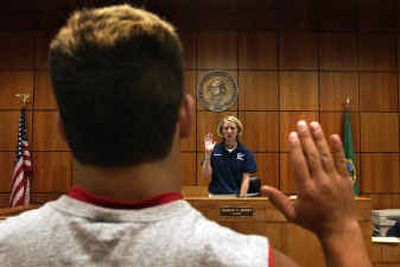
DAVENPORT, Wash. – High school students can avoid traffic fines and increases in their insurance rates, but not the third degree, if they throw themselves on the mercy of an unusual court.
But don’t try to pull the wool over the judge’s eyes in Lincoln County Student Traffic Court, which court officials believe is the only one of its kind in Eastern Washington. If the judge doesn’t spot a phony excuse, the clerk or the jurors probably will.
Everyone gets to ask questions in this court where matching T-shirts substitute for black robes. Besides, the court officers know teenagers as well as they know themselves. They are teenagers.
“I wasn’t really paying attention,” defendant Julie Jordan said Monday of a ticket she got for speeding. “I was listening to music, and I lost track of my speed.”
Judge Renae Nelson, a fellow Davenport High School student, wanted to know whether there was “any particular reason” Jordan was on the Sunset Highway, a back road that runs parallel to U.S. Highway 2.
The reason for the question became apparent when Nelson, Clerk Amy Harder and a half-dozen jurors retired to deliberate in their judicial chambers – which ordinarily belong to Lincoln County District Court Judge Josh Grant.
“You don’t take the Sunset Highway unless you want to speed,” Nelson told her fellow jurists.
Speed patrols are much less frequent on Sunset Highway than on nearby U.S. 2. But it is safer to speed on Sunset only if you’re thinking of tickets instead of accidents. Sunset Highway is narrower, lacks shoulders, is not as well maintained and gets icier in the winter, Nelson pointed out.
As in most traffic courts, though, penalties are based largely on a formula. Special circumstances and a defendant’s attitude can bump the penalty up or down. Fines in this court are paid in hours of community service, which typically means janitorial work at a school. An hour of work is considered roughly equal to a $10 share of the regular fine for an infraction.
Jordan got 14 hours and a lecture about the dangers of the Sunset Highway.
The student court operates under Grant’s authority, and is gaining popularity among students who often hear about it from friends. More than 40 defendants submitted to its peer justice in monthly sessions this school year.
Perceptive questioning by student jurists sometimes brings out facts that would have escaped him, Grant said.
“My favorite one was where the ticket was for passing in a no-passing zone,” Grant said. “There was nothing out of the ordinary in the officer’s statement.”
As far as anyone knew, the offense involved nothing but unsafe passing. Then one of the jurors asked whether the boy accused of the infraction knew the person he was passing, and the answer was yes. How did he know that, the juror persisted.
The defendant’s reply was, “Oh, we were racing,” Grant said. “I would have never asked that question.”
The student court imposed a “high-end” penalty in that case, Grant recalled.
Everyone who appears before the Lincoln County Student Traffic Court is required to attend a roughly 2½-hour “Reduce the Risk” class on traffic safety. In more egregious cases, defendants also are required to write a 500-word essay about their offenses.
In addition, defendants must get no more tickets for a year to have their cases dismissed. If they don’t stay out of trouble, the ticket goes on their record and their insurance premiums – or their parents’ – may go up.
Technically, the students get a “deferral” that anyone can get in District Court once every seven years for an infraction. The teenage defendants pay $10 instead of $150 for the privilege of keeping their records clean. However, student defendants have to work off their fines while older defendants pay only the $150 deferral fee. Fines are restored for adults who get another ticket while on probation.
In either court, defendants who want a deferral must admit guilt while making a case for leniency. Those who want to plead innocent must go to District Court and take their chances with Judge Grant.
The Lincoln County Student Traffic Court was established by the District Court four years ago and is believed to one of only 10 in the state. With officers from all six high schools in the county, the Lincoln County court apparently is the only one serving more than one high school.
The student court operates under guidelines set by Grant and the direct supervision of juvenile probation officer Tracy Gunning. Gunning sits in on deliberations, offering occasional advice but mostly urging jurists not to keep their courtroom full of speeders waiting too long.
Judge Nelson guides the discussion as clerk Harder hands up the paperwork in each case, and they join jurors in setting penalties.
Like Grant, these jurists have heard all kinds of excuses and have handled some cases that challenged their ability to suppress laughter. Take the case of the boy who claimed to be speeding to a Sunday School class – at 2:40 p.m. Or the boy who violated the no-passengers provision of his intermediate driver’s license. He got caught in the Davenport Cemetery, making out with his girlfriend.
A good attitude plays better than an inventive excuse. As a test, almost every defendant gets a chance to put his foot in his mouth with an invitation to rate the professionalism of the officer who issued the ticket.
“We want to see how they view authority,” Nelson said. “We’ve had some defendants who just rip right into the police.”
Of course, respect for authority can be a bit unsettling. Every time a female jurist asked defendant Austin Garner a question, he tacked a “yes, ma’am” or a “no, ma’am” onto his answer. (Davenport High junior Jerome Rosman, who will be next year’s judge, was the only male juror present for Monday’s court session.)
“I liked ‘yes, ma’am,’ ” Nelson said when it came time to discuss Garner’s case. Later, though, she said it also “kind of scares me when I get called ‘yes, ma’am.’ I’m 18.”
Garner also got points for accepting responsibility. Although he was cited only for failure to yield in a left turn, he admitted he caused what could have been a fatal accident when another pickup driver slammed into a guardrail before hitting his truck. Garner said his truck stalled out in front of the oncoming truck because he forgot to shift gears before turning.
If not for the other driver’s efforts to avoid and minimize the collision, “I probably wouldn’t be sitting here,” Garner testified.
Like most other defendants, Garner was asked whether he suffered any consequences at home.
“My old man’s been in the military for 20 years,” Garner said, “so I got the briefing first and then he sold my 1970 Chevy.” What was left of it.
Allowing for good manners and candor, Harrington High School juror Andrea Mielke thought Garner still deserved more than the standard 11 hours of community service called for in the court’s guidelines.
“That was a bad accident,” she said.
“I say an even 15,” Reardan High School juror Arnee Siem chipped in. “Can we do that?”
The court settled on 13 hours and an essay.
Mielke herself had been a defendant before becoming a juror, and two of next year’s jurors have tasted the court’s justice.
One of them is Odessa High School junior Daniel Costlow, who has an hour to go on his sentence of 17 hours of janitorial work at his school.
“It’s hard work, but it goes by so fast,” Costlow said.
He appreciated the opportunity to work instead of pay, and the fact that the court didn’t give him the 40 hours it could have for sliding his vehicle in snow. A police officer didn’t believe the sliding was accidental and took a dim view, according to Costlow.
Being a defendant “wasn’t all that much fun,” Costlow said, but he learned his lesson.
“Having to work it off, you really learn from working that many hours,” he said.