
CdA library works to help people be heard
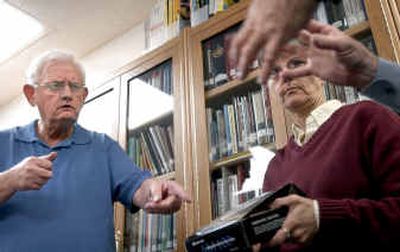
The woman whose stroke left her permanently speechless found a friend in Russ Patterson.The stroke hadn’t impaired anything but her speaking ability. She could hear when people spoke to her, but she couldn’t respond easily. Conversations were out, until Russ entered the scene.
He pulled a telephone device for deaf people – TTY – from his cabinet at the Coeur d’Alene Public Library, where part of Russ’ job is to demonstrate and lend to the public devices that help hearing.
He showed the woman she could call anyone, type her end of the conversation on a TTY keyboard and an operator between the two parties would read it to the person on the other end of the line. She tried the device with Russ’ help at the library.
“She was ecstatic. It had been two years since she’d had a conversation,” Russ says, smiling.
“This is why I do this job.”
The Coeur d’Alene Public Library has lent hearing-assistive equipment to the public since June.
A grant from the Council for the Deaf and Hard of Hearing in Boise enabled a few libraries throughout the state to buy devices that smooth life for people with hearing problems.
Each of those libraries set up centers to demonstrate the equipment and lending programs so people can try it at home.
Russ stocked his cabinet with TTYs, a Pocketalker Pro transmitter that creates a magnetic field around hearing aids and cuts out background noise, an alarm clock that shakes the bed, a notification system that flashes lights when the doorbell or phone rings, and an amplified phone that adjusts hard-to-hear tones so they’re in the hearing range. A $500 grant from Coeur d’Alene’s Three Cs helped with the purchases.
“This is state of the art,” says John Centa.
He started Idaho’s chapters of Self Help for the Hard of Hearing, or SHHH, a national advocacy group, 23 years ago and helped persuade former Gov. Cecil Andrus to create the Council for the Deaf and Hard of Hearing.
John and SHHH ran a center in Coeur d’Alene in the 1990s where the public could study and try hearing assistive devices.
The center was so important to SHHH members that they bought and donated the equipment and volunteered their time.
Aging and Adult Services provided office space.
“We probably talked to 1,000 to 1,500 people in the five or six years we were running,” John says.
He knows the frustration of buying equipment that sounds good but doesn’t work as he expects. He recognized his hearing problems in his 30s. He’s 87 now.
That’s why John pushed for a new center after SHHH’s folded. Aging and Adult Services needed its room back and SHHH volunteers were burned out. John knew the need hadn’t diminished.
He tried to talk Kootenai Medical Center into taking on the center, but the hospital already was aiming its time and money at testing children for hearing problems.
Russ was hired as the library’s on-site interpreter for the deaf five years ago and quickly became the best resource for North Idaho’s deaf population. John was impressed with his work and placed in Russ all his hope for a new hearing assistive center. John also saw the library as the most reliable site for a center.
SHHH just wanted a good center with expertise available for the hard-of-hearing population. SHHH didn’t need to run the center.
John’s hopes grew in February when Russ purchased a video relay for the library.
A video relay is a monitor with a Webcam connected to a computer with a high-speed Internet connection.
A deaf person can sign before the Webcam and his image will appear on the computer screen at the other end of the connection.
An operator between the two connections translates the sign language into spoken language. The library’s video relay was the first one in Idaho.
The library doesn’t lend the video equipment, but it’s available in Russ’ office for anyone to use.
The Council for the Deaf and Hard of Hearing offered Russ $1,800 in June for equipment to demonstrate and lend if he could supply a site.
The library was willing.
Five or six people have borrowed equipment every month since. They sign contracts to care for and return it.
Russ even has installed devices in some people’s homes on his own time.
Users don’t need a library card, just identification.
Equipment is available during library hours.
“These things make great Christmas gifts,” Russ says.
“Think of those people you could communicate better with.”