
Analysts ponder life after Microsoft dividend
NEW YORK — With Microsoft Corp. shareholders on the verge of collectively receiving $32 billion in cash from the software maker’s special $3 dividend, investors are wondering what’s ahead for one of Wall Street’s most popular stocks.
The July 20 announcement of the dividend ended years of speculation about Microsoft and its huge pile of cash. It also attracted new investors to the company’s stock.
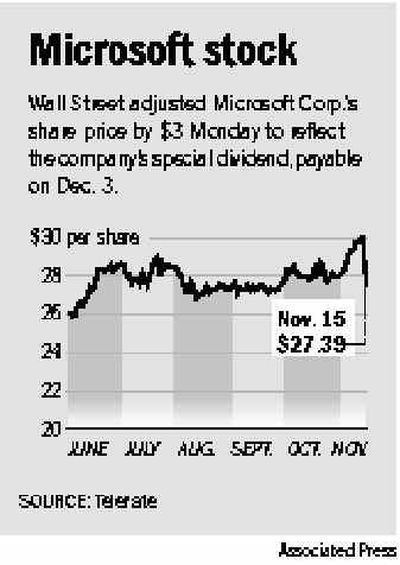
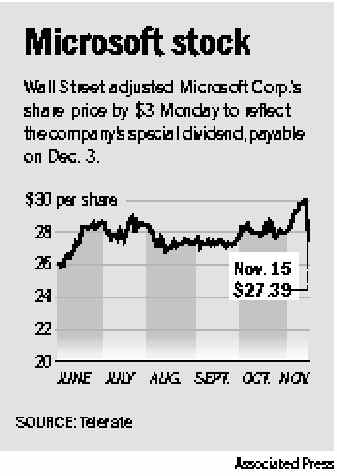
But with the approach of the payout, there are already changes in the marketplace. Wall Street adjusted Microsoft’s price by $3 Monday to reflect the dividend, payable Dec. 3, which will go to shareholders of record as of Wednesday. The stock, a Dow Jones industrial, closed up 42 cents at $27.39 on the Nasdaq Stock Market after the “ex-dividend” adjustment.
“Once the stock goes ex-dividend … we will likely see a corresponding drop in share price,” said Jason Maynard, a research analyst with Merrill Lynch, who added that those investors who bought Microsoft specifically for the gain would drive the price lower.
By approving the special dividend, the company was trying not only to stir short-term interest in its stock after three years of flat share prices, but also to try to improve its long-term performance as an investment. The stock has declined steadily since Jan. 17, 2002, when it closed at $34.93. Since then, it has vacillated between $24 and $29 per share.
Interest in Microsoft shares has been undeniable since the dividend was announced. The stock climbed 54 cents the day after the announcement, on volume of 201.6 million shares. This past Friday, the last day investors could buy the stock and become eligible for the dividend (factoring in the time it takes for a transaction to clear), 162 million shares changed hands — more than 2 1/2 times its daily average.
The stock has climbed 5.8 percent from its July 20 closing price of $28.32 to Friday’s close of $29.97.