
Quite a dish
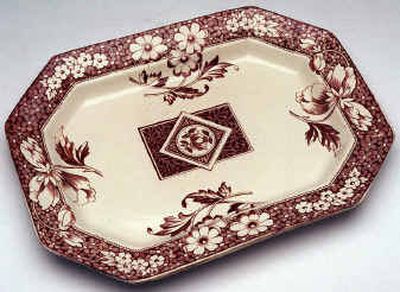
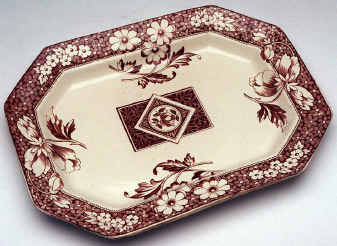
A table set with transferware is storybook pretty.
And it is a look that has graced well-dressed tables for centuries.
European potters invented transferware, the decorative pottery and porcelain dinnerware illustrated with pastoral scenes and elegant flowers, in the 18th century as a less expensive option to imported Chinese porcelain.
Instead of hand painting each piece, the china was decorated by using a paper transfer applied to glazed ceramics before they were fired.
Although early transferware was decorated to resemble Chinese porcelain, pastoral images, scenes of the English countryside, decorative floral patterns and drawings of men and women, became popular. Later, American, French and Italian scenes were featured.
Spode popularized the “Willow” pattern in 1790. Since that time many variations on what came to be known as “Blue Willow,” the romantic image of runaway lovers crossing the footbridge to escape an angry father, have evolved. It is still one of the world’s most popular china patterns.
Jana Matthews, of Spokane, succumbed to the romance of “Blue Willow” china three years ago. “I liked the story and the fact that it’s been around so long,” she says.
Matthews looked for pieces at garage sales and antique malls. Searching online, she located two women in England who were willing to look for transferware items and then ship them to her.
“It’s all so inexpensive there, and much easier to find,” Matthews says. “I ended up establishing a real relationship with these women,”
Eventually, all three women started selling to other collectors. One of Matthews’ British contacts was recently featured on television.
“She wanted to prove that she could sell anything on eBay,” Matthews says. “So they gave her a banana that had been signed by someone who is popular over there and she sold it for around $3000.”
Matthews, who is a nurse at Fairwood Assisted Living, began reselling items by renting retail space in a display case, and then an entire room at a local antique mall. She also sold her wares at a large antique show twice a year.
Four months ago she opened Jana’s Antiques and Collectibles in the Monroe Street antiques district. It is stocked with hard-to-find platters, teapots and eggcups, in new and vintage transferware patterns.
Matthews prefers the blue and white transferware “Willow” for her own collection, but she says that for most of her customers, red and white is the most popular color combination at the moment. Other colors like, brown, plum and black on a white or cream background are collectible as well.
Prices can be especially steep for vintage transferware. When Matthews purchased a Crown Royal bowl and pitcher set for $200 she knew it had a retail value of around $600. “I didn’t keep it,” she says. “And it sold pretty fast.”
Another favorite was a vintage Royal Daulton chamber pot, purchased online through one of her British connections.
“I paid $60 for it and sold it for around $240,” Mathews says.
Michelle Hair, manager of Auntie Milda’s Attic, the ring-box sized store at River Park Square that specializes in fine china, says that it is the timelessness of transferware that makes it appealing.
“The patterns are romantic and work for all occasions,” Hair said. “And they’re beautiful.”
Newer transferware pieces like Spode’s “Woodland” pattern, which was introduced in the 1990s and combines a traditional floral border and hand-painted animals in the center of each dish, are dishwasher and microwave safe.
Hair says that Spode’s blue and white “Winter’s Eve” is a popular pattern for holiday entertaining. The traditional blue and white dishes feature snowy village scenes surrounded by a decorative holly and ivy border.
Transferware patterns by Johnson Brothers, Stafordshire and Wedgewood are also perennial favorites. More contemporary pieces, like the vivid blue and white Danish pottery plates by Bing & Grondahl, especially those made before the 1960s are very collectible.
Matthews scouts for pieces of “Shelley” china and tries to keep a few cups and saucers stocked.
“They are the most, delicate and beautiful pieces,” she says. “I think there is even a local club of Shelley collectors.” Prices for Shelley porcelain can be high. Cup and saucer sets can sell for more than $100.
Although Matthews built her collection around vintage blue willow transferware, she admits to a weakness for Staffordshire fingerbowls.
“They’re expensive and hard to find,” she says. “I only have six or eight of them,”
But her true love is the willow pattern and the legend behind the three little figures crossing the arched bridge.
“I don’t know,” she says. “I guess I’m just a romantic.”