
Green Zone
Ever wonder if there’s a hands-on place in Spokane where you can explore environmentally friendly ways to garden and keep a yard? How about learning to use water wisely, reduce, reuse and recycle household garbage, conserve energy and choose environmentally friendly household cleaners and chemicals? If so, Spokane’s Green Zone and its fall festival is the place to head on Saturday. The Green Zone is a public education center devoted to demonstrating sustainable living practices. Created in 1996 by a coalition of private business, public agencies and concerned individuals, it is located in and around the Spokane County Extension Education Center and the Spokane Conservation District Office on north Havana.
Outdoors, the Green Zone is a series of 10 demonstration projects. Alternatives are shown such as dealing with roof run-off, composting, plantings of ornamental grasses, xeric or water-thrifty plants, appropriate trees for street-side plantings and plantings suitable for backyard wildlife habitat. People can walk through the displays and get ideas for their own households.
Inside the Cooperative Education Center’s Master Gardener Plant Clinic, the Zone presents a series of interactive displays, books and tapes to help you learn even more about conserving water and energy, environmentally friendly alternatives to household and garden chemicals, environmentally friendly transportation options and ways to preserve air quality. There are a number of handouts available to help you begin a new way of life.
“The Green Zone is all about sustainability,” says Jim Haynes, treasurer of the not-for-profit group.
The Green Zone came into existence in 1996 at the Spokane Interstate Fair. Fair visitors were able to walk through a series of interactive, interdisciplinary exhibits that demonstrated how we can all live, work and play in more environmentally friendly ways. Back then, visitors saw a patio made with porous pavers, low-energy lighting alternatives, furniture made of recycled materials, low-water use or xeric plants for landscaping, a fuel-saving van and worm boxes and compost bins. It was a huge hit.
Based on this success, the new Green Zone membership felt a permanent display would be more accessible to more people. They were able to set up the display with the cooperation of the WSU/Spokane County Cooperative Extension Center and the Spokane County Conservation District.
According to Haynes and Carol Albietz, president of the group, funding comes from grants and monetary and in-kind donations, 100 percent of which go directly into the projects and displays. “It’s all volunteer; all the money goes to the effort,” says Haynes.
Their primary grant sources are the Department of Ecology Public Participation Grant and Foundation Northwest. Numerous private businesses and individuals have contributed additional donations to set up and maintain the Green Zone’s displays. Foundation Northwest is a local community foundation that was founded in 1974 to provide a permanent source of philanthropic capital for the community.
One of the demonstration plantings is a series of alternatives to runoff basins (208 basins). Each planting is designed to show how you can manage runoff for an area that may be wet only three months out of the year up to year-round by planting grasses, shrubs and trees that survive with that amount of water. “This is unlike many of the 208 basins you see around town that are planted with bluegrass that takes 40 inches of rain a year and have to be mowed and fertilized,” says Haynes.
According to Albietz, Saturday’s events will have a little something for everyone. Representatives from the Master Composters will be demonstrating how to make compost with everyday garden waste. Representatives of the Washington Fish and Wildlife will talk about developing backyard wildlife habitats and explain the habitat demonstration plantings.
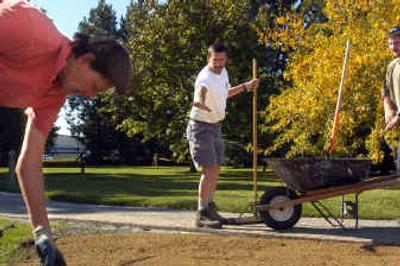
The Master Gardeners and others will be leading tours through the ornamental grass, xeric, wetland and rock garden plantings so you can see the options to traditional high-input gardening methods. A new series of walkways using alternatives to concrete will be available to walk on. Representatives from Spokane County Air Pollution Control Authority will be talking about indoor air, radon and other clean air issues.
Spokane Transit will have a demonstration of its “Bikes on Buses” system that lets you combine your commute by bus and bike to save fuel and cut pollution. A Volkswagen Bug that runs on bio-diesel fuel made from renewable crop plants will be on display to demonstrate this new technology that could be produced locally.
There will be short seminars on tree and shrub planting, gardening with efficient raised beds and composting garden debris.
The WSU/Spokane County Master Gardener Plant Clinic will be open to take your questions about plants, bugs, fall and winter garden preparation and more. Bring samples and/or photos of your problems to illustrate your questions.
A plaque listing the supporters and donors who helped create and maintain the Green Zone will be a part of the festivities.
Music will be provided by the Celtic Nots, Spokane’s well-known Celtic music group.
A special addition to this year’s festival will be a children’s activity. Michael Moon Bear, a well-known African drum performer and teacher, will lead a workshop for children to create their own musical instrument from recycled materials. After they create their instruments, they will be able to jam with the Celtic Nots.
The free Fall Festival is Saturday from 10 a.m. to 2 p.m. Park at the WSU/Spokane County Cooperative Education Center, 222 N. Havana St.
For more information, call the Conservation District at 535-7274 and ask for Vicki.