
Breakthrough diagnosis eases long, winding road
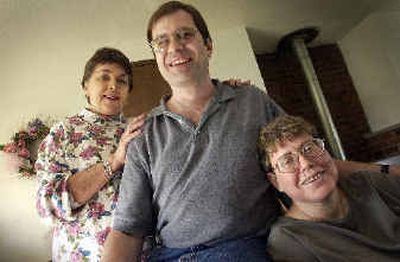
Dottie Papuzynski’s son not only could read at 3, he could read words upside down. By kindergarten, her boy, Bernie Woller, read like a college-educated adult.
Family and teachers loved the little genius boy. He was bright, well-behaved and quiet – unnaturally quiet. But the boy teachers viewed as a model student was a weirdo to other kids. As early as first grade, kids were so uncomfortable with Bernie that they tried to run him over with their bikes or bullied him on the playground.
Dottie agonized over her outcast son, but teachers in 1966 saw no problem. Neither did doctors.
“School was a nightmare,” Dottie says. The memories still trigger sobs from her. “Every year got worse. I hated school and I couldn’t get any help.”
Help arrived 36 years later. Psychologists at the Inland Center for Autism and Related Disorders diagnosed Bernie, then 41, with Asperger’s syndrome, a high-functioning form of autism.
People with Asperger’s have average or better intelligence, but lack social and communication skills. They’re overly sensitive to sounds or tastes, smells and sights. They resist change and are obsessive about routines. They’re oblivious to body language and personal space courtesies, and lack the skill to sense what people are thinking. They avoid eye contact.
The symptoms are so magnified that they prevent most people with Asperger’s from benefiting from their healthy brain power. People with Asperger’s are a step beyond acceptable society and that’s enough to severely limit their lives.
“They lack information most of us take for granted,” says Liz Mathes, director of the Panhandle Autism Society in Coeur d’Alene. “Can you imagine what the world would be like if you couldn’t intuit what people want from you?”
Bernie, 43, is president of the Panhandle Autism Society now. He speaks to large groups about Asperger’s even though he’s avoided group situations his entire life. He has a girlfriend, owns a house in Post Falls and has worked for the Coeur d’Alene Press for about 10 years.
“I like to be involved with advocacy,” Bernie says. “I need to work on eye contact, but speaking to groups is easier than I thought.”
His autism isn’t immediately noticeable. Bernie speaks intelligently and unemotionally. There’s neither warmth nor antipathy in his voice. He’s like a college professor more comfortable with facts than relating to students. At worst, he seems acceptably odd, an improvement for which Dottie is wholeheartedly grateful.
“I wish my mother could see him now. She was president of everything. She would be so proud,” Dottie says. “To see him today compared to what he used to be like … I’m speechless.”
Dottie’s mother, a doctor in a long line of doctors, guessed Bernie suffered brain damage during his birth. She predicted Bernie would need Dottie’s care his whole life. Newborn Bernie weighed 11 pounds. Dottie weighed only 105 pounds. Bernie was born purple from lack of oxygen. He hardly cried.
After the ravages of birth faded, Bernie became a dream baby. He crawled early, walked at 9 months and entertained himself. His parents were delighted until his progress stopped at his first birthday. He never talked. Doctors told Dottie not to worry, that Einstein didn’t talk until he turned 4.
His family was enchanted when Bernie read at 3, even though he didn’t speak other than to read. They had learned to accept his silence.
The family nightmare began with school. Bernie aced his class work. But he couldn’t learn to tie his shoes. He wet his pants. He screamed when the school bell rang. He had no clue how to make friends. Kids picked on him, shoved him.
“I’m not sure what I did to attract problems,” Bernie says. “I didn’t want to be around other kids.”
Bernie met a boy in fifth grade who shared his fascination with robots. They became friends and watched “Lost in Space” reruns together until Bernie moved. His dad’s work moved his family often.
In junior high, Bernie was grouped with special education kids because he didn’t work well with the mainstream.
“I thought he was going to be killed in there,” Dottie says.
She assaulted the school like an angry bee and school officials eventually declared Bernie “cured.”
“Oddly enough, I didn’t get picked on in those classes,” Bernie says.
By high school, he’d grown to 6 feet tall and learned to stay away from other kids. A computer science class his senior year introduced him to a few students with interests similar to his. The social contacts brightened his attitude toward school.
“I was pretty happy that year,” he says.
His friends disappeared after graduation and Bernie didn’t want to continue his schooling. The social strain was exhausting. But his stepfather insisted.
“We knew he had the intelligence,” Dottie says. “If he didn’t go, he never would have left his room.”
His family had settled in Coeur d’Alene by the time Bernie was in college. He enrolled at North Idaho College, then Eastern Washington University. The coursework suited him, but the environment didn’t. He dashed from classes with panic attacks. He sought help from the psychology department.
Bernie shared with the graduate student assigned to him his discomfort with groups. The student advised Bernie to leave home and move into the dorms. Bernie couldn’t do it.
“I was afraid of social situations,” he says.
The student’s disappointment plummeted Bernie into depression. He graduated in 1985 with a bachelor’s degree in math and computer science and had no idea what to do with his life. Job interviews terrified him. He survived a few, but no one hired him. Bernie’s depression and panic attacks grew. He lived with his parents and did household chores for work.
In 1990, a panic attack drove him to Kootenai Medical Center’s emergency room. Doctors diagnosed him with panic disorder and major depression. They referred him to the Department of Health and Welfare’s mental health division.
“That was a huge turning point,” Dottie says. “He really started to come out of himself. They got him involved in projects. He met his girlfriend. I never thought he’d have a girlfriend.”
At mental health, Bernie met other people society didn’t accept. They all accepted each other. His panic attacks stopped. He worked in the division’s greenhouse growing bedding plants until he became chairman of the project. He met Nancy Craft in his treatment group and the pair formed a deep and lasting partnership.
Bernie took over mental health’s newsletter and found satisfaction writing articles and calendars and designing ads. The experience eventually helped him land a job at the Coeur d’Alene Press as an ad setter. Bernie designed ads by computer among older and quiet co-workers.
“I felt great,” he says with a rare smile. “I couldn’t believe I was getting a paycheck. And I could talk to people at work.”
His improving life gave him confidence to move into his own apartment, then buy his own home in Post Falls in 1998. Life was better, but Bernie still needed a doctor for anti-depressants. A few years ago, his doctor suggested Bernie might have a mild form of autism. Bernie researched online and found Asperger’s syndrome. The description matched Bernie’s characteristics.
He called the Panhandle Autism Society. Liz, who not only directs the society but is a counselor with an autistic son, referred him to the Inland Center for Autism in Spokane and invited him to participate in her support organization. Inland Center psychologists interviewed Bernie and Dottie and tested Bernie. They concluded he has Asperger’s. The diagnosis didn’t change Bernie’s condition, but it allowed him to relate his behavior to the syndrome and avoid aggravating situations whenever he could.
Noise still disturbs him and he often can’t avoid it. A younger, louder crowd has replaced the older group at work and Bernie admits he sometimes rages over the noise. His solution is to open his own ad design business eventually.
Earlier this year, he met with actor Josh Hartnett, who was in Spokane filming a movie, “Mozart and the Whale,” about two people with Asperger’s syndrome falling in love. The actor asked Bernie about his life, mannerisms, sensitivities. Bernie visited the movie set, read the script and offered corrections.
Dottie finally can relax a bit over the son she’s protected from society for 40-plus years. Bernie wants to help other people living on society’s hemline and help society understand Asperger’s. He’s helping design the Northwest Autism Center, which is in the planning stages at St. Luke’s Rehabilitation Center in Spokane.
An Asperger’s diagnosis may pain most families, but it was a gift for Bernie’s.
“We lived through a horrible time,” Dottie says. “Things Bernie says or does used to bother me, but now I know he just has a harder way of expressing himself. I used to get offended. Now I know better. It’s 100 percent better now.”