
Bridge
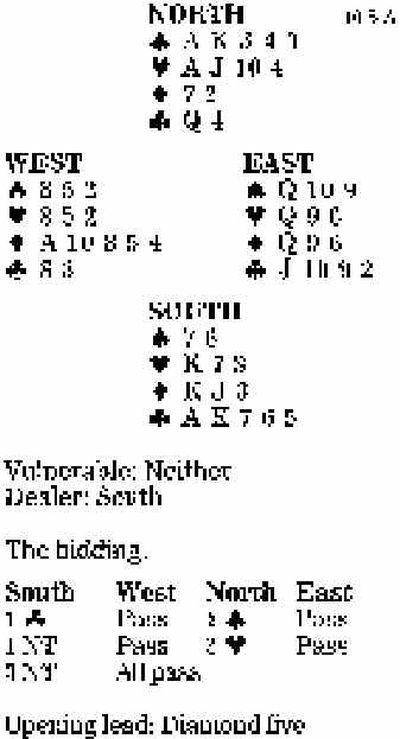
South is too weak for a strong no-trump, so he opens one club and rebids one no-trump (not two clubs) over his partner’s response of one spade. A rebid of two clubs would imply a six-card suit. When North responds one spade and then jumps to three hearts, he implies he has at least five spades and four hearts. South cannot see an eight-card fit in a major, so he rebids three no-trump, and North has no reason to mistrust his partner.
When a diamond is led to East’s queen and South’s king in three no-trump, declarer has eight tricks on top. It might be tempting for South to play on spades, but a losing finesse would let East in for a potentially disastrous diamond continuation. Similarly, South could try to build extra tricks in clubs, but the point to focus on is that South must prevent East from gaining the lead while he sets up his ninth winner. The safe route is to cross to dummy and run the heart 10. This is a safe route to nine tricks – indeed, as it turns out, this produces a 10th winner.
This maneuver is called an avoidance play. On hands like this, you diagnose which opponent you want to keep off lead, then arrange the play of the suits to minimize the danger of that hand getting in. Here, the heart suit offers a perfect example of allowing you an avoidance play against either opponent.
Bid with the aces
South holds:
| •A K J 4 3 | |
| •A J 10 4 | |
| •7 2 | |
| •Q 4 |
| South | West | North | East |
| 1 • | 2 • | Pass | Pass |
| ? |
Answer: Double for takeout rather than bidding two hearts. If you double, you can correct two diamonds to two hearts to show your shape and extras. But you might also get to defend two clubs doubled if partner is lying in wait with a club stack – and that would be highly desirable from your perspective.